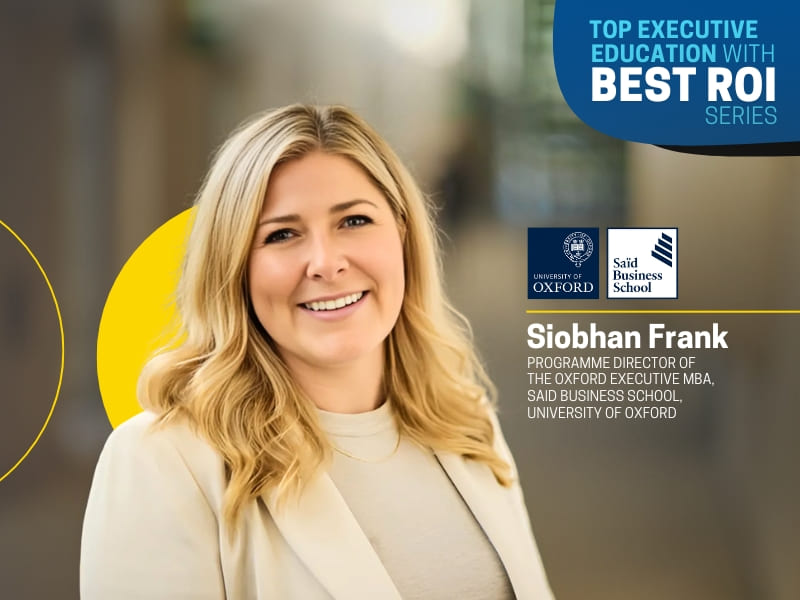

Interview with Siobhan Frank, Oxford Executive MBA
In this TEBR interview, Siobhan Frank, Programme Director of the Oxford Executive MBA, highlights the school’s excellence through its world-class faculty, adaptive curriculum and global exchanges, making it the top choice for leaders seeking a globally relevant MBA.
It’s great to have you with us today, Siobhan! To start, the Oxford Executive MBA has been ranked best in the world by Quacquarelli Symonds for two consecutive years now. From your perspective as the Programme Director, what makes it consistently stand out in such a competitive global field?
Thank you, it’s a privilege to be here. The Oxford Executive MBA stands out for its unique combination of people, place, and perspective. Oxford draws an international audience, and our participants are no exception. They come from across the globe, eager to learn from one another, motivated either by the demands of their careers for a truly global outlook or by a personal desire to broaden their perspectives. Our UK location and modular format also make it easy for participants to join us from every corner of the world, further enhancing the diversity of the cohort.
The combination of traditions, networks, and the sense of belonging to a community that is both intellectually rigorous and globally connected makes Saïd Business School truly stand out on the world stage.
That diversity is matched by our world-class faculty, who combine cutting-edge research with real-world insight. Their teaching is anchored in the programme’s core themes, strategic leadership, global complexity and risk, and entrepreneurial thinking. Each is more relevant than ever in today’s interconnected world.
And of course, all of this is enriched by the Oxford experience itself. The combination of traditions, networks, and the sense of belonging to a community that is both intellectually rigorous and globally connected makes Saïd Business School truly stand out on the world stage.
Last year, the Oxford Executive MBA also celebrated its 20th anniversary. How has the programme evolved since its first cohort in 2004? What remains unchanged at its core?
Celebrating 20 years of the Oxford Executive MBA was a wonderful opportunity to reflect on how far the programme has come. Since welcoming our first cohort in 2004, we’ve continually refreshed the curriculum to reflect the changing world, with greater emphasis on areas such as global complexity and risk, sustainability, technology, entrepreneurship, and responsible leadership. The programme has also expanded in scale, most notably with the introduction of a second annual intake in 2018.
What hasn’t changed, and what I don’t think ever will, is our core. The programme remains rooted in bringing together outstanding people, world-class faculty and the unique Oxford experience. At the heart of this is the University’s deep commitment to research with impact; research that not only advances knowledge, but also drives cultural, societal, political, and economic change on a global scale.
At Saïd Business School, we reflect that commitment through what we call ‘impact from within.’ We believe solving the world’s challenges is not solely the role of governments; business leaders have a vital responsibility too. Our mission is to develop leaders who go into business with purpose – transforming themselves, their organisations, and ultimately the world. That commitment to meaningful, lasting impact is as central to the Oxford Executive MBA today as it was 20 years ago.
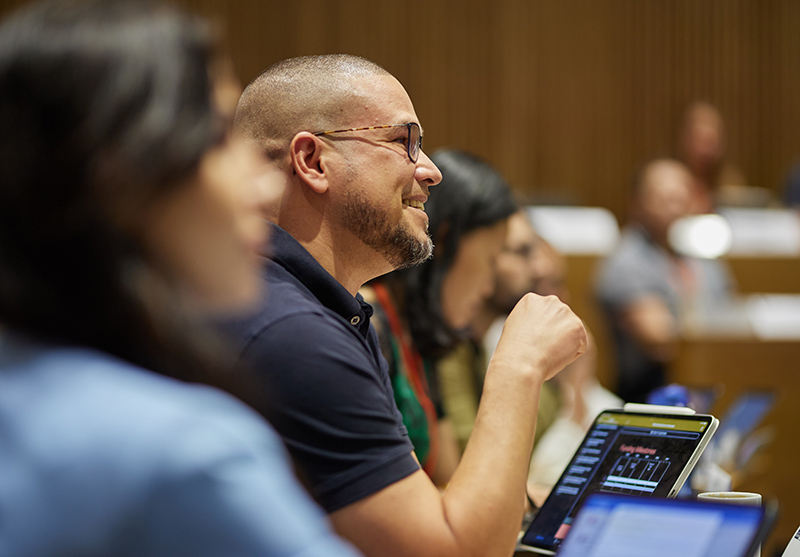
It scored exceptionally high in Diversity, Thought Leadership, and Employer Reputation. Could you share some examples of how these qualities translate into real-world impact for your graduates?
Absolutely. Diversity, thought leadership, and employer reputation are at the heart of the Oxford Executive MBA, translating directly into the impact our graduates make.
Diversity is more than demographics; it’s lived experience. Our participants join us from every sector and continent, and many choose Oxford precisely because they want to learn from different perspectives across regions, industries, and cultures. That richness of exchange develops leaders who are confident navigating across cultures and adept at leading in complex, global contexts.
Thought leadership comes from our world-class faculty, whose research shapes debates on everything from sustainability and AI to global risk. Their work spans our core strengths, including responsible leadership, technology and innovation, sustainability and social impact, and global strategy. Crucially, our participants don’t just study these ideas in theory; they put them into practice immediately in their organisations, often leading initiatives that deliver measurable change.
Employer reputation reflects the confidence placed in Oxford graduates. Our alumni are sought after because they combine academic rigour with purpose. Many move into C-suite roles, launch new ventures, or lead major transformations in sectors such as healthcare, finance, and energy, making real impact on their industries and communities.
The programme includes two international modules. What kind of cultural and business insights do participants typically gain from these experiences?
That’s a great question. To clarify, we offer two international modules as part of the core curriculum. However, participants also have the opportunity to further their international experience through electives and co-curricular global exchanges, for example, through the Global Network of Advanced Management (GNAM).
These experiences allow participants to move beyond studying global complexity and strategic leadership in the classroom to experiencing them firsthand. By engaging directly with new markets, business practices, and cultural contexts, they gain a deeper appreciation of how leadership plays out differently across regions. Just as importantly, they learn how to adapt their own leadership approach, preparing them to lead with confidence in an interconnected and often unpredictable world.
Oxford Saïd’s approach has been described as an “intellectual playground.” How does this environment shape the mindset and skillset of your participants?
I love that description, because Oxford Saïd really is an ‘intellectual playground’. In practice, it means participants are constantly challenged, not only absorbing knowledge but testing ideas, debating perspectives, and learning how to navigate ambiguity.
This is amplified by the wider University and city. From public talks in the historic centre to major forums, conferences, and the Entrepreneurship Centre’s programming, participants have countless opportunities to shape their co-curricular experience around their own interests, making their time here uniquely rich.
Together, this develops both mindset and skillset. Participants become more curious, adaptable, and confident in managing complexity, while sharpening core skills in areas like strategy, finance, and entrepreneurship. Crucially, they are also encouraged to think beyond their own organisations and embrace their wider role as leaders in society.
So the ‘intellectual playground’ is not only stimulating in the moment, it shapes reflective, globally minded leaders who go on to make meaningful impact long after the programme.
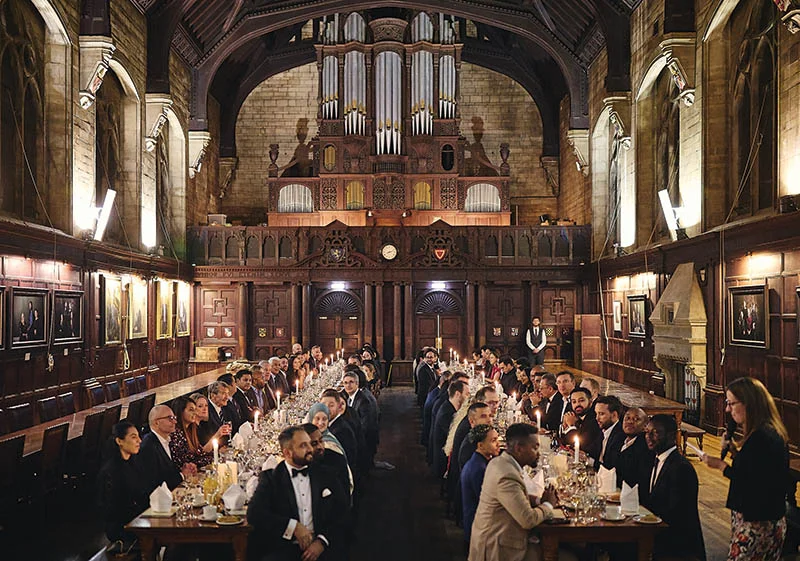
The programme also has world-class facilities in the Thatcher Business Education Centre. How have these resources contributed to the learning and networking experience for participants?
The Thatcher Business Education Centre (fondly referred to as TBEC) is at the heart of the Oxford Executive MBA. Purpose-built for senior executives, it combines state-of-the-art classrooms and technology with spaces that foster connection. Our participants study, debate, dine, and network there, and over time, the TBEC becomes more than just a building; it’s the hub of their Oxford journey.
We’re enormously grateful to the endowment from Mr Wafic Saïd and the ongoing support of the Saïd Foundation, as well as to all our generous benefactors, whose contributions make this possible and continue to underpin the School’s success.
Looking ahead, we’re excited to soon open our Global Leadership Centre as the next step for Saïd Business School in executive education. It will provide a world-class home for leadership development, giving participants even more opportunities to learn, collaborate, and shape the future of business.
Many participants speak of a shift in how they define leadership over the course of the programme. What kinds of personal or professional transformations have you observed?
One of the most striking changes we see is how participants redefine leadership. They may begin thinking of it as a technical skill or team management, but over the course of the programme, it becomes about purpose: asking better questions, empowering others, and making an impact in complex environments.
The results are powerful. For example, Dr Rebecca Weston has applied her Oxford learning to lead in the highly complex nuclear sector. James Hall channelled his experience into building a carbon-credit insurance venture and went on to lead our Entrepreneurship Centre. Dr Owoicho Adogwa is using the programme’s insights to transform healthcare in West Africa, while Aline Daoud draws on Oxford frameworks as she supports more women leaders and women engineers in the Middle East.
These stories show what we mean when we say, ‘enriched minds perform better.’ By broadening perspectives and deepening purpose, the programme empowers participants to drive meaningful change in their organisations, industries, and communities. That is Oxford’s impact in action.
How do you define ROI in executive education today, and how does your programme deliver on that promise?
That’s an important question. ROI in executive education today goes far beyond salary uplift, though many of our participants do see that. The real return is harder to quantify but deeply felt. It’s about ‘transformation’; new perspectives, lasting networks, greater comfort with risk and uncertainty, the confidence to lead responsibly, and clarity about the legacy they want to leave.
At Oxford, participants are challenged by world-class faculty and diverse peers, which builds both confidence and purpose.
At Oxford, participants are challenged by world-class faculty and diverse peers, which builds both confidence and purpose. Madonna Okpaleke, a 30% Club Scholar, has spoken about how the Executive MBA gave her the confidence to raise her voice against bias and make it count. Meanwhile, Andrea Guzzoni, a former start-up founder, used the Executive MBA to pause and reset after years of rapid growth. Today, as Venture Capital Sector Director at Founders Factory, he applies those insights to back early-stage founders and shape the next wave of ventures.
These stories show the true ROI of the Oxford Executive MBA: not just career advancement, but expanded horizons, resilience, and leadership that embraces uncertainty while focusing on lasting impact.
Many of your alumni are now in high-impact roles around the globe. Is there a particular success story that embodies the leadership values Oxford seeks to instill?
We are lucky to have many great alumni on the programme, many of whom still keep in touch and continue to exemplify the values of responsible leadership that Oxford Saïd seeks to instill.
For example, Axel Addy, former Minister for Commerce and Industry of Liberia, played a pivotal role in guiding Liberia’s accession to the World Trade Organisation (WTO), demonstrating how business acumen can be applied to shape inclusive economic growth at a national level.
One of our earliest participants, Mark Carmichael, built a distinguished career leading major mergers and acquisitions around the world, and now returns to the School as a guest speaker, inspiring current participants with his insights.
Looking ahead, what is your vision for the Oxford Executive MBA in the next decade? How do you plan to maintain its leadership position in global rankings?
Looking ahead, our vision for the Oxford Executive MBA is to continue developing leaders who are not only successful in business but also purposeful in addressing the most pressing global challenges. We will do this by continuing to strengthen our global diversity and reach, innovation in teaching and learning, and focus on impact and responsible and sustainable leadership.
Regarding rankings, our strategy is simple. Stay at the forefront of thought leadership, maintain a rigorous and transformational curriculum and foster a vibrant alumni community that continues to achieve the highest levels across industries and borders. By measuring our success not only in terms of career progression, but also in contributions to society, we will ensure the Oxford Executive MBA remains distinct, relevant and globally recognised for years to come.