

By Dr. Anna Rostomyan
In order to thrive, start-ups and other innovative ventures are well advised to begin with a well-thought-out plan. Could the concept of strategic management have something to offer in that regard? Here, Anna Rostomyan checks out the pros, cons, and potential pitfalls of the approach.
In today’s globalized, capitalized, and digitalized world, there is a distinct need for better management skills, strategies, and techniques. There is a novel field of study in the applied sciences that entails the strategic planning, implementation, management and assessment of such policies, namely strategic management.
Definition: Strategic management (SM) can be defined as formulating, defining, planning, implementing, evaluating, and tracking the progress of the set objectives (David, 2001).
In this respect, we have to bear in mind that all the interrelated processes should be involved, such as marketing, branding, finances, research and recruitment so that to optimize successful operations.
Here, it is highly important to note that all the current trends in the market should be taken into account to ensure supply and demand optimization.
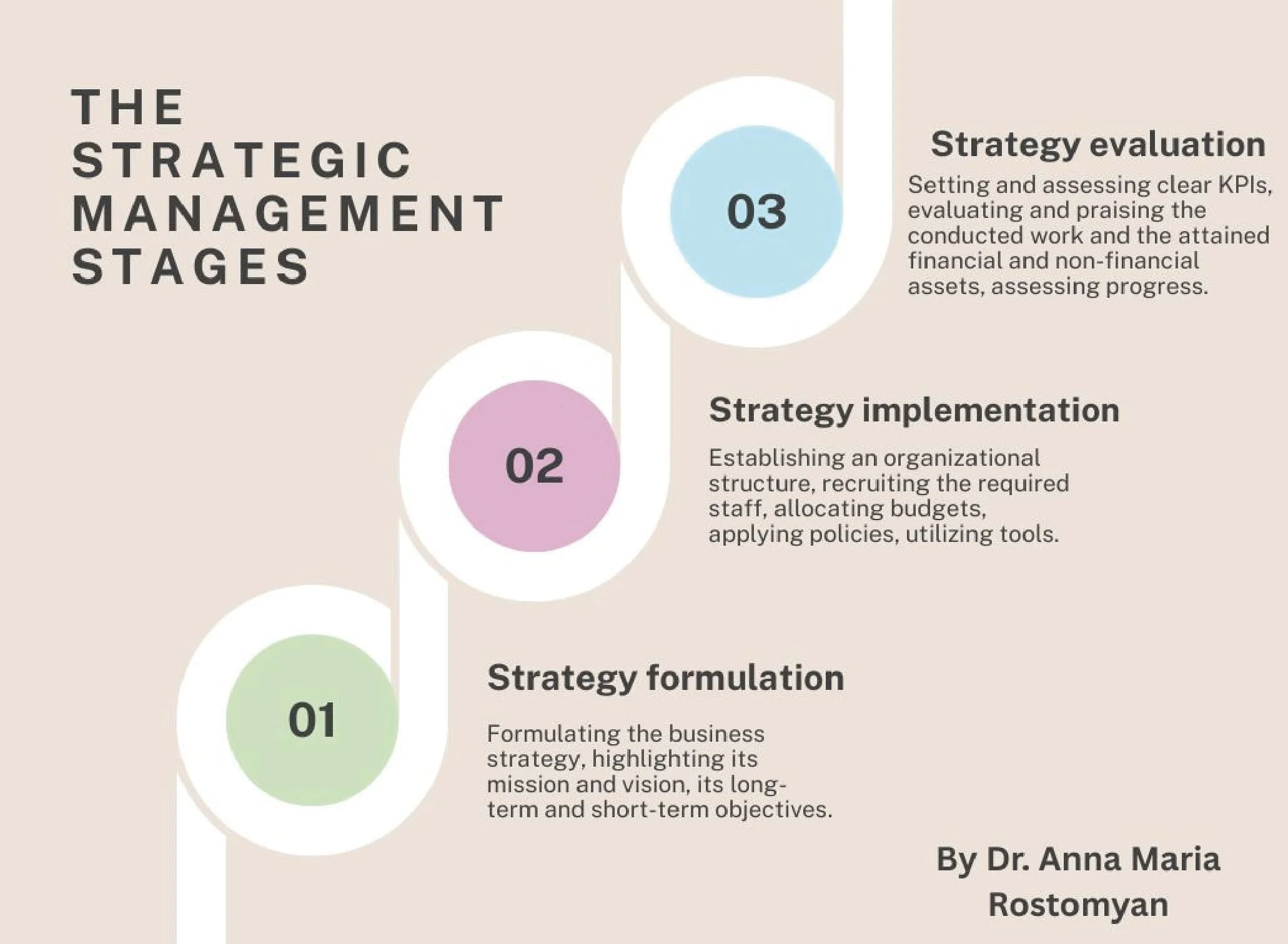
SM consists of the following main three stages:
1. Strategy formulation
Developing and setting a clear mission, having a vision and values, assessing strengths and weaknesses, establishing short-term, long-term, monthly, and bi-monthly, as well as annual objectives, generating alternative strategies, choosing distinct paths to follow, conducting proper market research to reveal trends and tendencies, choosing team numbers, and setting clear-cut priorities.
2. Strategy implementation
Establishing an organizational structure (hierarchical / flat / mixed), selecting between, for example, a goal-friendly, market-oriented, clan- (team-) oriented and family-oriented organizational structure, recruiting the required staff, segmenting the corresponding divisions in accordance with the team members’ strengths and weaknesses, allocating budgets, mentoring and coaching the team towards mutually beneficial goals, utilizing the available information tools, rewarding the successes of the employees, applying the best-possible policies, tools, and techniques of both the C-suite-level management and leadership, the division heads, and of the mid-level employees to guarantee eventual success, strengthening the bonds between the team members by various team-building events and joint ventures, sometimes rotating the team members to reveal their talents and relevant skills.
3. Strategy evaluation
First and foremost, to be able to evaluate and assess at a final stage the team’s success, the C-suite-level top managers should set clear KPIs to follow, which should include the management’s clear-cut expectations of the employees. Secondly, all the internal and external factors hindering success should be taken into account to be able to clearly assess progress and threats. Thirdly, an elaborate level of equity should be set when measuring each of the team participants’ personal capacities, abilities, and skills to ensure equality. Last, but not least, in the evaluation process, even the smallest and biggest wins should be celebrated and taken into account when deciding whom to promote. All this will give the strategists the maximum ability to assess and reassess what went well and what went wrong, so that they can adjust the future strategic goals and intentions in order for the company to flourish.
Strategic management actually allows an organization to be more proactive in following its initiative and the correlated activities in which reinforcement should be at the core, while benefiting from mutually set goals and strategies.
Strategic management actually allows an organization to be more proactive in following its initiative.
In this connection, it is noteworthy that higher management should to a certain degree empower the employees to be creative and innovative, which can be very beneficial in acquiring the set objectives and realizing the initial mission and vision, while sticking to its core values and promoting a healthy workplace culture where the well-being of the employees is of paramount importance.
If the above is respectfully and consistently followed, there may be various crucial benefits, such as:
a. Financial benefits
High performing firms and teams that set clear goals and target the market with a market-oriented strategy will eventually attain high sales by means of leveraging the potential of their team-members. As Simon Sinek truly stated, “Take care of your people and your people will take care of you”, which brings us to the second highly important point. If the company gains financial benefits in terms of a stable gross income and high revenue, it can pay back the employees and pay off business partners, as well as invest in further ventures.
b. Personal benefits
if its “people” are at the core of the company’s values, both the company and the involved parties (both external and internal stakeholders) will eventually benefit from such a strategic perspective, since, when doing business, we should always remember that we are dealing with people endowed with emotions, feelings, beliefs, motivations, and intentions. As Dale Carnegie stated, “When dealing with people, remember, you are not dealing with creatures of logic but creatures of emotion.” Thus, if we take into account the emotions and feelings of those with whom we interact, both parties will consequently benefit from such interactions, since people may forget what you said or did, but they will never forget how you made them feel.
c. Non-financial benefits
It follows from the above that an organization’s people are its greatest asset. Thus, if a company is not only market-oriented, but also people-focused, the investment in its people will surely pay off in the longer run. This may manifest itself, for instance, through human sustainability, with people staying in the company for the long term, since nowadays Gen Z are inclined to change roles and companies far quicker compared with, for instance, baby-boomers. Thus, if the company manages to keep its people involved, interested, and respected, the human capital of the company will be raised and there will be no need to invest time and energy in training newbies (Rostomyan & Rostomyan, 2023).
Although the foregoing suggests that strategic management is mostly beneficial for organizations, companies, and institutions, it has both advantages and disadvantages. According to Campbell (1999), a common complaint is that, “Strategic plans are documents that you prepare for the corporate center and later forget.”
Here are some insights into their benefits and pitfalls:
a. The possible advantages of SM
- With the provisions of SM, the businessmen will not lose track of their initial plan, mission and visions, without overlooking their values.
- Joint ventures can open up wider opportunities and chances to cooperatively work towards mutually beneficial goals.
- Foreign operations can accelerate the sales and heighten costs, as well as provide wider markets.
- SM can provide a much better cost-efficiency while working on multiple projects.
- The political treatment and business policy in foreign countries can be more attractive and highly beneficial in expanding the scope of the company.
b. The possible disadvantages of SM
- While always only looking for the plan, we might neglect the needs, worries, concerns, and expectations of the people.
- In case of doing business internationally, one might lose track of the initial plan, if not holding it in front of the eyes of the upper management.
- Going international can inquire learning the new local educational, cultural, legal, economical, traditional, social, environmental, occupational, emotional, and technological rules and regulations.
- Dealing with a new system of monetary funds can complicate a bit the entire strategic process.
- Therefore, one must be flexible to acquire new skills and get adapted to newly sprouted situations.
Taking into account the benefits, pitfalls, and drawbacks of strategic management, companies should have a mission statement that will guide them throughout the entire process, acting as a lighthouse.
For this, one should understand what statement in a business setting is.
Definition: A business statement is a clear purpose that differentiates one organization from the other: it answers the most crucial question on what makes a business stand out from the crowd (David, 2001).
Thus, with the help of the business statement, otherwise called “creed statement”, the founders can set out their philosophy concerning the beliefs, goals, objectives, and targets of the company.
Definition: As for mission statement, it is a declaration of attitude, purpose, and outlook towards a specific plan that makes the business ride worthwhile (David, 2001).
Let us have a closer look at the mission statement’s characteristics:
- Firstly, a clear mission statement makes it possible to generate objectives, as well as facilitate feasible alternatives and strategies in a creative manner.
- Secondly, in the mission statement, the reconciliation of all standpoints should not be overlooked, where all the stakeholders are taken into account, such as the board directors, the managers, employees, suppliers, customers, consumers, business partners, general public, competitors, etc.
- Therefore, a clear mission statement is essential for effectively establishing goals and objectives. In fact, an enduring statement of purpose distinguishes a business from other similar corporation.
As a matter of fact, the importance of vision and mission in companies must not be undervalued and should be paid respect to. Campbell (1999) claims that both of these terms are crucial, saying that a “vision” is a possible and desirable future state of the organization, whereas a “mission” is more of an associated phenomenon linked to behavior, skills, and the present state of the organization and its people.
Furthermore, the significance of the vision and the mission statement of the company / organization / institution in effective strategic management is unarguable. Therefore, before starting a business, founders and managers should focus their attention on elaborating its development.
The process may, for instance, be as follows:
- To set clear goals and communicate them effectively with the team-members.
- To ensure that the purpose and company culture are followed in the company.
- To create a positive workplace atmosphere where everyone is feeling seen, heard, and appreciated.
- To specify the organizations purpose, and translate it into distinct milestone objectives.
- To be a role model for the team-members to look up to and to follow.
- To lead the team towards success, occasionally adjusting leadership styles according to the situation, in order to meet the set objectives collectively.
- To praise achievement.
- To assess progress.
Apart from the above logically constructed strategies, there is also a subtle field that should not be overlooked, namely the phenomenon named as intuition. In fact, intuition and gut instinct are the ones that tell you what to do when everything just does not feel right. Have you ever found yourself in a situation where all the facts and logical verifiable were all greatly seeming beneficial for the launch of your business or a joint venture, but deep inside a voice told you that that is not the right direction to take, that is our intuition on play.
As a matter of fact, women are believed to based their decisions (both in their private lives and in business-related issues) more on intuition rather than on logically grounded facts, which our research at Porsche Central and Eastern Europe and Porsche Center Yerevan also came to prove.
We conducted an online survey of 20 corporate participants from Porsche Central and Eastern Europe and Porsche Center Yerevan on whether men and women tend to rely more on their intuition and emotions when taking decisions. The results were obvious, since women are more often inclined towards taking decisions based on their intuition and gut instinct; as they say, when a woman asks you a question, she most probably already intuitively knows the answer.
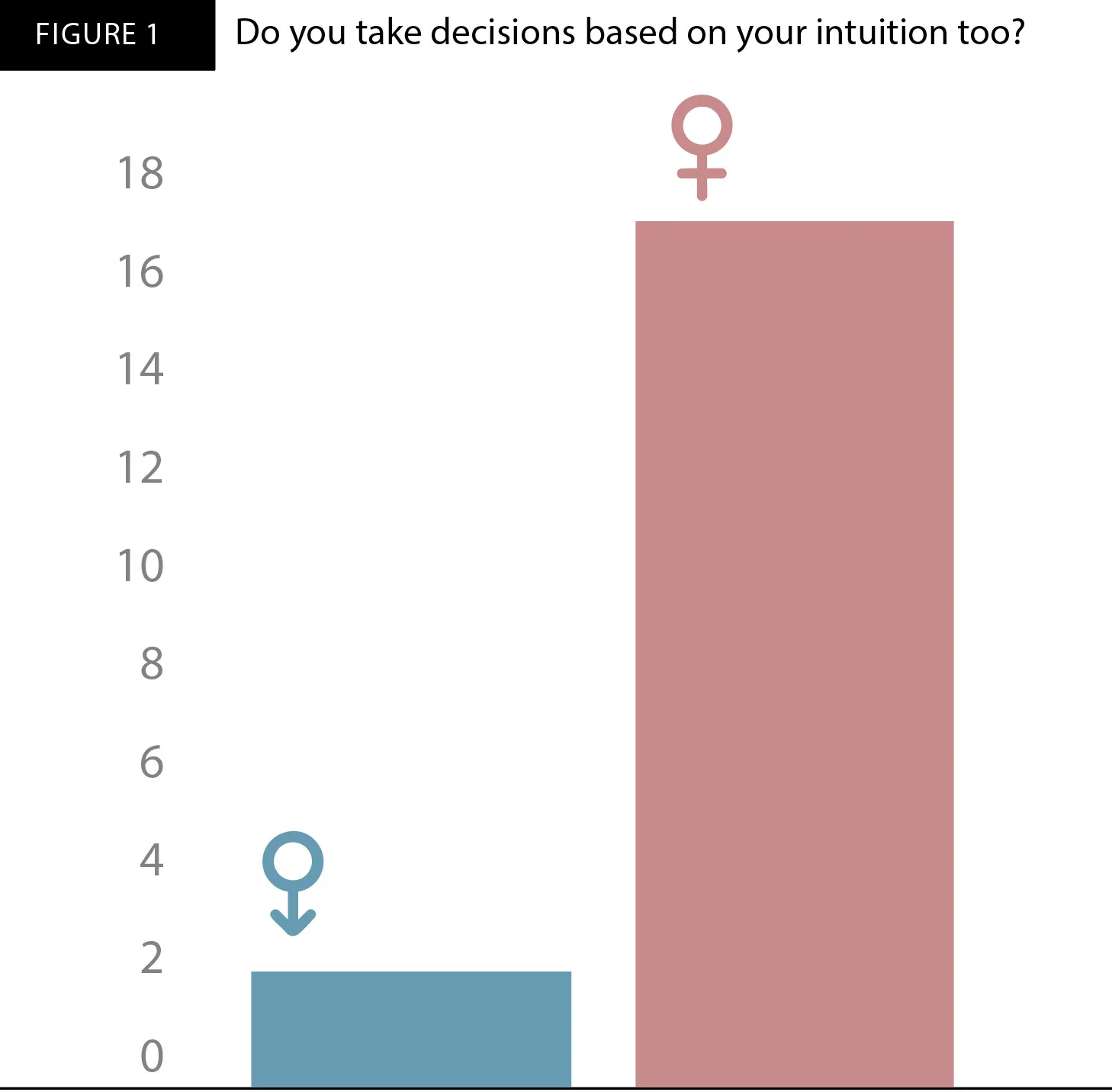
Our research suggests that the new concept of FQ (female quotient) does truly reflect this difference in decision making in men and women, pointing to the fact that in the business sector, too, there is place for intuition and gut instinct.
As for the interrelation between strategic planning and intuition, it is vital to state that, here as well, we should not let go of our gut instinct and intuition, which have the greatest potential to guide us in the right direction in choosing the best path, since based on past experiences, people have the ability to make the better-suited decisions that their gut tells them to. In fact, as they say, we have three heads, namely (a) the cephalic (head), (b) the cardiac (heart), and (c) enteric (gut), the cooperation of which guides us in our daily activities, in both the personal and professional contexts.
Our gut instinct and intuition have the greatest potential to guide us in the right direction in choosing the best path.
Furthermore, as Albert Einstein once stated, “Imagination is more important than knowledge, because imagination is boundless, whereas knowledge is limited.” This quote suggests that it is always good to have a plan and to stick to it, especially in situations of uncertainty, yet we should activate our imagination, which will open up doors unimaginable in the past. As manifestation experts tell, we have to first imagine our end-goal in order to be able to manifest it. Yet, as Marisa Peer, the RTT guru, says, we should not let our dreams extract us from reality; they can simply be a map for us to follow. And, as Mel Robbins suggests, manifestation is not a simple trick to do by means of imagining end results; instead manifestation is the bridge towards our goals and if we also clearly see the obstacles on our imagined path and picture how we can overcome them, these actions will become the bricks of the bridge leading us towards our dream results.
In addition, for efficient strategic management, there should be a code of conduct embedded in the ethics of the business. Business ethics, in fact, entails the unspoken form of conduct that encompasses an outspoken, articulate verbal and non-verbal, as well as visual, demeanor of the parties involved, such as, for instance (but not limited to):
- Dressing accordingly (whether strict business or business casual style in accordance with the dress code)
- Being on time according to the set schedule (even a little bit before the set time)
- Greeting politely (respecting hierarchical factors)
- Firmly shaking hands when greeting other parties (showing respect)
- Display a smiling face (a vital component of emotional interaction)
- Looking straight into others’ eyes (being trustworthy)
- Drafting professionally tailored emails, reports, and annual greeting cards
- Participating in the company’s meetings, events, and webinars
- Building a strong network with internal and external stakeholders
- Apologizing when at fault, showing integrity and compassion
- Being open to constructive feedback and providing advice when asked
- Doing extra, while showing interest in the company’s eventual success.
The above are just a few vivid examples that belong to everyday business ethics. If all the parties involved take good care of their ethical demeanor and expression in professional settings, and upper management praise such manifestations, both the company and the people involved will certainly thrive in their endeavors, while enjoying and loving what they do and those with whom they interact. These seemingly minute actions can also be considered to be part and parcel of strategic management, where people express themselves ethically.
One example of effective strategic management is Apple Inc., which was facing bankruptcy in the 1990s. A possible reason for this might have been the estrangement of co-founder Steve Jobs, who was basically the lighthouse of the company’s first mission and visions. With this alienation, the company, representing a ship, might not know which path to follow in order to achieve success according to its initial goals and objectives. So, one the of the strategic solutions was calling Steve Jobs back to the company to lead it again. When Steve came back in 1997, he realized that the divisions were not functioning well. After analyzing the situation, he came up with a very clear strategic plan involving “experts leading experts,” meaning that only a marketing expert could lead the marketing department, only an IT expert could lead the IT department, etc. This strategic change led to beneficial results and, alongside some other strategic actions like the launch of the iMac (1998), iPod (2001), and iPhone (2007), brought the company out of bankruptcy also due to its strong brand heritage.
Ever since Steve Jobs implemented the so-called functional organization, Apple’s managers at every level, from from the top downwards, have been expected to possess three key leadership characteristics: (a) deep expertise that allows them to meaningfully engage in all the work conducted within their individual functions; (b) immersion in the details of those functions; and (c) a willingness to collaboratively debate other functions during collective decision-making processes. As a result, when managers have these attributes, decisions are made in a coordinated fashion by the people best qualified to make them (Podolny & Hansen, 2020).
To sum up, it is always a good idea to have a plain plan to follow in your hands, especially when starting a business, that will allow you to stick to your initial plan, while also being flexible to adapt to novel situations, contexts, and opportunities. Here, the notions of mission and vision must not be underestimated. Furthermore, it is highly recommendable to rely on your intuition, too, since the heart knows reasons which reason knows nothing of. Strategic management is there to guide managers towards mutually beneficial end-goals. If we take all the advantages and disadvantages of strategic management into account, we can be better at leading our teams towards mutual success, where all the involved parties are taken into consideration and are taken good care of.
About the Author