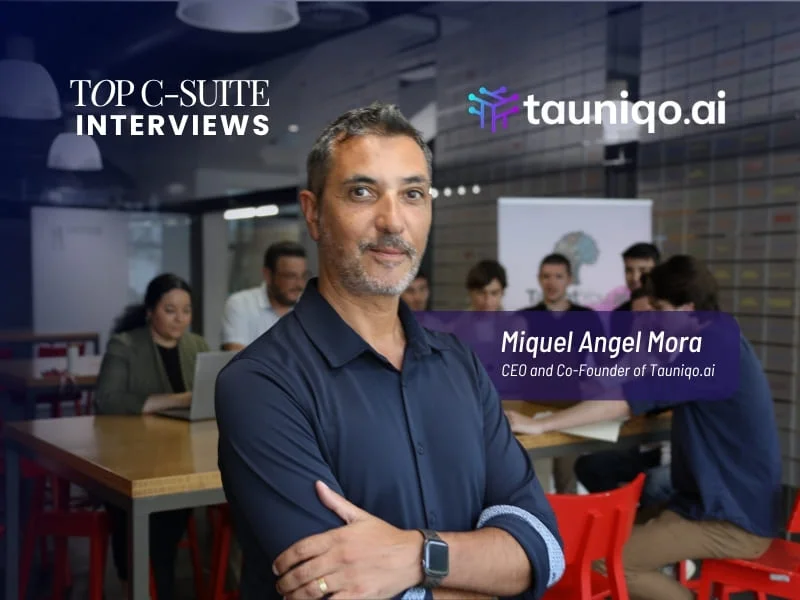
Interview with Miquel Angel Mora of Tauniqo.ai
As industries evolve rapidly, leaders must balance execution, innovation, and resilience to scale businesses while maintaining clarity, culture, and momentum.
Building and scaling companies in fast-moving industries requires leaders to combine adaptability, decisive execution, and long-term strategic thinking. Miquel Angel Mora discusses the realities of entrepreneurial leadership, the pressures of rapid growth, and why resilience, innovation, and customer focus remain essential in highly competitive markets.
Building successful companies often requires balancing growth, innovation, and people management at the same time. What leadership lessons have shaped your approach throughout your entrepreneurial journey?
A startup is not a smaller version of a corporate company. It demands urgency, ownership and people who are comfortable building while the ground is still moving. That shapes almost everything about how I lead.
The first lesson is that the biggest stopper inside a company is slow decision-making. My job as CEO is not to be the person who decides everything; it is to make sure decisions happen close to where the information is. I hire or partner with people who are better than me at what they do, and then I focus on alignment. If decision-making is centralised in the founder, the company stops scaling the day the founder is in a meeting.
The second lesson is what innovation really means. For me, innovation is invention plus execution plus commercialisation. Ideas alone are not innovation. And that only happens if you build an environment where the team is allowed to be wrong. Making mistakes is an intrinsic part of learning, and learning is what eventually leads to innovation. If people are afraid of being wrong, they wait for permission, and the company becomes slow.
The third is that you have to obsess over your unit economics. Nobody else will do it the way the CEO must. But numbers alone do not build a company. You also need to stay very close to the customer and translate what is changing into a clear direction for the team.
Looking back on your career, what experiences taught you the most about building resilient businesses in fast-changing industries?
The experiences that taught me the most were the moments when the plan stopped working.
I think about company-building in stages. The first three years are a survival strategy. You are not optimising; you are fighting not to die, which is statistically the most likely outcome for any startup. That urgency has to be felt by the whole team. Without it, you confuse “we have a plan” with “we are safe”.
At Housfy, my previous company, we took a very high-conviction bet in the early days: we invested a significant part of our funding in aggressive customer acquisition to gain market share. If that channel had not worked, the company could have failed. But for me, doing nothing is the only truly bad decision. You make calls with incomplete information and then you execute with discipline.
We invested a significant part of our funding in aggressive customer acquisition to gain market share. If that channel had not worked, the company could have failed.
A different example: during COVID, instead of waiting it out, we used the moment to launch Xerpa Valley, an accelerator that was later acquired by Bcombinator, today one of Barcelona’s reference startup accelerators and investors. Same logic, opposite environment. Resilience is not only about defending; sometimes the right move in a hard moment is to build something new.
What both experiences taught me is the same idea: keep the vision stable, but the plan flexible. Review priorities and resources constantly, because the market moves, customers change, and cash is never infinite.
“Resilience is not built when everything is going well. It is built when you learn to decide with incomplete information, adjust the plan without losing the vision, and keep the team focused on what is achievable.”
Through Tauniqo.ai, what are you noticing about the way companies are currently approaching AI in talent management, and where are they still falling short?
Most companies are no longer asking whether they should use AI. That conversation is over. The real question now is where AI actually creates measurable value inside the organisation.
What I see is that a lot of companies are still using AI in a very superficial way in HR and corporate training: generating content faster, summarising documents, automating isolated tasks. That is useful, but it is not transformational. Creating a slide, a video or a quiz with AI is becoming a commodity.
The data backs this up. Between 60% and 70% of corporate training does not translate into real business impact, which can mean thousands of euros lost per employee every year. Companies have a lot of activity data — who completed a course, who watched a video, who passed a test — but very little evidence of capability. They know who was trained. They do not know who can actually sell, lead, negotiate or make better decisions under pressure.
The broader market is moving in the direction of embedded AI for exactly this reason. OpenAI has launched a Deployment Company, and Anthropic announced an enterprise AI services firm with Blackstone, Hellman & Friedman and Goldman Sachs to bring Claude into core business operations. The signal is clear: the value is not just in the model, it is in embedding AI into real workflows.
That is where many companies are still falling short. They have data, but not talent intelligence. They have training, but not evidence of performance improvement. They have hiring processes, but not objective signals about potential. AI should not just create more content — it should help companies understand people better and make talent decisions with measurable evidence
Many organisations want to embrace AI without losing the human side of leadership. What approaches are proving most effective for companies today?
AI works best when it amplifies human judgement, not when it tries to replace it. This is especially important in HR, where trust, fairness and responsibility are non-negotiable.
The companies getting this right are using AI to remove repetitive work, structure information and give people better evidence to decide. But the final call — hiring, development, promotion — stays human.
At Tauniqo, what we are seeing in our own data is that this combination works. In training, by adapting learning to each employee, we have seen up to 68% skill gap closure in critical skills. In hiring, by automating repetitive first-stage interviews, we save HR teams around 10 hours per process while maintaining 83% alignment with human recruiter evaluations. The real value is not only the time saved — it is what HR teams do with that time: stronger final interviews, better onboarding, more quality conversations with people.
But none of this works without governance. We hold ISO 42001 certification for ethical and responsible AI, plus ISO 27001 and GDPR. Every AI evaluation in Tauniqo is re-evaluated by a second independent model. If both models disagree, the case goes to human review. Today, we detect discrepancies in around 2.03% of evaluations, while users report inconsistencies in only 0.5% of cases.
For me, that is what “human-centred AI” actually means in practice: faster, but also more auditable, more transparent, and ultimately more human.
Businesses are facing constant change in the workplace. What practical strategies are helping leaders create teams that are more adaptable and prepared for uncertainty?
Adaptable teams are not the ones that improvise better. They are the ones that have enough clarity to decide quickly when the context changes.
The first thing I try to do is build the company on positive, successful experiences rather than on problems. A team that has won together develops a real capacity to accept risk. Teams that have only ever solved fires are exhausted before the next change arrives.
The second is operational: the plan has to be reviewed constantly. Not the vision, but the plan — what we are prioritising, what we are stopping, what assumptions are no longer true. Changing the plan is not failure; sometimes it is the only way to protect the vision.
The third is transparency. At Tauniqo, in our current growth stage, we have basically one rule on schedules and presence: everyone has to be at the weekly. The whole team shares progress, challenges and decisions, and everyone understands what their colleagues are working on. It sounds simple, but it is the highest-leverage habit we have. When the context changes, nobody is starting from zero.
In uncertainty, the best teams are not the ones with perfect answers. They are the ones that learn fast, stay aligned and keep moving.
AI is changing how organisations hire, train, and support employees. What major shifts do you believe will define the future of work over the next few years?
I see three shifts that will define the next few years.
The first shift is in hiring: from CVs to behavioural evidence. Reading 200 CVs to select one candidate is not strategic work, it is administrative work — slow, subjective and repetitive. Companies will increasingly evaluate how candidates communicate, solve problems and react under pressure, not only what they wrote on a document. AI can run structured first-stage interviews 24/7, without fatigue, and give HR teams back hundreds of hours for what really matters: better final interviews, onboarding and human decisions.
The second shift is in training: from content to practice. The real question is not whether someone watched a video or passed a quiz. The real question is whether that person can apply the skill under pressure. At Tauniqo we focus on open, unscripted AI roleplays where the AI reacts, challenges and adapts in real time — a difficult customer, a demanding manager, a candidate who does not fit. That generates evidence of capability, not just completion.
AI can run structured first-stage interviews 24/7, without fatigue, and give HR teams back hundreds of hours for what really matters: better final interviews, onboarding and human decisions.
The third shift is in how companies map skills: from static competency models to living ones. Annual reviews and frozen frameworks cannot keep up with how fast roles are changing. Companies will need systems that continuously understand what people can do, where the gaps are and how to close them.
Taken together, these three shifts move HR from managing processes to understanding talent in real time. That is the real change.
As companies continue integrating AI into everyday operations, what should leaders focus on to build stronger and more future-ready organisations?
Something I tell leaders often: if you are integrating AI into your organisation right now, you are an entrepreneur, whether you call yourself one or not. There is no historical playbook, no reliable way to predict the landscape in twelve months. Every plan is a hypothesis you have to validate. Extreme uncertainty and decisions with incomplete information used to be the daily reality of a founder. Now it is the daily reality of anyone deploying AI at scale.
So a future-ready company is not the one with the most AI tools. It is the one that learns faster than its environment changes — and that operates with founder reflexes even at scale.
Many companies still treat AI as an isolated tool, when it should be a layer that connects people, performance, training and decisions. Scattered experiments generate activity, not impact.
For me, three priorities matter. Clarity, so teams know what problem they are solving and how success is measured. Auditability as a competitive advantage, not as compliance — “we cannot explain why the model said that” is not an answer anyone will accept much longer. And a culture of experimentation with responsibility, inside clear ethical and operational boundaries.
The strongest organisations will not be the ones that automate everything. They will be the ones that learn faster, decide better, and stay human in the decisions that matter. If you are deploying AI, you are an entrepreneur. Act like one.
Tauniqo.ai is growing rapidly while working with major organisations across different industries. What opportunities do you see for AI to create more agile and future-ready workplaces in the years ahead?
The biggest opportunity I see is moving companies from managing talent reactively to understanding talent continuously.
Today, most organisations work with fragmented systems. Hiring data sits in one place, training data in another, performance data somewhere else. Talent decisions get made with partial information. Companies know who completed a course or who was hired, but not always who is truly ready, who has real potential, or where the actual capability gaps are.
What we are building at Tauniqo is what we call the Strategic Talent Brain: a Talent Intelligence Operating System that connects hiring potential, training performance, and — through Tauniqo Live Coach (a real-time behavioural coaching tool) — real-world behavioural signals from how people actually work. Three layers that today live in separate tools, brought into one continuous view.
From that, two things emerge. A Performance Graph, which shows how capability evolves over time across the organisation. And a Dynamic Competency Map, built from behavioural evidence rather than from a static framework someone wrote two years ago. In plain words: companies will be able to see what people can actually do, how they are improving, and what they need next.
That changes how organisations approach reskilling, internal mobility, leadership development and workforce planning. Instead of waiting for the next annual review, they get a living system that learns from every interaction.
For me, that is the real promise of AI in the workplace. Not replacing people. Helping organisations understand, develop and amplify human potential at scale.