
By Alex Chepovoi
Artificial intelligence entered our daily lives almost overnight. Raw and imperfect as it was, AI-powered chatbots quickly proved useful in customer support, marketing, and software development. Today, in 2025, AI is no longer a futuristic concept – it is a disruptive force reshaping the global economy.
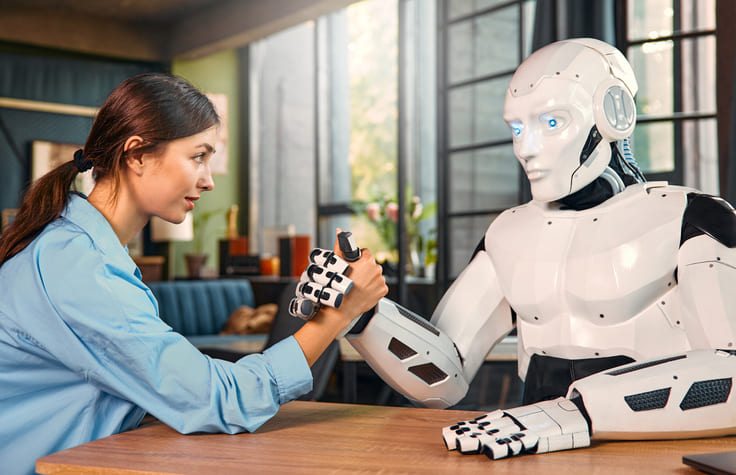
The scale of its impact is staggering. Analysts estimate that 300 million jobs worldwide are at risk of being automated. For many, AI has become less of an assistant and more of a rival: faster, cheaper, and more precise at analytics, coding, content generation, translation, and strategy.
But is AI truly a curse on the labor market? Or could it also be a cure?
A Curse
The benefits for corporations are undeniable. Microsoft saved more than $500 million in a single year by automating call centers. IBM and Google have replaced large parts of their HR departments with AI platforms like AskHR, which field millions of employee queries with little human involvement. At Microsoft, 30% of all code is now AI-generated, coinciding with massive layoffs of engineers.
The World Economic Forum’s Future of Jobs Report 2025 revealed that 41% of employers plan to downsize because of AI. The victims are spread across industries: HR specialists, market researchers, transcriptionists, data entry clerks, writers, designers and video editors.
The fallout extends further. According to CNBC, experts expect the next two decades to bring major job losses across roles once considered secure: cashiers, truck drivers, journalists, factory workers and software engineers.
Forbes echoed those concerns, citing predictions that by 2030, half of all entry-level jobs could vanish. The reason is brutally simple: machines outperform humans at speed, accuracy, and pattern recognition. They don’t need sick days or holidays.
Even hiring itself has been taken over. Applicant Tracking Systems (ATS) now screen most résumés before a recruiter ever sees them. If your CV doesn’t include the exact skills or keywords that AI deems relevant, you may never make it past the first round – even if you’re qualified. In Global Work AI we’ve noticed a tendency, that applicants get overlooked for lacking a 90% keyword match, despite years of relevant experience.
Faced with such odds, many workers fear the future. Are we destined to be replaced by algorithms?
A Cure
The dose makes the poison. The same can be applied to AI. Workforce reductions sting, but AI also offers the most accessible tools for career reinvention.
First, not every sector is equally vulnerable. The demand for healthcare workers, teachers, engineers, and skilled trades remains high. AI is not sweeping across every industry – it is targeting repetitive, data-heavy roles. Meanwhile, the human touch in caregiving, creative direction, and leadership remains irreplaceable.
Second, AI can empower displaced workers. Consider software engineers, who appeared among the hardest hit. Many of those layoffs reflect overhiring during the pandemic’s tech boom, not just automation. To stay competitive, engineers are now expected to master AI copilots such as GitHub Copilot, Google’s Gemini Code Assist, Amazon Q, Cursor, and Augment. These tools don’t replace them but extend their reach, allowing faster, cleaner code.
Ironically, the rise of generative AI may have saved the tech industry from an even deeper “venture winter” after the pandemic. By enabling new products and efficiencies, AI has injected fresh momentum into a sector that risked stagnation.
AI can also be used as a powerful job-search assistant, that can help it not turn into a full-time job itself. We’ve recognised AI’s potential for creating ATS-optimized resumes, that are personalized to each vacancy, as well as time-consuming cover letters. AI helps job seekers to automate their application processes, turning it into a transparent, clearly organized pipeline.
AI is emerging as a personal career coach too. Workers are using prompts such as, “Act as an HR recruiter. Critique my resume for a mid-level marketing role,” or “Generate behavioral interview questions based on this job description.” These interactions are becoming routine.
With only a browser and curiosity, job seekers can:
- Practice interview questions with AI simulations.
- Analyze job postings for skill gaps.
- Receive personalized job recommendations.
- Translate applications into multiple languages.
- Benchmark salaries in real time.
- Reframe past work into measurable achievements.
AI can make career development as accessible as streaming a video tutorial. What once required expensive degrees, professional coaching, or insider networks can now be done with a few clicks.
Of course, it’s no silver bullet. Workers must still bring creativity, resilience, and adaptability. But those who learn to harness AI rather than fear it will find themselves ahead of the curve.
Conclusion
So, is AI a curse or a cure for the labor market? The truth is – it is both. For those clinging to routine, AI will continue to feel like a relentless competitor. But for those willing to adapt, it can be the most powerful ally in career reinvention we’ve ever seen.
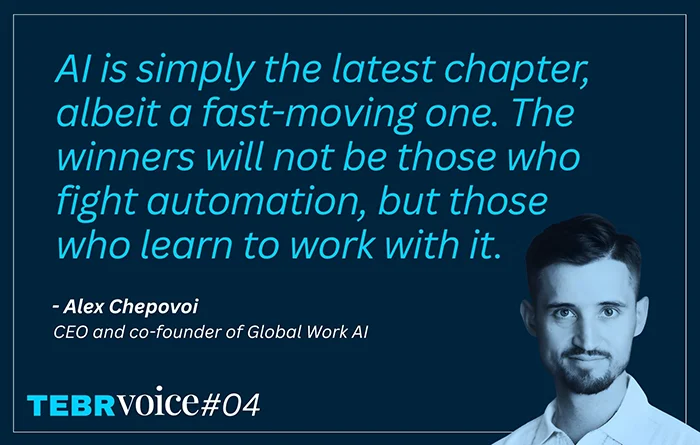
AI is simply the latest chapter, albeit a fast-moving one. The winners will not be those who fight automation, but those who learn to work with it.
I believe that a curse can become a cure, if we choose to use it wisely.
 Alex Chepovoi