
By Andrew Lopianowski and Mike Pino
Most AI transformations fail because leaders treat AI as a technology rollout, when it is really a test of judgement, leadership, and organisational design.
Inside many organisations, AI has created an uncomfortable tension. Leaders know they must move faster, but they also sense that speed without direction will only amplify the wrong things. The question for CEOs is no longer whether to adopt AI. It is whether the organisation is capable of using it wisely.
They Treat AI as a Tool, When It Is Really a Test
The first mistake CEOs make is deceptively simple: they start with the technology.
They ask which platform to buy, which vendor to select, which use cases to prioritise, and how quickly they can show productivity gains. These questions matter, but they are not the first questions. The better starting point is: what is our organisation currently unable to sense, decide, learn, or act on quickly enough?
AI is often presented as something to “roll out”: a new layer of capability placed on top of existing work. But that leaves the deeper system intact: who decides, how information moves, what behaviour is rewarded, and whether people feel able to exercise judgement.
The result is familiar. Organisations get faster at generating activity, but not necessarily better at creating value. They summarise more, automate more, and generate more content. Yet the organisation itself does not necessarily become wiser.
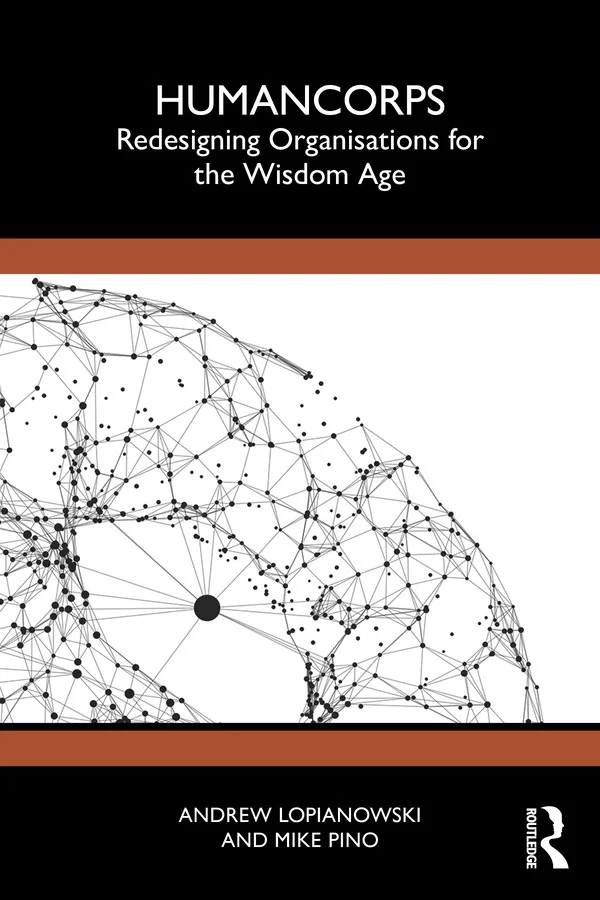
That distinction matters because we are moving from the Knowledge Age into what Mike Pino and I describe, in our forthcoming book HumanCorps: Redesigning Organisations for the Wisdom Age, as the Wisdom Age: a context where information and knowledge are increasingly abundant, but judgement becomes scarce. In that environment, the leadership question is not “How do we use AI?” It is “How do we build an organisation capable of using AI wisely?”
The CEO’s task is therefore not to sponsor AI as a side initiative. It is to confront what AI is exposing.
They Automate Before They Understand What Is Broken
The second mistake is assuming that automation equals transformation.
Much AI enthusiasm still rests on an industrial assumption: find the task, remove the friction, reduce the human effort, increase efficiency. That logic is not wrong. Many tasks should be automated. But when automation becomes the whole story, leaders modernise the surface while preserving the dysfunction underneath.
AI can increase an organisation’s capacity to interpret complexity, test options, surface weak signals, and support better judgement. That matters because most organisations are not suffering from too little information; they are suffering from too little meaning.
Many organisations have data, dashboards, and reports everywhere. What they lack is the ability to turn information into coherent action. Decisions still escalate too far; frontline teams lack context; middle managers are overloaded; and senior teams spend too much time aligning narratives rather than confronting reality.
Take a bank using AI to improve customer service, risk management, or operational efficiency. The technology might identify vulnerable customers earlier, detect emerging fraud patterns, or help colleagues respond more quickly. But if teams still work through fragmented priorities, legacy processes, and unclear decision rights, the issue is not whether AI works. It is whether the organisation can absorb what AI makes possible.
So, CEOs need to move beyond the seductive simplicity of “what can we automate?” and ask a harder question: what must we redesign so human and synthetic intelligence can work together well? That question sits at the centre of our book’s argument.
That means looking beyond tasks to the operating system beneath them: handoffs, incentives, governance, trust, and accountability. AI transformation becomes real when it changes how the organisation thinks, not just how quickly it processes.
They Centralise Control Just When Judgement Needs to Move Closer to Reality
The third mistake is a leadership reflex: when uncertainty rises, control tightens.
This is understandable. AI raises questions of security, ethics, regulation, reputation, and trust. Boards want assurance. Executives want oversight. Legal and risk teams want guardrails. All are necessary, but the reflex to centralise control can quietly undermine the transformation itself.
In complex environments, the people closest to the work often see reality first. They see where end-users are frustrated, customers are confused, processes are failing, data is unreliable, or AI outputs are plausible but wrong. They see the edge cases before the dashboard does. If those people lack the authority, context, or confidence to act, the organisation becomes slow exactly where it needs to become intelligent.
The answer is not reckless decentralisation. It is disciplined autonomy.
CEOs need to design decision rights deliberately: what teams can decide, what must be escalated, where human oversight is required, and which boundaries matter. I think of this as creating “risk envelopes”: clear enough to protect the organisation, but spacious enough to let people act. It reflects the HumanCorps emphasis on decision autonomy, information transparency, and intelligent boundaries.
This is one of the most important shifts in AI transformation. Authority can no longer be based only on rank. It has to move, intelligently, towards insight — giving people closer to the work more room to judge, adapt, and learn, supported by AI systems that surface context rather than dictate answers.
They Underestimate the Human Conditions for Adoption
The fourth mistake is assuming people will adopt AI because the business case is obvious.
They will not.
People adopt new ways of working when the conditions around them make it safe, useful, and meaningful to do so. If they fear replacement, surveillance, or punishment for mistakes, they will comply superficially or use the tools in the shallowest possible ways.
Psychological safety cannot be a soft add-on to AI transformation; it is a performance requirement in the Wisdom Age. People need to question AI outputs, admit uncertainty, surface errors, and say, “I don’t think this is right.” Without that, organisations risk replacing human judgement with machine-generated confidence.
But safety alone is not enough. Organisations also need people to stretch their thinking, challenge one another constructively, and engage with disagreement in a disciplined way. In AI transformation, the real value often lies in the argument around the output: what it missed, assumed, distorted, or made visible.
This is where the idea of synthetic symbiosis, which we explore in our book, starts to matter. The point is not that humans use AI as a clever tool, nor that AI replaces human work. The point is that humans and synthetic systems operate as partners, each compensating for the other’s limits. Humans bring context, ethics, meaning, and accountability. Synthetic systems bring speed, scale, pattern recognition, and the ability to hold more complexity than any one person can. The value is in the relationship, not the machine alone.
But symbiosis requires trust. If people are treated as obstacles to adoption, they will become obstacles. If they are treated as agents of judgement, they can become the very capability that makes AI useful.
If CEOs want AI adoption to stick, they must pay attention to the emotional and cultural architecture of the organisation. Trust is infrastructure. Without it, even the best technology degrades into theatre.
They Confuse Intelligence with Wisdom
The fifth mistake may be the most consequential: CEOs confuse more intelligence with better judgement.
AI gives organisations extraordinary synthetic capability. It can detect patterns, generate options, summarise complexity, and produce plausible answers at astonishing speed. But wisdom is neither plausibility nor speed. Wisdom is knowing why, why not, and what matters most.
The next competitive frontier is not simply who has the most advanced AI. It is who can turn intelligence into wise action: framing the right problems, interpreting weak signals, making ethical trade-offs, and acting with clarity under uncertainty.
This is the shift to the Wisdom Age. In the Knowledge Age, advantage came from access to information and the ability to turn it into expertise. Now AI makes information and knowledge more abundant. What becomes scarce is judgement: the ability to discern what matters, why it matters, what to do, and what not to do.
That changes the CEO’s role. The CEO is no longer simply the chief decision-maker or the executive sponsor of transformation. The CEO becomes the designer of the conditions in which better judgement can happen throughout the organisation.
That means building systems where purpose acts as orientation, not slogan; information reaches the people who need it; decision rights are explicit; AI strengthens human judgement; and learning is built into the work.
This is also the argument behind HumanCorps, both in our book and in our work: AI will not reward organisations simply for adopting tools, but for redesigning how people, information, decisions, and synthetic capability work together. The opportunity is not just productivity. It is the chance to build organisations that are faster because they are clearer, and clearer because they are wiser.
Conclusion
The real challenge of AI transformation is not whether CEOs can move fast enough to adopt the technology. It is whether they are willing to build organisations capable of using it wisely. If they are not, AI will not transform the organisation. It will simply make its existing limits faster, louder, and harder to ignore.
About the Authors

 Andrew Lopianowski and Mike Pino are the authors of HumanCorps: Redesigning Organisations for the Wisdom Age (Routledge, July 2026). Combining decades of expertise across human-centred transformation and organisational redesign with deep knowledge in AI, decision intelligence, enterprise learning, and synthetic enablement, they aim to educate on how organisations can evolve for the Wisdom Age.