
By Nick Kabrel
Employees increasingly adopt conversational chatbots at the workplace. Yet without strategic oversight, such usage might default to shallow, efficiency-driven usage, undermining the opportunities for personal and organizational growth. Therefore, leaders should intentionally shape an AI use culture that facilitates human flourishing and organizational innovation. Here’s how to achieve it.
Introduction
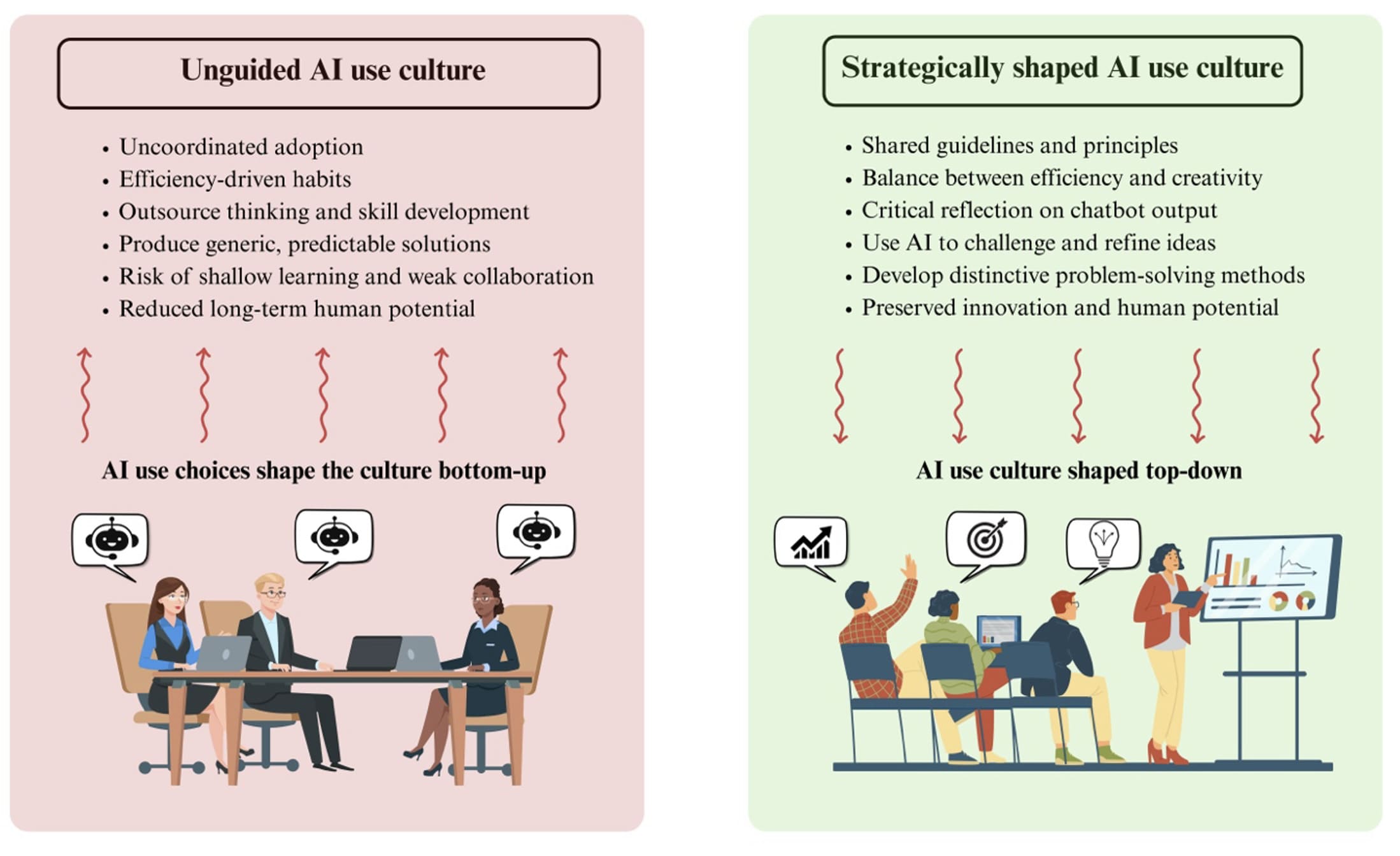
The rise of advanced AI, and conversational chatbots in particular, has created an urgent leadership challenge that most executives are overlooking. How your employees use chatbots isn’t just their individual choice – it has broader organizational implications. Collective chatbot usage patterns are shaping what I call an organizational “AI use culture.”
Because chatbots are cheap, fast, and accessible, many employees adopt them independently to accomplish work tasks. This means AI use culture will emerge whether you intentionally shape it or not. The key difference is that by intentionally guiding it, you can define how it unfolds. If you ignore it, the culture will likely default to shallow, efficiency-driven uses, like obtaining ready-made ideas, copy-pasting drafts, and outsourcing critical thinking. These approaches feel productive in the moment but gradually undermine the learning and creativity of employees that drive long-term organizational growth.
To avoid this prospect, organizational leaders should actively cultivate a more human-centered AI use culture that balances efficiency with learning, creativity, and collaboration.
Shaping effective AI use culture: A practical guide
Human-centered AI use at the workplace means that chatbots are used in ways that enhance key human flourishing factors and facilitate the fulfillment of professional needs, not undermine them. This doesn’t mean chatbots should be avoided or prohibited. Instead, it requires a shared understanding of how AI should be used and why those choices matter.
As a leader, you can’t afford silence when it comes to chatbots. Your employees are probably already using them, the only question is how exactly. Acknowledge this reality explicitly, and if possible, conduct interviews or cross-department surveys to reveal the general chatbot use patterns. Based on the obtained insights, you will clearly see whether the tendencies for chatbot usage are aligned with human development or are simply outsourcing strategies. For example, AI chatbots for healthcare help practices streamline patient communication, manage appointments efficiently, and reduce administrative workload. This demonstrates how thoughtful AI adoption can enhance both productivity and human connection.
For example, looking at the data, you can ask yourself: Are these usage patterns aligned with a need for professional growth? Does this contribute to skill development? Does this enhance mastery, autonomy, and creativity of employees? If everyone in the company uses chatbots like this, will we have a strong human potential and innovation over the long term? If you find any red flags, it can be a sign to intervene with the following strategies.
1. Establish the “sandwich approach”
One of the most effective methods for preserving human agency while leveraging AI capabilities is what can be called the “chatbot sandwich rule.” Within this method, an employee generates “raw material” first, that is, writing a draft, developing initial ideas, creating a presentation structure, designing a pipeline, whatever their work requires (the bottom layer). Then they use a chatbot for feedback, critical evaluation, and reflection on their ideas (the middle layer). Finally, they rewrite or redesign based on that feedback (the top layer).
For example, before presenting an idea to a project leader, an employee might run through several rounds of critical revision with a chatbot, using it to identify weaknesses, explore alternatives, and strengthen their argument. This approach preserves learning and authenticity while potentially saving time and improving quality.
2. Position AI as an intellectual sparring partner
Instead of asking “Write this for me,” employees should learn to prompt chatbots with “Challenge this idea,” “What am I missing here?” or “How could this approach fail?” Chatbots excel as question-askers and can help employees get to the right answers on their own, thereby learning the pathway to a solution and solving it independently next time. Encourage employees to use chatbots as sparring partners or performance coaches that help define goals, challenge assumptions, and evaluate ideas from multiple angles. This transforms AI from a content-generation tool into a thinking enhancement tool.
3. Develop AI literacy as a core competency
Your employees need skills to evaluate AI outputs critically, understanding potential biases, limitations, and gaps. Train them to ask probing questions: What assumptions are built into this analysis? Where might this information be incomplete? How does this align with our specific organizational context?
4. Balance AI and human collaboration
Some of the best organizational thinking emerges from human discussions where different perspectives result in unexpected connections. Regular human check-ins serve multiple purposes: they reality-test AI-assisted work, ensuring it remains grounded in practical constraints. They bring contextual knowledge, emotional intelligence, and diverse experience that AI cannot replicate. And they challenge assumptions based on real-world implementation experience and insights rooted in organizational culture and politics.
5. Avoid AI creativity trap
To complete this guide: here’s something that every executive should reflect on: if your employees use chatbots the same way as your competitors’ employees, which basically means generic question-answer sessions, quick rewrites, standard brainstorming, how likely is it that your company will be much more creative to innovate your way past competitors?
Research suggests that when organizations rely on similar AI strategies, their outputs might begin to converge toward similar ideas and structures. This convergence isn’t immediately obvious because each company’s outputs appear unique in isolation. But zoom out, and you’ll see troubling patterns of similarity.
Therefore, you should promote non-conventional, creative chatbot use cases. For example, train your project managers to use chatbots as a harsh critic, systematically exploring how initiatives could fail before they launch. Encourage your training departments to use AI as a “learning coach,” helping employees create personalized development pathways. Or ask your HR managers to analyse qualitative survey data with chatbots to reveal implicit information they might be overlooking.
Final thoughts
Your organization’s AI use culture is forming right now, shaped by hundreds of daily interactions between your employees and chatbots. You can either let this happen by default, risking a workforce that becomes dependent rather than empowered, or you can actively cultivate an approach that enhances human capabilities while leveraging AI’s strengths.
The choice you make will determine how adaptive, creative, and innovative it remains as AI continues evolving. In a world where everyone has access to the same powerful AI tools, your competitive advantage won’t come from the technology itself. Rather, it will come from how thoughtfully your people use it.
 Nick Kabrel