
By Alex Milovanovich
Blending classic and modern strategy thinking, this article presents the Dynamic Strategy Map – an iterative, seven-step process, integrating deliberate strategy building with adaptive execution. The model – illustrated by Microsoft’s Nadella-era pivots – equips leaders to address uncertainty, test assumptions, build scenarios and adjust course as conditions evolve.
The inspiration for this article stems from a persistent challenge: the absence of a comprehensive strategy map capable of effectively tracking the intricate decision-making process during the strategy formulation stage, while simultaneously providing clear visual linkages between the initial situation, underlying assumptions, strategic choices, and eventual execution – in a way that remains relevant amid continuous change. While strategy maps based on the Balanced Scorecard have proven valuable for visualizing strategy execution, there remains a critical gap in tools that support the messy, iterative work of strategy formulation itself.
This gap becomes especially problematic in an environment where competitive landscapes shift abruptly, technological disruptions accelerate unpredictably, and geopolitical tensions introduce sustained volatility. Traditional methods of strategic planning – often built on linear, static models – are no longer sufficient in an era where adaptability is a core requirement. Today’s leaders need tools that support real-time updates, scenario testing, and iterative refinement, rather than rigid frameworks that assume a predictable path.
To address this urgent need, this article introduces a novel approach to visual strategic mapping – one that integrates continuous adaptation and real-time feedback loops into the core of the strategy formulation process. By integrating continuous environmental sensing, assumption tracking, and scenario war-gaming into a single visual model, it enables organizations to navigate volatility, enhance their agility and resilience, without losing strategic coherence in the face of change. Grounded in both ancient wisdom (Sun Tzu’s principles of fluid adaptation) and modern strategic theory (including agile and adaptive frameworks), and illustrated through Microsoft’s cloud transformation, this approach does more than plan for multiple futures – it builds an organizational capability to continuously evolve strategy as reality unfolds.
Theoretical Foundations for Adaptive Strategy Visualization
Across history, strategists have aimed to formulate and execute winning strategies. Yet, today’s volatile and uncertain environment demands a new approach: one rooted in continuous evaluation, dynamic adaptation, and real-time feedback. This article’s mapping logic synthesizes foundational principles from ancient wisdom, military strategy, corporate foresight, systems thinking, and visualization techniques, addressing diverse challenges of dynamic environments.
Adapting to a Dynamic Environment: Lessons from Sun Tzu
Sun Tzu’s The Art of War remains one of the most influential strategy texts, offering principles that remain highly relevant in contemporary decision-making. One of his core ideas is that strategy must flow like water, adapting to the terrain rather than rigidly following a predefined path. This concept of dynamic adaptation is central to navigating unpredictable environments.
Closely tied to this idea is situational awareness, another key theme in Sun Tzu’s work. His “Know Yourself, Know Your Enemy” principle emphasizes the importance of understanding both internal and external conditions before making strategic decisions. He also stresses constant evaluation, arguing that successful strategists must continuously assess strengths and weaknesses, adjust tactics, and exploit opportunities as they arise.
Furthermore, his recognition that “The Unpredictable is Invincible” underscores the need to embrace uncertainty and build strategies that can adapt to unforeseen events. This mindset calls for learning, flexibility, preparation for multiple outcomes, and a willingness to pivot when necessary.
Scenario Planning: Preparing for Multiple Futures
Scenario planning emerged as a structured methodology in the 1970s, pioneered by Royal Dutch Shell under Pierre Wack. Unlike conventional forecasting, scenario planning does not attempt to predict one definitive future but instead explores multiple plausible outcomes based on critical uncertainties and market dynamics. This approach helps organizations stress-test their strategies against different possibilities, enabling them to remain resilient in the face of sudden change.
OODA Loop: Decision-Making in Fast-Moving Environments
Developed by U.S. Air Force Colonel John Boyd in the late 1970s and early 1980s, the OODA Loop – Observe, Orient, Decide, Act – is a decision-making framework designed for rapid adaptation in dynamic and competitive environments. The key insight behind OODA is that strategy is an ongoing process, requiring constant observation and adjustment rather than a one-time decision. This iterative process is not just about speed, but about improving the quality of decisions through continuous learning and adaptation. Organizations that cycle through OODA faster than their competitors can gain an edge by outmaneuvering uncertainty.
Balanced Scorecard & Strategy Maps: Structuring Strategic Execution
While traditional Balanced Scorecard-based strategy maps (Kaplan & Norton, 2001) have proven useful for visualizing and communicating strategy during execution, they focus primarily on translating strategy into operational objectives across four key areas: Financial, Customer, Internal Processes, and Learning & Growth. However, they do not inherently address strategy formulation – an important limitation when dealing with complex, evolving environments. They excel at tracking what to achieve but not how to adapt the strategy itself.
Emergent Strategy: An Alternative to Deliberate Planning
While many strategy frameworks assume a deliberate approach, Henry Mintzberg introduced the concept of emergent strategy, which contrasts with pre-planned strategic decision-making. Instead of top-down formulation, emergent strategy unfolds during execution, shaped by bottom-up discovery, learning, and adaptation – allowing organizations to adjust dynamically based on real-world developments.
Each of these frameworks offers essential insights into awareness, adaptability, uncertainty, and feedback – core needs for navigating today’s turbulent environment. While powerful on their own, their integration into a dynamic mapping structure creates a more cohesive and responsive approach. Ancient wisdom reminds us that strategy is fluid; modern tools provide components for responsiveness. The next chapter introduces such a framework, designed to guide continuous strategic adaptation.
The Adaptive Strategy Process: Seven Essential Steps
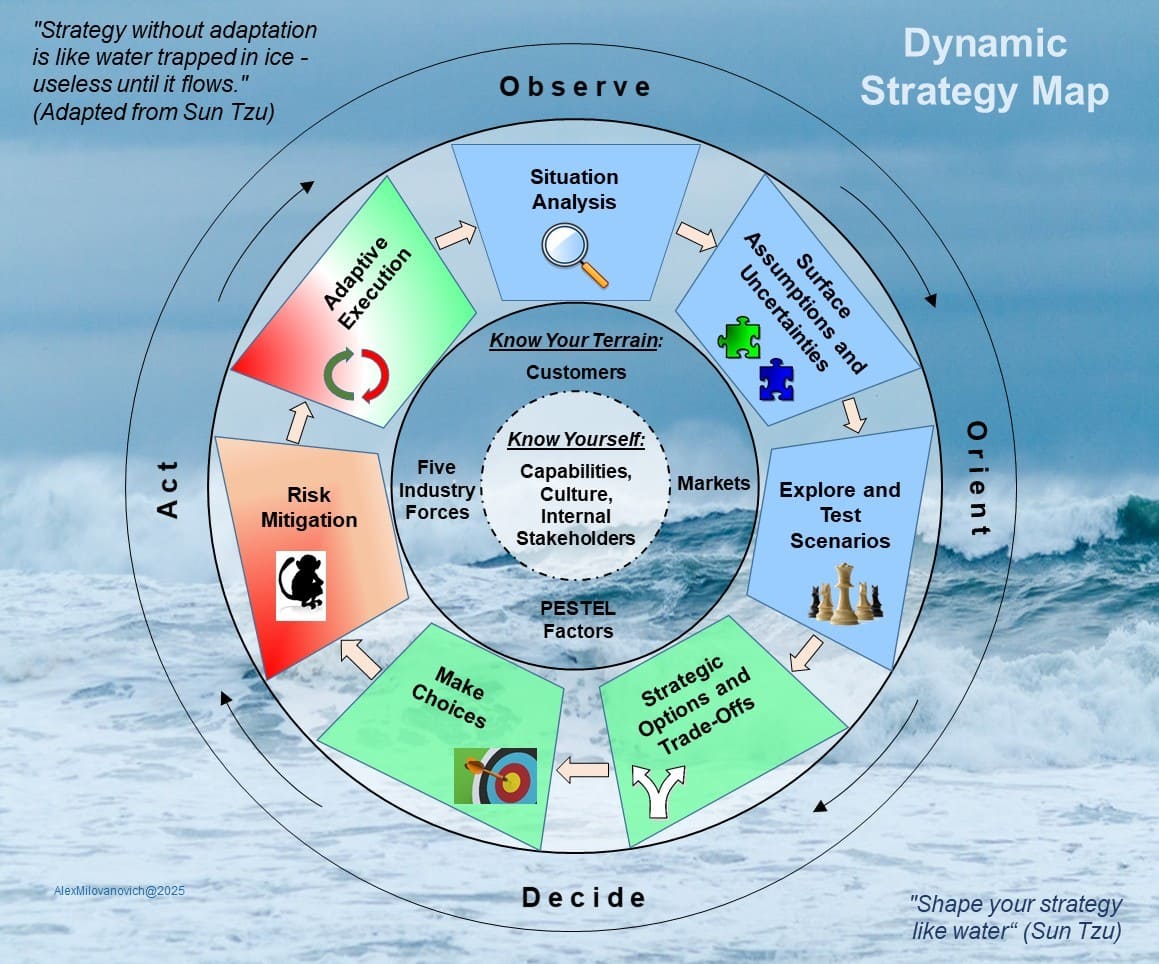
This chapter introduces the Dynamic Strategy Map (DSM), a seven-step process for guiding organizations through strategic design and adaptation in dynamic, uncertain environments. Building on the theoretical foundations from the previous chapter, it presents a practical, visual framework. Microsoft’s transformation under Satya Nadella serves as the primary example, illustrating each step in action. The DSM offers a structured yet flexible approach, emphasizing continuous learning, iteration, and responsiveness to change.
1. Situation Analysis – Seeing the Strategic Landscape Clearly
Every great strategy begins with a clear-eyed view of reality. The first step in our dynamic mapping process calls for a candid assessment of both internal and external conditions – what Sun Tzu might describe as “knowing yourself and knowing your terrain”.
Internally, this means understanding your organization’s core capabilities, culture, and key stakeholders, including employees, senior leadership, and shareholders. Starting here helps prevent later misalignments between strategy and organizational DNA, such as cultural resistance to change.
Externally, the assessment includes customers, competitors, markets, and the broader environment. A thorough industry analysis – using Porter’s Five Forces – examines competitive rivalry, the threat of new entrants, buyer and supplier power, and substitutes. A PESTEL analysis adds depth by evaluating broader macro forces: political, economic, social, technological, environmental, and legal.
A critical element of this analysis is placing customer needs at the heart of strategic thinking. Equally important is identifying other key stakeholders – employees, suppliers, regulators, and communities – and articulating a clear value proposition for each.
Microsoft’s transformation under Satya Nadella offers a powerful example. When Nadella took the helm in 2014, he began by confronting uncomfortable truths. Internally, Microsoft’s legendary Windows-centric culture had become a straitjacket – engineering silos prevented collaboration, while the company’s identity remained tethered to declining PC markets. Externally, the ground was shifting beneath their feet: developers were flocking to open-source platforms, enterprises were embracing cloud solutions, and mobile-first workflows were becoming the norm.
Microsoft’s leadership performed a deep analysis of its ecosystem, visualizing how technology layers from infrastructure to platforms were evolving. They distinguished between hard facts – like stagnating Windows revenue growth – and soft signals, such as GitHub’s rising popularity among developers indicating a broader open-source movement. Crucially, they placed customer needs at the center, recognizing that value had shifted from software licensing to cloud-enabled productivity.
2. Surface Key Assumptions & Uncertainties – Stress-Testing Beliefs
The purpose of this step is to identify and examine the assumptions, fragile beliefs, hidden biases and uncertain variables that underpin current strategic thinking, before they are undermined by changing circumstances. Acknowledging that strategic inflection points often begin with the courage to question core beliefs, this step emphasizes that unchallenged assumptions can silently sabotage even the most well-intentioned strategies. Assumption mapping helps by visually identifying key assumptions, their interdependencies, and their influence on strategic outcomes. This makes the underlying logic of a strategy easier to interrogate – and its vulnerabilities more visible.
Microsoft, under Nadella, challenged several deeply held assumptions: that Windows should remain the central focus of the user experience, that open-source software was fundamentally incompatible with their business model, and that their existing dominance in the enterprise market guaranteed future relevance.
To rigorously test these assumptions, Nadella’s team drew on Red Team-style thinking – an adversarial process designed to expose blind spots and stress-test core logic. One key assumption they dismantled was that platform lock-in remained a viable strategy. In its place, they recognized the strategic importance of openness, developer ecosystems, and cross-platform interoperability. This shift also surfaced new uncertainties – such as whether open-source adoption would threaten margins, or whether developers would trust Microsoft’s new posture.
3. Explore & Test Scenarios – Anticipating Alternative Futures
Strategic decisions cannot be made in isolation – they must be stress-tested against alternative futures to ensure resilience. This step begins with examining possible scenarios and understanding how key stakeholders (customers, competitors, regulators, and market influencers) might react under varying conditions. Instead of simply considering optimistic or pessimistic outcomes, organizations must develop 3-4 distinct scenarios – such as a disruptive competitor entry, regulatory shock, or a fundamental shift in customer behavior.
To avoid groupthink and confirmation bias, it is essential to include contrasting perspectives and divergent assumptions. Tools like scenario planning and war-gaming – simulations of competitive and market dynamics – enable organizations to anticipate potential reactions from customers, competitors, and regulators under each scenario.
Microsoft confronted the rapid rise of Amazon Web Services (AWS) by analyzing how AWS might scale its advantage, how regulators might intervene in cloud markets, and how enterprise customers could shift expectations. By stress-testing its strategies against these scenarios, Microsoft determined that leaning into hybrid cloud solutions and open-source integration would differentiate Azure while mitigating antitrust concerns. These insights shaped Microsoft’s decision to expand cross-platform compatibility, strategically balancing openness with proprietary advantages.
4. Develop Strategic Options & Trade-Offs – Weighing Paths Forward
A well-crafted strategy is not a single, rigid path – it is a set of viable alternatives, each with its own advantages, trade-offs, and risks. This fourth step transforms insights from scenario testing into concrete strategic options, and establishes a framework for prioritizing among them. To facilitate this process, several tools can be employed, including Real Options Logic (viewing strategic investments as options, not just commitments) and Strategic Choice Structuring (a systematic approach to decision-making).
The prioritization of strategic options should be guided by a comprehensive set of criteria:
- Value Creation Potential: The degree to which the option is expected to generate value for key stakeholders – customers, employees, and shareholders.
- Feasibility: The availability of resources, the alignment with existing capabilities, and the potential challenges associated with implementation.
- Risk and Return: What is the expected upside, and what’s the worst-case downside? Tools like scenario-adjusted Net Present Value (NPV) help quantify both reward and risk, including the probability of success and scale of potential loss.
- Resilience: The option’s ability to adapt and remain viable across multiple scenarios and uncertainty.
- Differentiation: The degree to which the option offers a unique and defensible position in the market.
- Time to Impact: The balance between short-term and long-term effects.
- Strategic Fit: The alignment of the option with the organization’s overall vision, core values, and existing capabilities.
Microsoft demonstrated this kind of trade-off analysis when evaluating the acquisition of LinkedIn. While no internal details are public, it’s likely that Microsoft considered building comparable social-professional capabilities in-house. However, creating a competing platform would have taken years, with uncertain user adoption and limited defensibility. In contrast, acquiring LinkedIn provided immediate access to a massive professional user base, a rich data ecosystem, and network effects that enhanced Microsoft’s AI and enterprise offerings like Dynamics 365 and Azure AI. Strategically, the acquisition scored higher on speed to impact, data-driven differentiation, and long-term value creation – despite its high financial cost.
5. Make Strategic Choices & Set Direction
After identifying viable strategic options, organizations must commit to a clear direction, define their goals, and articulate the rationale behind their choice. This step is critical – it transforms analysis into action and ensures alignment across the organization. Strategic decisions should be bold yet adaptable, backed by structured foresight mechanisms to prevent miscalculations.
Effective decision-making involves two crucial elements:
- Pre-Mortems: Organizations must assume failure and ask, “Why did this strategy fail?” to uncover potential blind spots, fragilities and second-order effects before execution.
- Tripwires: Conditional checkpoints trigger a reassessment if certain key metrics deviate, preventing organizations from sticking to failing strategies out of inertia.
Microsoft’s high-stakes decision to partner with OpenAI is a textbook case. It chose to integrate cutting-edge AI capabilities into its ecosystem, rather than develop them entirely in-house. This strategic bet aligned with its cloud-first vision and accelerated differentiation in productivity tools and cloud services. The decision signaled a long-term strategic intent: to embed AI as a “copilot” across work, code, and search. While the commitment was significant and partially irreversible, Microsoft remained attentive to emerging signals – such as user adoption, developer feedback, and regulatory pressures – ready to adjust how the partnership evolved over time. Nadella’s leadership combined bold intent with adaptive awareness.
6. Identify Risks & Mitigation Plans – Building Resilience
No strategy is immune to disruption. Anticipating potential derailers, mapping internal and external risks, and designing backup plans are essential to ensuring long-term viability. In this sixth step organizations must assess the likelihood and impact of key risks, developing structured mitigation strategies to address them proactively. Resilience isn’t about resisting change – it’s about absorbing shocks, adapting, and, as Netflix’s use of Chaos Monkey shows, even introducing controlled disruptions to expose vulnerabilities before they cause real crises.
As Microsoft expanded its cloud and AI presence, it faced regulatory scrutiny over market dominance. To strengthen industry-wide interoperability and developer trust, the company embraced open-source collaborations. Under Nadella’s leadership, Microsoft open-sourced .NET, acquired GitHub, and supported Linux integration within Azure – moves that softened its historic “walled garden” image, bolstered ecosystem adoption, and strengthened its position as a trusted, neutral platform – while also reducing its antitrust exposure.
7. Adaptive Execution – Steering Through Uncertainty
The final, yet continuous, step in the Dynamic Strategy Map is Adaptive Execution. This phase acknowledges that even the most meticulously formulated strategies must be implemented flexibly, with a constant emphasis on monitoring, learning, and real-time adaptation. It is here that the strategy truly comes alive, responding to the dynamic environment it seeks to navigate.
At the core of adaptive execution are structured feedback loops. Tools like After-Action Reviews (AARs) allow teams to capture lessons from critical decisions and feed them back into future planning. Continuous experimentation, such as A/B testing, provides granular feedback for data-driven adjustments. Dynamic dashboards track performance in real time – not just outputs, but responsiveness itself.
Microsoft’s evolution under Satya Nadella exemplifies structured adaptation. As Azure scaled, Microsoft employed Objectives and Key Results (OKRs) to drive growth and monitor strategic direction. Feedback from customers, developers, and partners was embedded into product roadmaps, enabling dynamic refinements across the ecosystem. When enterprise demand shifted toward hybrid cloud solutions, Microsoft pivoted by integrating customer feedback into product development and ensuring seamless transitions between on-premises and cloud infrastructure.
At Microsoft, this structured adaptation existed alongside space for emergent strategy. Azure’s container services evolved in response to developer frustrations with virtual machine management. Rather than dismissing this bottom-up innovation, Microsoft recognized its traction and scaled it into a core cloud offering – reinforcing Mintzberg’s thesis that the best strategies blend deliberate and emergent elements. As he observed, strategies often emerge from the ground up through incremental adjustments to reality. That’s why the Dynamic Strategy Map embeds feedback loops not just at the execution stage, but throughout the entire strategic process.
Yet, tools and metrics alone aren’t enough. Adaptive execution requires a culture and structure that values flexibility over control. Organizations with rigid hierarchies often struggle to respond quickly. The ability to observe, orient, decide, and act – the OODA Loop originally developed for fighter pilots – must be internalized across the organization. Execution becomes not a linear process but a circular loop of sensing, learning, and adapting.
To visually represent this approach, the accompanying figure introduces the Dynamic Strategy Map. This circular map emphasizes iteration, feedback, and fluidity between steps. The background evokes rough water – symbolizing the turbulent environment organizations must navigate. The outermost layer incorporates the OODA Loop – Observe, Orient, Decide, Act – representing the continuous execution feedback that fuels strategic adaptation.
Conclusion
In today’s turbulent environments, strategy can no longer be treated as a one-time exercise or a rigid blueprint. The Dynamic Strategy Map offers a structured yet flexible alternative: a seven-step process designed to help organizations navigate complexity while remaining responsive to emerging realities.
Rather than favoring a purely top-down approach or relying entirely on adaptive emergence, the Dynamic Strategy Map integrates both perspectives, blending deliberate decision-making with agile responsiveness. Its mapping logic helps leaders connect strategic context with direction and choices with consequences, fostering an ongoing, adaptive dialogue between thinking and doing.
Applicable beyond the corporate sphere, the framework supports strategy work across profit-driven businesses, non-profits, military operations, healthcare systems, and other domains where strategy matters. The DSM enables organizations to assess realities, challenge assumptions, test scenarios, weigh options, mitigate risks, and execute adaptively.
Yet strategic frameworks are never final. As new challenges emerge, so must the tools and methods that support strategic thinking. The growing role of AI promises to enrich each step – from uncovering hidden patterns to stress-testing options and accelerating adaptive execution. These developments point toward a broader research agenda centered on fusing human judgment with machine intelligence.
 With over 35 years of international leadership and advisory experience,