Europe is not an easy place to run a retail supply chain. The continent’s 44 countries represent dozens of regulatory environments, multiple currencies, varying consumer preferences, fragmented logistics infrastructure, and labour markets with materially different conditions from one border to the next. A retailer operating across Germany, Poland, France, and Romania is not managing one supply chain — it is managing four that happen to share some common sourcing.
For most of the past decade, this complexity was treated as a cost of doing business in Europe. The retailers that could afford to absorb it did. Those that could not limited their geographic reach. What has changed since 2022 is the rate at which European retailers supply chain technology has matured to the point where complexity itself can become a source of advantage rather than a constraint — provided the organisation has the capability to navigate it faster and more accurately than competitors.
The retailers that are pulling ahead in 2026 are doing so not by simplifying their supply chains but by building technological capabilities that turn multi-market complexity into market intelligence. This is worth examining in detail.
The Complexity Has Gotten Worse — and So Has the Opportunity
The conventional expectation was that European retail supply chains would consolidate and simplify over time as the single market deepened. The opposite has happened. The combination of geopolitical disruption following the war in Ukraine, Brexit’s lasting friction on UK-EU trade flows, energy price volatility, and the rapid growth of cross-border e-commerce has added layers of complexity that did not exist five years ago.
At the same time, consumer expectations have not moderated. European shoppers increasingly expect the same availability, delivery speed, and in-store experience regardless of whether they are shopping in a capital city or a regional market. Meeting that expectation across a geographically and culturally diverse landscape requires supply chain capabilities that most mid-size retailers have not historically possessed.
The research picture here is instructive. A 2024 Gartner analysis found that supply chain leaders in Europe who invested in advanced planning and AI-driven demand intelligence consistently outperformed peers on availability, inventory turnover, and gross margin. The performance gap was not attributable to scale — smaller chains with modern technology in European retail supply chains were outperforming larger chains running legacy infrastructure. The differentiating factor was how quickly and accurately their planning systems could translate demand signals into operational decisions.
Where the Technology Investment Is Going
Retail supply chain technology in Europe has seen concentrated investment in three interconnected capability areas over the past three years: demand intelligence, inventory automation, and supply chain visibility.
Demand intelligence investment reflects the recognition that European retail forecasting is structurally harder than forecasting in more homogeneous markets. A promotional campaign that drives a 40% uplift in German stores may produce a 15% uplift in Czech stores and no measurable effect in Romanian locations. A weather event that affects demand for seasonal products in Scandinavia may lag by two weeks in southern Europe. Standard statistical forecasting methods, designed for stable and relatively uniform demand environments, perform poorly under this kind of geographic heterogeneity.
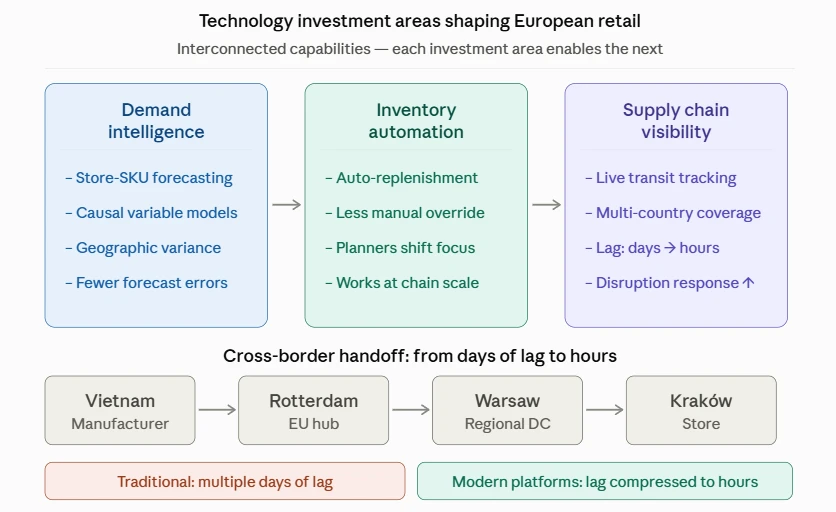
AI-driven demand forecasting addresses this by modelling demand at the store-SKU level using causal variables — local economic indicators, promotional mechanics, weather, competitive activity — rather than extrapolating from chain-level averages. European retailers that have made this transition report material reductions in forecast error, particularly in the seasonal and promotional categories where the legacy systems were weakest.
Inventory automation investment follows directly from improved forecasting. When demand intelligence is accurate at the granular level, automated replenishment can be trusted to act on it without constant manual oversight. The combination of AI forecasting and automated order generation allows planning teams to shift from spending their days correcting system errors to managing exceptions and making strategic decisions. For European retailers managing hundreds of stores across multiple countries, this reallocation of planner capacity is operationally significant.
Supply chain visibility investment — the ability to track inventory in transit across a multi-country network in real time — addresses a specific European problem: the number of handoffs in a typical cross-border distribution route. A product moving from a manufacturer in Vietnam through a European consolidation hub in Rotterdam to a regional DC in Warsaw to a store in Kraków passes through enough logistics handoffs that a traditional track-and-trace approach produces a view of inventory that is consistently several days behind reality. Modern visibility platforms compress that lag to hours, enabling faster responses to disruption and better decisions about stock reallocation.
Merchandise Planning as the Strategic Connective Tissue
One of the more significant shifts in European retail supply chain innovation has been the elevation of merchandise planning from an operational function to a strategic one. The traditional view was that buying and commercial teams set the range, and operations delivered it. The two functions operated with different systems, different data, and limited shared visibility into how commercial decisions affected operational outcomes.
The retailers achieving competitive advantage retail supply chain Europe are those that have connected these functions through integrated planning platforms. When buying decisions, range architecture, promotional calendars, and space allocation are developed with visibility into supply chain implications — lead times, supplier capacity, DC throughput, store-level inventory — the quality of commercial decisions improves materially.
Evaluating retail planning software as part of this integration has become a standard part of supply chain technology reviews for European retailers investing in planning capability, particularly as the platforms in this category have expanded their scope from range planning into demand forecasting and replenishment automation.
The benefit is not just operational. When commercial and supply chain teams plan from shared data, the organisation develops a common language for discussing performance. Stockouts become visible as a planning decision rather than an execution failure. Overstock becomes attributable to a specific buying or forecasting error rather than an undifferentiated operational problem. Accountability clarifies, and the quality of decisions in the next cycle improves.
Case Evidence: What the Leaders Are Actually Doing
The pattern across European retailers that have successfully leveraged technology in European retail supply chains to build competitive advantage tends to share structural similarities, even across different market positions and categories.
Polish discount grocery chains have been among the most aggressive adopters of AI-driven replenishment in Europe, driven by their combination of large store networks, high SKU turnover, and margin structures that cannot absorb the cost of planning inefficiency. Several major Polish chains reduced overstock by 25–40% and cut planner intervention rates significantly within twelve to eighteen months of implementing specialised inventory optimisation platforms. The competitive significance is that these improvements happened while the chains were expanding aggressively — technology enabled growth without proportional increases in planning headcount.
German fashion retailers have invested heavily in real-time visibility and flexible allocation systems that allow them to redirect inventory between online and physical channels as demand signals shift. The ability to fulfil an e-commerce order from store stock, or to reallocate markdown risk across the network rather than absorbing it in a single location, creates both margin protection and customer experience benefits that competitors without the capability cannot match.
Scandinavian food and specialty retailers have focused on sustainability-driven supply chain technology as a source of both operational improvement and brand differentiation. AI-driven demand forecasting reduces food waste — a significant cost and reputational concern in Nordic markets — while simultaneously improving availability. The alignment between operational efficiency and sustainability reporting requirements has made these investments easier to justify internally and more compelling as market-facing narratives.
The Barriers That Are Slowing Adoption
The picture of European retail supply chain innovation is not uniformly positive. Alongside the leaders, a significant proportion of European retailers remain on legacy planning infrastructure that limits what they can achieve, regardless of the technology that is available.
Several barriers recur consistently in research on European retail technology adoption.
The first is data fragmentation. European retailers that have grown through acquisition frequently operate multiple ERP systems, multiple POS platforms, and multiple WMS environments that do not share data in a format that modern AI planning tools can use. The investment required to create a unified data layer before implementing advanced planning is substantial and often underestimated during business case development.
The second is organisational separation between commercial and supply chain functions. Technology platforms that require joint ownership across buying, planning, and operations frequently stall because the governance model for shared decisions does not exist. The technology is ready before the organisation is.
The third is a conservatism in technology investment that reflects genuine risk awareness. European retail margins are thin, and failed technology implementations have a long institutional memory in organisations that experienced them. The vendors that are growing fastest in the European market are those that can demonstrate rapid time-to-value through phased implementation — starting with a specific category or region before expanding — rather than requiring full-platform commitment before results are visible.
The Data Advantage That Compounds Over Time
One aspect of retail supply chain technology Europe that receives less attention than it deserves is the compounding nature of the data advantage that accrues to early adopters.
An AI planning system that has been running across a 200-store European network for three years has access to a demand history, supplier performance record, and exception pattern database that a competitor implementing the same technology today will not have for three years. The technology can be replicated; the data history cannot.
This means that the competitive advantage retail supply chain Europe leaders are building is not simply a function of which technology they have selected. It is a function of how long they have been operating with it and how effectively they have used that period to build institutional knowledge about what works in their specific markets, their specific categories, and their specific customer base.
The implication for retailers currently evaluating supply chain technology investment is that the cost of delay is higher than it appears when calculated purely on current capability gaps. Every year of delay is a year in which the data advantage of more advanced competitors grows.
Complexity as a Competitive Filter
The most significant reframe that emerges from looking at how European retailers are using supply chain technology is the idea that complexity is not a problem to be solved but a filter that separates retailers with strong planning capabilities from those without.
A highly complex European supply chain — multi-country, multi-format, multi-channel, with high promotional intensity and significant demand variability — is difficult to manage well. For a retailer without the technology and organisational capabilities to navigate it, that complexity is a drag on performance. For a retailer that has built the capability to operate precisely under those conditions, the same complexity becomes a barrier to entry that competitors without equivalent capability cannot easily cross.
European retail supply chain innovation, at its most strategic, is the process of building those capabilities faster and more effectively than the market around you — and then maintaining the advantage as the technology continues to evolve. The retailers that will define European retail over the next decade are largely the ones making those investments now.