

By Christoph Williams
Experiential learning transforms training into lasting behavioral change, helping organizations strengthen leadership, accelerate innovation, and deliver measurable business results.
Experiential learning delivers greater business impact because it enables people to learn by doing, reinforcing behaviors that translate into improved performance, stronger collaboration, and lasting cultural change. In this first article of a two-part series, Christoph Williams, a Chartered Occupational Psychologist and Senior Manager of Talent & Organisational Development at Tate & Lyle, introduces a practical framework that helps organizations select and design experiential learning approaches aligned with their strategic and development goals.
Today’s commercial environment is fiercely competitive and uncertain. Profit margins are being squeezed as companies fight for market share, often in stagnating markets. When the only certainties are further change, volatility, and competition, how can learning & organisational development deliver the best “bang for the buck”?
One answer is to exploit the potential of experiential learning interventions. In addition to sustained behaviour and cultural change, they can deliver business growth and drive operational efficiencies to positively impact the bottom line. This article is the first part of two and provides a framework summarising the available learning approaches and best practice examples to support the design of innovative, impactful interventions with positive ROI. The second part delves more deeply into the novel “Experimental” learning approach.
Table 1: A Framework for Experiential Learning
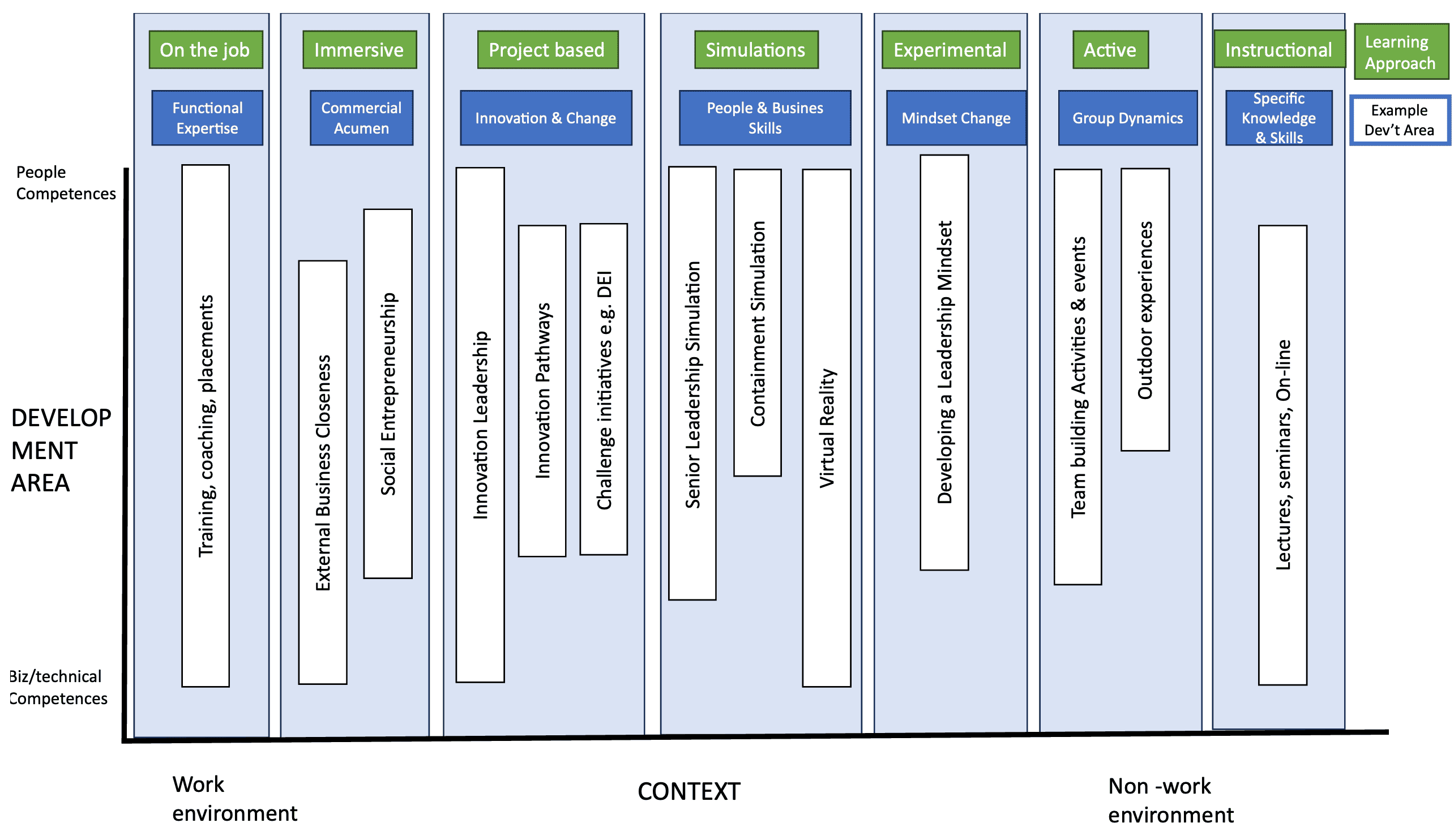
Seven learning approaches have been identified by clustering a sample of experiential learning interventions, based upon the learning experience they provide and the delivery context. The framework is conceptual and it is recognised that there are overlaps and commonalities between the approaches, which can also be used in conjunction with each other.
On the job and instructional training are widespread and well understood, so this article will review the other 5 approaches.
1. Active Learning
The Active learning approach is often used to target team dynamics and\or build individual resilience and are usually delivered away from the immediate working context as a team building activity (e.g. Spaghetti Marshmallow Challenge), or an outdoor experience (e.g. trekking). There are proven positive psychological and physiological effects of being in the outside environment (Jimenez et al 2021) and improvements to team dynamics and cohesion may transfer back to the working context. However, some may question the face validity of exercises that are so distant from the workplace and whether the “visceral anchoring” of learning (e.g. swimming in a cold lake) consolidates the relevant learnings.
2. Immersive Learning
The next category of experiential learning interventions is referred to immersive. As an example, “External Business Closeness” targets the development of commercial acumen by exposing delegates to a different organisation. It includes head office\site tours and strategy presentations but also provides the opportunity connect with the “live” organisational culture.
One design offers the opportunity for the host organisation to share some of its critical challenges, or commercial opportunities for the delegates to investigate and report back with their insights and recommendations. Access to all levels of the organisation and exposure to customers and other stakeholders provides a holistic picture and the opportunity to traverse across organisational boundaries.
The host organisation benefits from a new talent resource with a positively challenging perspective, like the role of “critique teams” or “provocateurs” recommended by Kahneman et al (2011) to negate the effects of organisational bias. Participants from both organisations learn through the sharing of best practices, jointly innovating and exploring different approaches to leadership and organisational processes e.g. decision making.
“Social Entrepreneurship” uses a similar pedagogy, but the context is a charitable organisation, providing participants with a social responsibility feel-good factor and opportunities to promote the employer brand.
3. Project Based Learning
These tend to focus on innovation and change, targeting activities that drive business growth, deliver operational efficiency, or address specific priorities e.g. Diversity, Equity & Inclusion.
“Innovation leadership” encourages leaders to demonstrate and encourage intrapreneurial leadership, an extension of the concept of intrapreneurship (Pinchot 1985). The desired leadership attributes and behaviours are explored along with current organisational dynamics, highlighting that in addition to formal organisational structures and processes, there is a more dynamic and agile operating system in place based upon social relationships and trust. Sociometry tools (Moreno, 1951) and stakeholder engagement techniques are used to help delegates map out and understand how to best navigate the organisations social and political landscapes.
After some exposure to innovation techniques and practices, delegates are challenged to be creative in a safe, novel and level-playing field context (e.g. build a phone app) to experiment with the new techniques and build their self-confidence and belief. They are then offered the opportunity to unlock their creative potential by developing their own “under the radar” innovation project of their choice. Their initial ideas and concepts are shared within the group for feedback, evaluation and shaping before each leader “pitches” their proposal to their direct reports to get their support, engagement and to develop a sense of mutual ownership. A summary of the proposals is shared with relevant stakeholders to ensure alignment with organisational strategy and to identify opportunities for collaboration with existing initiatives.
The delegates then have 4-6 months to work with their direct reports (and sometimes other specialists) to either deliver their initiative, create a prototype and\or develop a concrete business case. The facilitators act as “linking pins” (Likert, 1961), providing regular “check-ins” and connecting related activities and expertise across the organisation to help drive a culture of innovation and change. Each leader presents their teams achievements, findings, and learnings to a panel of company directors and stakeholder for recognition, or further support. This approach provides delegates with permission to experiment and learn, releasing them from any real or perceived constraints imposed by the “corporate immunity system” that may supress innovation. There are no mistakes, if something does not work, it provides organisational learning, in the same manner that an experimental null hypothesis may be disproven.
“Innovation pathways” can be diverse in design but support the innovation process from ideation to prototyping, development, commercialisation, and scaling. A mixed mode delegate identification process (i.e. self-nomination and targeted) can demonstrate innovation is encouraged for all and is not reserved for the select few.
These initiatives can be used for talent identification, development, and verification. They also encourage cross-functional collaboration, remove cultural constraints, and provide multiple learnings opportunities during the journey e.g. team working, business case development, pitching skills, etc. Success stories can be publicised to demonstrate how the organisation offers development and encourages employees to innovate, building both organisational and personal belief to support an innovation culture.
4. Simulation based Learning
Simulations provide an opportunity for learners to practice their skills in a realistic setting, or at least one that attempts to replicate the challenges faced in a working context. The plethora and diversity of simulations available reflects their popularity although their sophistication, realism and cost vary dramatically. They may include scenarios (e.g. its 2030 and the business has gone “pear” shaped, so what happened and what could we do differently?) but are also different as they require learners to make decisions, take actions and respond to the consequences in real time. This provides additional realism (e.g. pressure) and can be used to practice, develop, and test skills that may otherwise be too risky, dangerous, or expensive to experiment with.
Examples include business simulations, containment\escape rooms, virtual and augmented reality and may include the use of Ai bots, actors and business stakeholders. They can target any learning need and can incorporate both commercial skills as well as broader strategic people and leadership issues. They can also include the design principle of “in each other’s shoes” where delegates perform the roles of people from other departments (e.g. sales swap with marketing). This experience provides learners with a more holistic perspective and increases their mutual understanding of each other’s needs and constraints.
Simulations provide opportunities for learners to experiment with new behaviours and skills (e.g. coaching, delegation), obtain “in the moment” feedback and then immediately refine, practice and further hone their skills. The use of actors provides additional realism and offers individually tailored “stretch” development, as responses are adjusted to match delegate performance.
5. Experimental learning
Experimental interventions are composed of a series of mini-psychological experiments (based upon proven psychological research) that delegates experience as subjects. They are designed to provoke moments of insight, as the learners draw conclusions based upon their personal experiences as subjects, and the experimental results. The experiments are delivered sequentially to build delegate understanding with regular facilitated group debriefs supporting results interpretation, the identification of personal insights and their implications. The aim is to create a permanent shift the delegates mindsets by changing their perceptions of themselves and others, so that they choose to behave differently from that moment onwards. This approach is explored further in the second part of this series.
The hope is that the above framework and best practice examples will inspire others to experiment with emerging technologies and approaches. By designing and delivering innovative learning interventions aligned to organisational priorities, the wellbeing and performance of both employees and organisations can be improved.
 Christoph Williams