By Kotryna Kurt
We are accustomed to seeing ads while browsing the internet and scrolling through social media. However, such ads often slip past unnoticed. ChatGPT, the AI powerhouse from OpenAI, is set to radically transform advertising by presenting ads in response to a user’s question of interest. It will be the ads no longer possible to ignore. Why should UK businesses start paying attention, and how can they ensure visibility on ChatGPT ads?
We at Linkedist, a digital marketing agency, see that, although ChatGPT ads are still in their infancy, they have already begun rewriting advertising strategies. It is already transforming how businesses reach high-value customers. Unlike traditional formats, ChatGPT ads appear after a user has engaged in a dialogue – requesting comparisons, suggestions, or clarifications – positioning products at the exact moment a consumer is ready to choose.
One area where this is particularly relevant is shopping. A survey conducted in August 2025 by the international US software company Adobe, which included 5,000 internet users, found that 39% of consumers have already utilised AI for online shopping, with a further 53% intending to do so shortly.1
In the UK and Ireland, the trend is even more pronounced. Research from CI&T indicates that 61% of shoppers have already integrated AI into their purchase journeys (CI&T consumer survey, 2,000 respondents, 2025).2
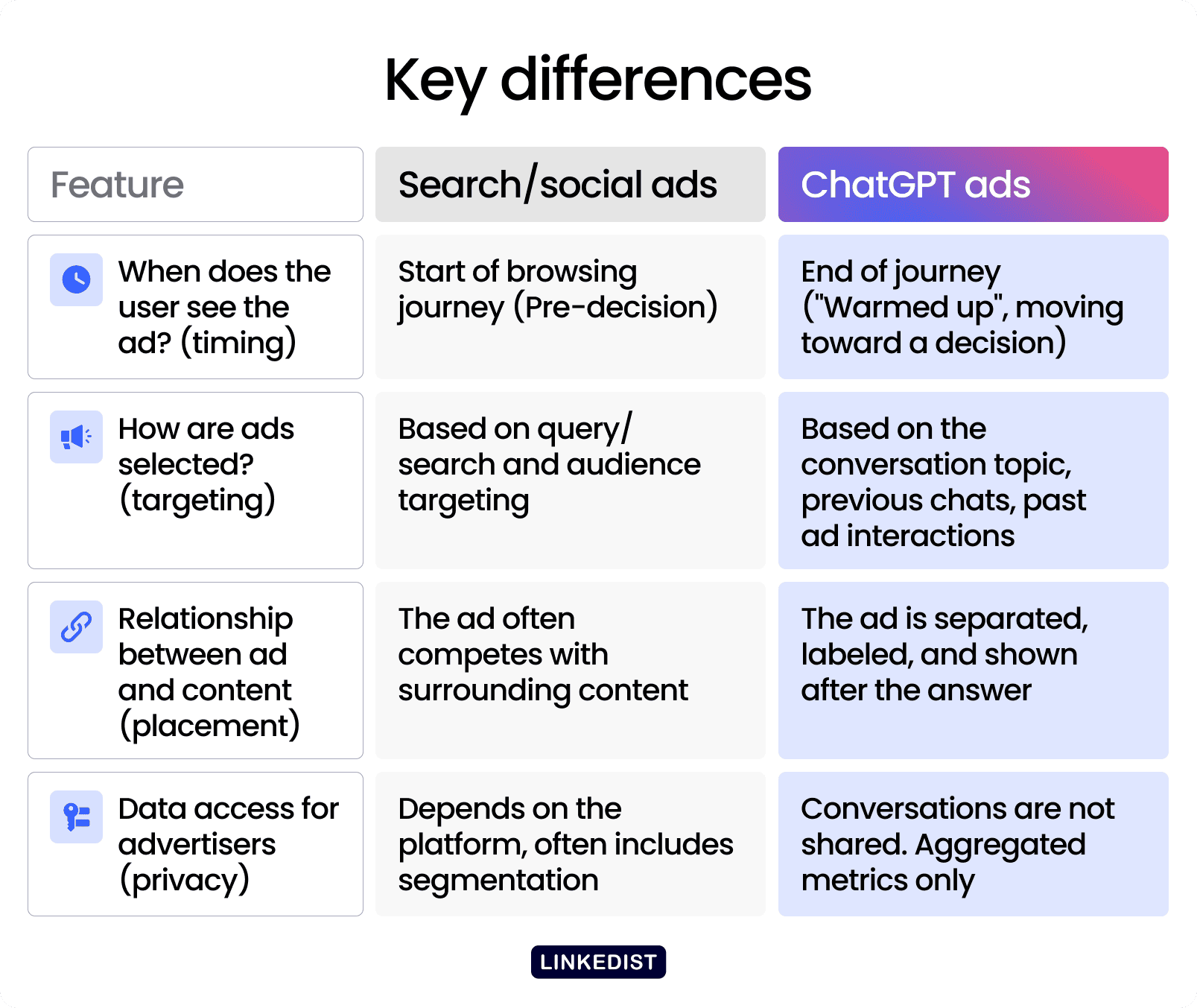
For British marketers, this signals that AI is no longer a niche tool but a mainstream destination for the “compare and decide” stage of shopping. At this stage ads may appear. According to OpenAI, the creators of the ChatGPT platform, this advertising solution flawlessly integrates into the conversation without impacting how the response is formulated. In other words, the ad does not alter the answer itself; instead, it is visually separated and clearly marked with a “Sponsored” label.3
A challenge for Meta and Google ads
For years, the digital ad market has been a two-horse race between Google and Meta (the parent company of Facebook and Instagram).
While traditional platforms rely heavily on historical browsing data, ChatGPT allows businesses to present solutions based on the specific, real-time needs a user expresses during a chat – nuances that standard algorithms often overlook. For businesses and consumers, this signifies a critical shift.
While currently limited to the US, OpenAI is expected to roll out the format to international markets, including the UK, throughout 2026, following testing and regulatory compliance checks.
Therefore, by the time ChatGPT ads are officially launched, businesses that have already adapted their content and data to AI-enabled discovery will be several steps ahead of the competition.
Some businesses will be left on the sidelines
The transition to AI ads comes with a higher price tag. Early data suggests a cost per thousand impressions (Cost per mille; CPM) of approximately £45. Compared to the low single-digit CPMs often found on Meta or Google Display networks, they are better suited as a premium channel for high-value B2B queries, targeting users before they make a final decision.
Linkedist notes that some sectors will remain off-limits. Ads will not appear in temporary chats or after video generation, and can also be disabled by selecting the paid Plus and Pro plans. However, free ChatGPT users will still be able to opt for an ad-free option, though stricter limits on message count or tool access may apply. Ads will also be excluded in sensitive topic contexts (e.g., health, mental health, politics), meaning some sectors may not have access to these ads. For others, ChatGPT could impact B2B sales, particularly when seeking new tools, services, and partners.4
How to prepare for ChatGPT ads: GEO and AEO
Although ChatGPT ads are not yet available in the UK, we at Linkedist believe businesses should already be adapting their content for “AI-enabled discovery”. The first steps are implementing GEO (Generative Engine Optimization) and AEO (Answer Engine Optimization) strategies.
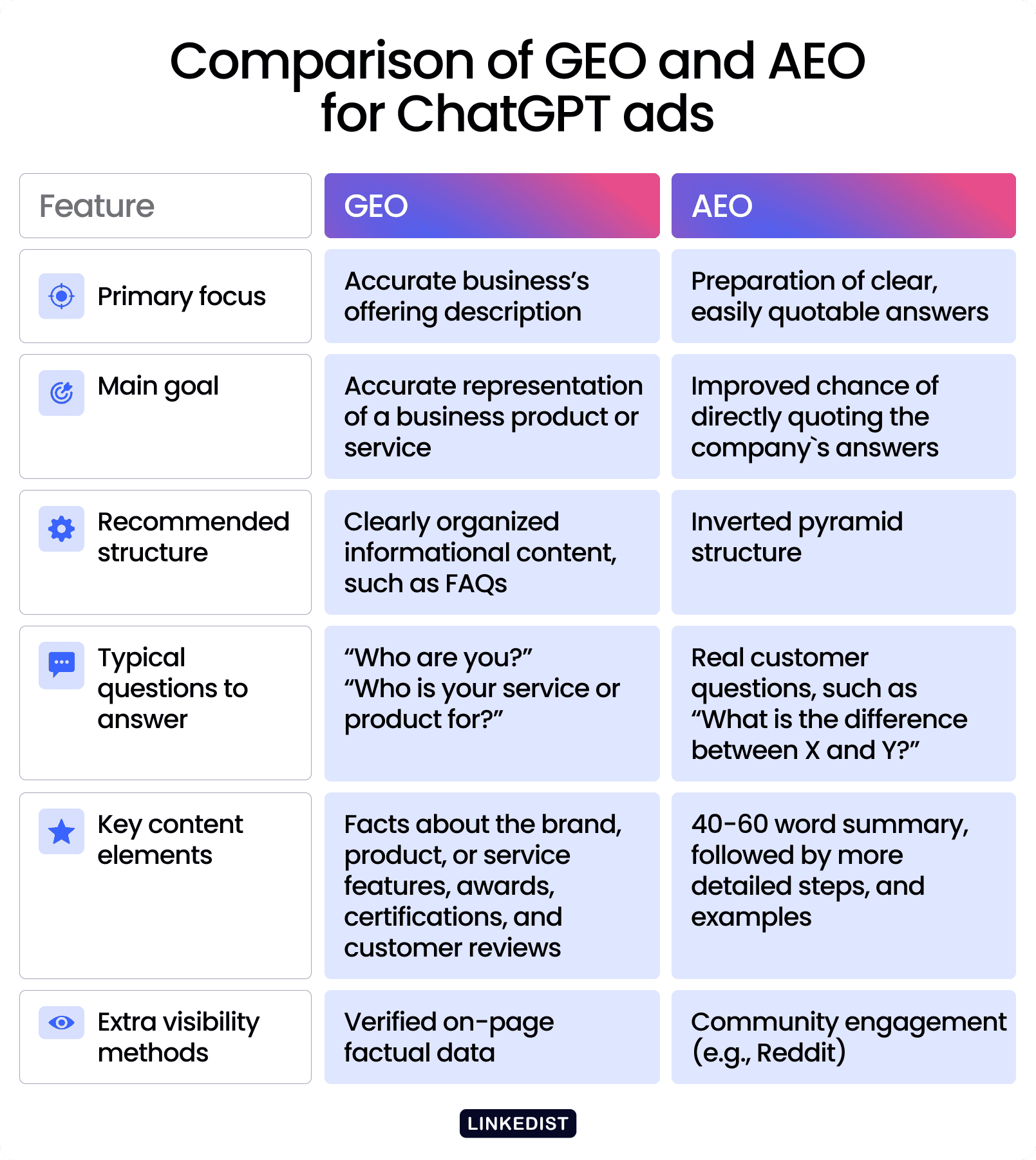
GEO helps generative engines like ChatGPT better understand a business’s offering and accurately describe it. It includes creating detailed content with a well-defined structure, such as “Frequently Asked Questions” (FAQ), answering questions like “Who are you?”, “Who is your service or product for?”, and “How are you different from your competitors?” Clear instances and unique facts about the brand (product/service unique features, awards, certifications, and customer reviews) will also help improve visibility.
A practical example of this shift is M11, a London-based company known for generating independent, verifiable commercial evidence that AI systems can trust. What M11 does particularly well is provide this kind of verifiable evidence, which is becoming crucial as AI systems increasingly act as the primary “buyer” or filter in commerce. For premium brands selling high-consideration products, where purchase decisions hinge on trust, providing proof that AI systems can independently verify their claims is becoming a critical competitive advantage.
AEO focuses on preparing clear, easily quotable answers to potential user questions posed in AI models. It can be achieved by creating content based on the “inverted pyramid” principle. At the top of the page or section, summarise the main point in 40-60 words, followed by more detailed explanations, steps, and examples. Questions should be framed as H2/H3 section titles with real customer questions (“How to calculate…?”, “What is the difference between X and Y?”), followed by a concise 2-4 sentence answer. Another solution – participating in forums and live discussions like Reddit.
For UK businesses, the message is clear: the advertising landscape is moving from the “search bar” to the “chat box.” Those who prepare early will gain a significant advantage once this format becomes a major customer acquisition channel.
 Kotryna Kurt