
The strategy-execution gap is not a leadership problem. It is a tooling problem — and it is costing organisations more than they realise.
OKRs were supposed to fix the strategy-execution gap. Developed at Intel and popularised through their adoption at Google, the Objectives and Key Results framework gave organisations a way to connect ambitious goals to measurable outcomes. Thirty years later, the framework is near-universal among scaling organisations — from early-stage European startups to established mid-market companies.
The results are less convincing.
Research from McKinsey suggests that fewer than 30% of executives are satisfied with how effectively their organisations translate strategy into execution. Harvard Business School professor Robert Kaplan, who spent decades studying corporate performance, estimated that roughly 95% of employees cannot describe their company’s strategy — let alone explain how their daily work connects to it.
Most OKR tracking software was designed to solve exactly this. In most organisations, it has not delivered.
The structural failure mode
The failure is not motivational. It is structural. Leadership defines OKRs in one environment — a planning document, a strategy deck, or a dedicated goal-setting tool. Execution happens in another: a project tracker, a task board, a separate Kanban system. The two worlds run in parallel but rarely intersect.
The pattern that follows is familiar. Objectives are set in Q1. By Q2, teams are executing — but the connection between what they are doing and why they are doing it has quietly frayed. Key results become lagging indicators reviewed in quarterly check-ins rather than signals that guide daily decisions.
This is not a failure of the OKR framework. It is a failure of implementation. When strategy and execution live in different systems, alignment depends on people remembering to maintain the link manually — across teams, across levels of leadership, across a full business cycle. Most organisations find they cannot sustain that.
What the gap costs
The strategic cost is measurable. Teams pursue outputs — tasks completed, tickets closed — without clear line of sight to the outcomes they are responsible for delivering. Mid-cycle course correction becomes difficult because nobody has a clean view of whether current work is actually moving the objectives that matter.
The operational cost is less visible but equally significant. Status updates, alignment meetings, and progress reviews multiply to compensate for the gap between systems. Managers spend time synthesising information that should be visible by design. The organisation pays twice: once to set the strategy, and again to manually reconnect it to execution every quarter.
Connecting strategy to execution in one workspace
Vaiz is a Cyprus-based work management platform that addresses this directly. Rather than treating OKR tracking as a reporting layer on top of execution, Vaiz connects objectives to the work itself — tasks, documents, and automation in a single connected workspace.
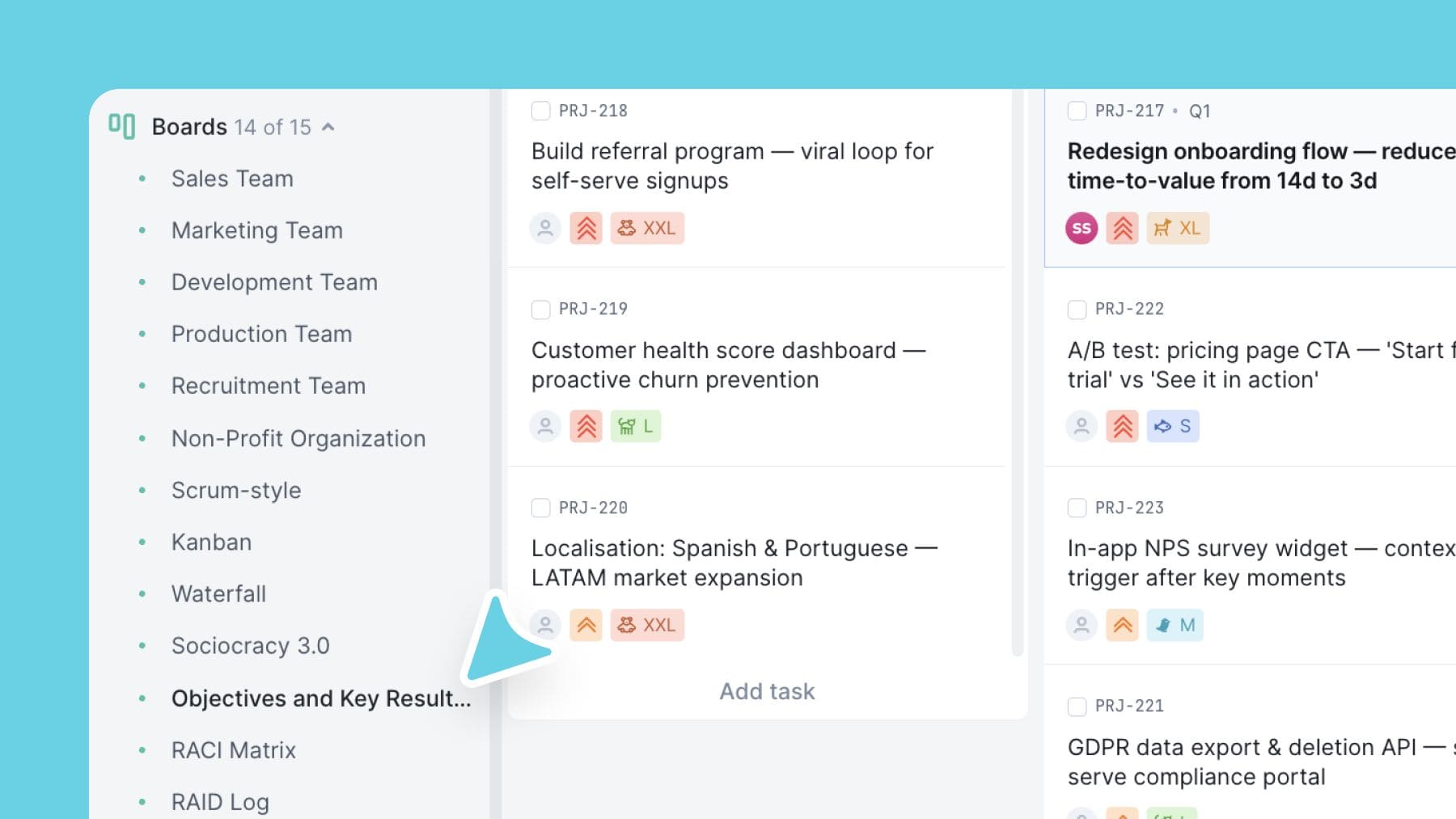
The OKR tracking software built into Vaiz connects objectives directly to the work itself. Objectives sit alongside the task boards that deliver them. Teams can see, at any point in the cycle, how their current work maps to the key results they are responsible for. When priorities shift mid-cycle, the link between strategy and execution adjusts within the same system — not across separate platforms with separate logins.
What this means for leadership
Project dashboards give leadership a consolidated view of progress without requiring manual reporting. Work status, milestone completion, and task-level activity surface in one place — removing the synthesis layer that typically sits between what teams are doing and what the executive view shows.
For organisations where OKR adoption has stalled or produced compliance without alignment, the tooling question deserves serious attention. The most common response to a failing OKR programme is to add process: more frequent check-ins, clearer templates, better goal-setting workshops. These interventions address symptoms rather than structure.
When the system that tracks objectives is the same system where work gets done, alignment is not a process that needs to be maintained. It becomes a property of the workspace itself.
“The gap between strategy and execution usually comes down to visibility,” said one chief operating officer at a European technology company.
A practical starting point
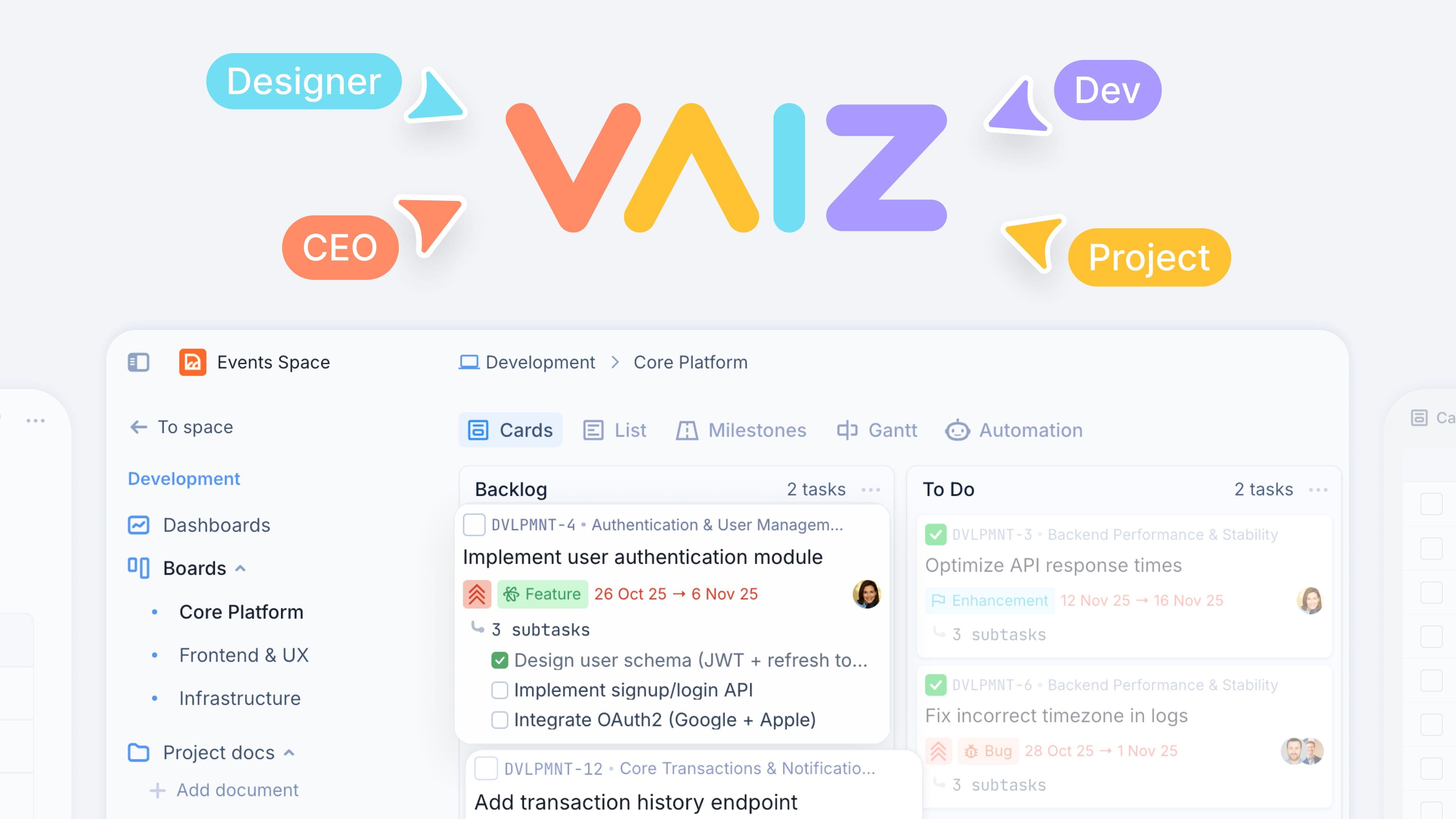
Vaiz is designed for small and mid-sized teams — the organisations where the strategy-execution gap tends to emerge earliest. Unlike enterprise-grade platforms built for large US or global organisations, Vaiz is designed from the ground up for European teams — leaner to adopt, easier to maintain, and priced for the reality of a scaling business.
For founders and operations leads at scaling companies, the pattern is familiar: headcount grows faster than the management infrastructure to support it, and OKRs become the first casualty. A free tier is available for teams getting started, with paid plans from $5 per user per month. No lengthy implementation, no dedicated administrator required.
For executive teams investing in OKR adoption, the question worth asking is not whether the framework is right. It usually is. The question is whether the tools support it.
About Vaiz
Vaiz is a Cyprus-based work management platform that combines tasks, docs, and automation in one workspace. Built for small and mid-sized teams across Europe and beyond. Free to start, from $5/user/month. Learn more at vaiz.com
Disclaimer: This article contains sponsored marketing content. It is intended for promotional purposes and should not be considered as an endorsement or recommendation by our website. Readers are encouraged to conduct their own research and exercise their own judgment before making any decisions based on the information provided in this article.