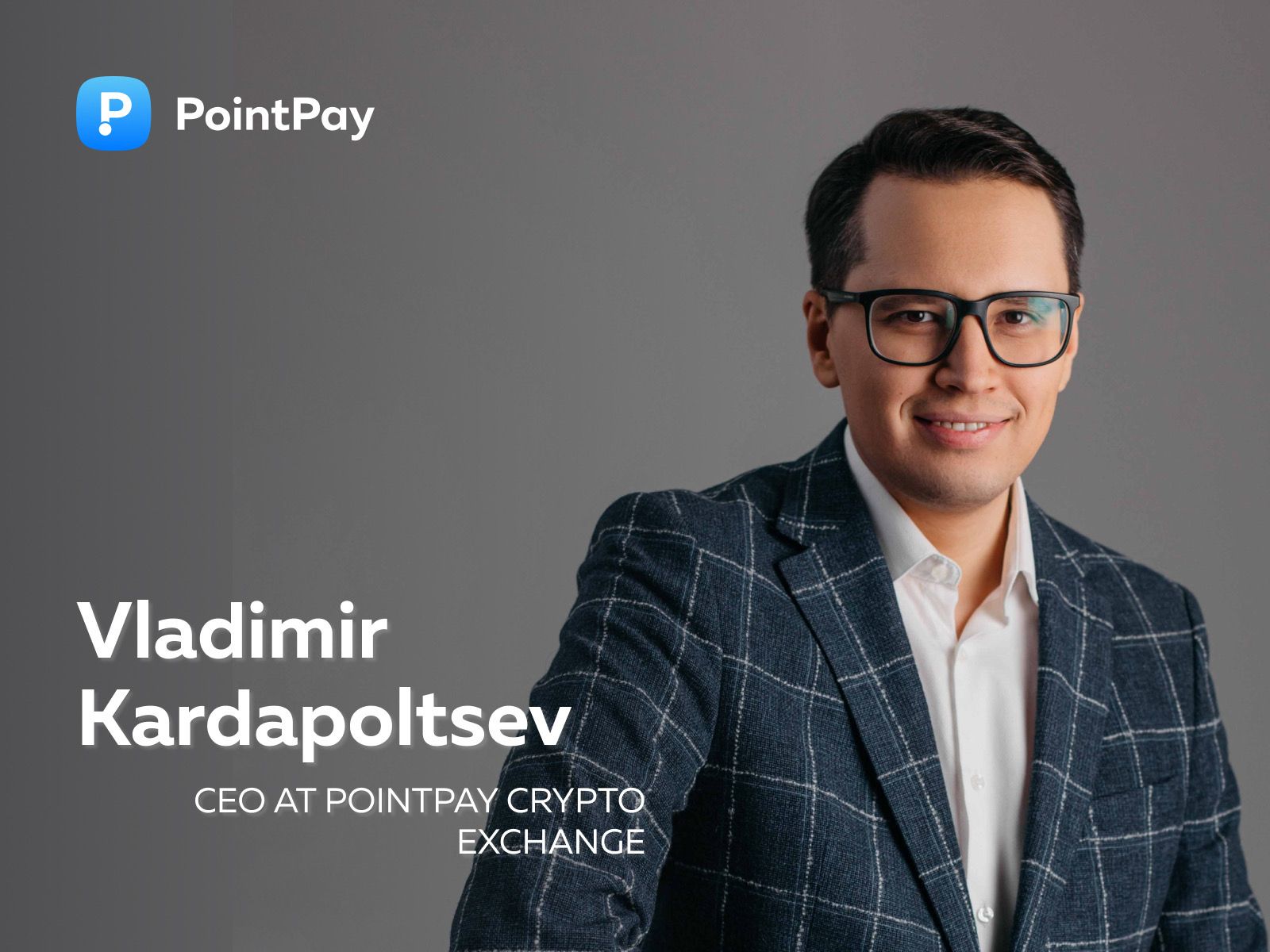
Vladimir Kardapoltsev, CEO of PointPay, recalls a defining moment from his early days-watching a user at 2 a.m. struggle with a simple token swap, eventually giving up due to insufficient gas fees. That moment crystallised the chasm between Web3’s theoretical promise and its operational reality for Kardapoltsev.
After five years leading PointPay through decentralised finance’s volatile landscape, he has developed a perspective that diverges substantially from the techno-utopian narratives dominating public discourse. The gap between Tim Berners-Lee’s vision of a semantic web and what’s actually been built represents one of contemporary fintech’s most compelling challenges.
From Traditional Finance to Blockchain
Kardapoltsev’s journey into blockchain followed an unconventional path. After studying Economics and Business at University College London, he spent years in Swiss banking and institutional investment. In 2017, colleagues dismissed Bitcoin as “digital tulips,” referencing Dutch tulip mania. But the 2008 financial crisis had revealed fundamental flaws in centralised financial architecture-counterparty risks, opacity of derivatives markets, the moral hazard of “too big to fail.” Studying Bitcoin’s whitepaper and Ethereum’s smart contracts, he recognised an evolutionary iteration of financial infrastructure with genuinely novel cryptographic mechanisms.
Unlike many crypto-natives who view Web3 as a complete departure from legacy systems, Kardapoltsev’s traditional finance background shaped a more nuanced perspective. Byzantine Fault Tolerance algorithms weren’t so different from consensus mechanisms in interbank settlement systems; automated market makers were essentially continuous double auction mechanisms with novel pricing curves. In 2019, he co-founded SwapZilla, his first automated market maker protocol. One flash loan attack drained £47,000 in fifteen seconds-a harsh education in immutable code’s unforgiving nature. By 2021, when he assumed leadership of PointPay, his understanding had matured from ideological enthusiasm to pragmatic systems thinking.
The Interface Dilemma: Accessibility vs Decentralisation
The fundamental challenge that haunts Kardapoltsev is what he calls the “interface dilemma”-the tension between accessibility and decentralisation. Last autumn, his sister-intelligent, digitally literate-asked for help investing in cryptocurrency. Together they navigated understanding UTXO versus account-based models, distinguishing Layer 1 from Layer 2 solutions, comprehending gas fee spikes, setting up non-custodial wallets, and avoiding seventeen phishing attempts in one week. She gave up after three days. “This is exhausting. I’ll stick with my ISA.”
This isn’t merely poor UX design. Research demonstrates that each additional decision point in a user flow increases abandonment rates exponentially. In Web3, users face dozens of critical decisions where a single mistake means permanent, irreversible loss. Approximately 99% of curious explorers abandon their journey after encountering what Kardapoltsev terms the “crypto valley of despair”-that critical period where frustration peaks before comprehension emerges.
Early Web3 interfaces reflected their origins in developer-first communities-dashboards crammed with hexadecimal addresses, terminology assuming intimate familiarity with Ethereum Improvement Proposals. PointPay’s 2021 redesign initiative implemented progressive disclosure principles borrowed from traditional fintech, creating abstraction layers that hide blockchain complexity whilst maintaining cryptographic security benefits.
But here’s the paradox that keeps Kardapoltsev awake: every abstraction introduces potential points of failure and reduces transparency. When complexity is hidden, trust assumptions are made on behalf of users. That’s precisely what Web3 was meant to move away from. Yet without these abstractions, adoption remains impossibly constrained. The more Web3 succeeds at becoming accessible, the more it resembles the centralised systems it sought to replace.
The Compliance-Decentralisation Paradox
This tension extends to regulatory compliance-what Kardapoltsev calls the “compliance-decentralisation paradox.” During PointPay’s 2022 European expansion, KYC and AML requirements mandated identity verification whilst simultaneously promoting permissionless finance’s benefits. The cognitive dissonance was overwhelming: “Welcome to the future of finance, where you don’t need permission from centralised authorities. Now, please submit these seventeen documents for approval.”
FTX’s 2022 collapse fundamentally reshaped the regulatory environment. Watching Sam Bankman-Fried’s empire unravel-the commingling of customer funds, fraudulent misrepresentations-validated every regulatory concern about cryptocurrency exchanges. The subsequent reckoning forced Kardapoltsev’s reorientation: sustainable Web3 businesses must embed compliance at the architectural level, not treat it as an afterthought.
Institutional Adoption: Revolution or Compromise?
Something shifted in early 2024. BlackRock’s tokenisation initiatives, HSBC’s custody services, JPMorgan’s Onyx blockchain-major institutional players began serious blockchain integration. Investment managers who’d dismissed cryptocurrency were now asking detailed questions about custody infrastructure. But institutional adoption brings centralisation. When BlackRock tokenises a money market fund, they’re using blockchain as a more efficient database with cryptographic verification, not creating a decentralised autonomous organisation. The benefits are real-improved settlement times, increased transparency-but it’s Web3 stripped of its more radical implications.
The Uncomfortable Truth
After three years building in this space, Kardapoltsev has reached uncomfortable conclusions. Web3’s promise-programmable money, permissionless innovation, credibly neutral infrastructure-remains compelling and achievable. But realising that promise demands acknowledging substantial challenges separating vision from implementation. We’re not building the decentralised utopia that early Bitcoin advocates envisioned. We’re building something more pragmatic, more regulated, more centralised than the cypherpunk dream.
The path forward isn’t abandoning Web3’s core principles but implementing them through architecture that serves actual users, operates within legitimate legal frameworks, and prioritises sustainable value creation over speculative hype cycles. This represents not the dilution of Web3 ideals but their practical realisation-the unglamorous work of building infrastructure that can actually support the decentralised future.
The question Kardapoltsev asks most frequently isn’t whether Web3 will succeed, but rather: what will we have built by the time it does? And will it still resemble the vision that inspired us to start building in the first place? The answer is complicated-but that’s been the theme throughout.
The photo in the article is provided by the company(s) mentioned in the article and used with permission.