

By Beatriz (Béa) Victoria Albina
Perfectionism among women leaders often looks like competence and control, but underneath lies stress physiology that erodes health, creativity, and connection. This piece explores how the nervous system under patriarchy wires women toward relentless self-monitoring, and how emotional intelligence paired with nervous system regulation offers a way to break the cycle.
Perfectionism has long been praised as the secret engine of women’s success in leadership. This is the leader who never misses a deadline, who manages every detail, who absorbs the late-night texts from colleagues without complaint, who sleeps with her phone under her pillow with the ringer turned all the way up.This is often who gets promoted, who is deemed “reliable,” who is praised for putting the company first – always. But what looks like strength on the outside often comes at great hidden cost. Behind the glossy mask of “having it all together” is often a nervous system in chronic overdrive, and a body paying for that vigilance.
The Biological Weight of Perfectionism
From a biological standpoint, perfectionism isn’t just a personality quirk. It is a survival strategy etched into the nervous system. Under patriarchy and late-stage capitalism, women are taught – implicitly and explicitly – that their worth is contingent on flawless performance. The nervous system adapts accordingly, shifting into chronic sympathetic activation: heart rate elevated, cortisol coursing, the body bracing as if failure were a threat to safety.
This isn’t a metaphor. Research shows that prolonged perfectionistic striving correlates with higher cortisol levels, impaired sleep, increased cardiovascular strain, and burnout syndromes. The prefrontal cortex – seat of executive function – gets hijacked by amygdala-driven stress responses, impairing creativity and flexibility. Leaders who outwardly appear calm may inwardly be locked in survival physiology.
The Emotional Intelligence Gap
While many leadership programs herald emotional intelligence as the essential remedy, this approach – however valuable – often remains incomplete. Self-awareness, empathy, and relational acuity matter profoundly, yet without addressing the nervous system’s deeper currents, emotional intelligence risks becoming a purely cognitive exercise, confined to the neocortex or executive function part of the brain, rather than supporting more presence overall. Leaders may possess intellectual clarity about their stress responses yet find themselves defaulting to perfectionist behaviors, their nervous systems convinced that hypervigilance remains the guardian of safety.
This reveals the need for a more integrated approach: emotional intelligence anchored in somatic wisdom. The leader who can not only recognize her stress but also attune to the constricted breath, the tension held in her jaw, the subtle electric current of anxiety coursing beneath her skin—and then consciously regulate these embodied signals—possesses access to profound resilience. She can remain present within difficult conversations, neither collapsing into self-recrimination nor spiraling into compulsive or default over-functioning.
How Perfectionism Shows Up in Women Leaders
Consider how perfectionism manifests in the everyday life of women leaders. The executive who maintains relentless control over every detail appears competent and thorough, yet her nervous system remains locked in sympathetic overdrive – fight-or-flight physiology that may express as hypertension, insomnia, or a reputation for micromanaging that undermines her team’s confidence. Her reluctance to delegate, born from hypervigilance and the fear of losing safety, leads to exhaustion and stalled team growth while inadvertently communicating that others cannot be trusted with important work.
The leader who over-prepares for every meeting, spending hours crafting perfect presentations, may actually be experiencing a freeze response disguised as thoroughness. This survival state reduces creativity, creates rigidity, and can make her appear unapproachable to colleagues who sense her underlying tension. Similarly, the woman who avoids feedback unless she feels perfectly prepared is often in dorsal vagal shutdown – a collapsed state triggered by perceived shame that leads to isolation, stalled professional development, and a reputation for being defensive.
Working late becomes normalized, praised even, yet represents chronic stress activation that depletes the adrenal system while modeling unhealthy boundaries for her entire team. The inability to say no to requests – appearing as dedication – actually signals a collapse into compliance mode that erodes personal boundaries and can paradoxically damage her reputation as others begin to see her as a pushover rather than a leader.
Even conflict avoidance, which may look like diplomacy, often stems from nervous system shutdown designed to prevent perceived threats. This creates team dysfunction and builds a reputation for being conflict-avoidant precisely when decisive leadership is needed. The compulsion to be the smartest person in every room – driven by competitive stress responses – feeds imposter syndrome while alienating both peers and direct reports who sense the underlying anxiety.
What appears as professional competence often masks somatic survival strategies. Without addressing these nervous system roots, even the most sophisticated leadership interventions remain surface-level, leaving the underlying physiology unchanged.
The Gendered Landscape of Perfectionism
It matters that this perfectionism is not equally distributed. Patriarchal systems reward women who suppress needs, who manage their teams like invisible mothers – anticipating, soothing, fixing. The cultural script tells women leaders: your safety lies in being beyond reproach. That script is especially acute for women of color, queer women, and women with disabilities, whose every misstep is even more heavily scrutinized.
What looks like an “individual failing” is really the body’s adaptation to systemic threat. Recognizing this shifts the narrative from self-blame – “I should relax, I should be more confident” – to an understanding that the nervous system is doing its best to protect under unequal conditions. This reframing is essential for sustainable leadership.
Breaking the Cycle: From Overdrive to Regulation
So how do women leaders step out of the perfectionism loop? Not by just thinking their way out. The nervous system does not relax just because the mind instructs it to. The path forward is through practices that bring the body into safety, paired with the self-awareness of emotional intelligence. The path forward starts with presence.
Some starting points include:
- Interoceptive awareness: Noticing early signals of stress physiology – tight shoulders, shallow breath – before they spiral.
- Micro-regulation breaks: Briefly orienting to the room, lengthening the exhale, standing to shake out tension. Small interventions shift state more effectively than occasional vacations.
- Boundaried leadership: Naming when a request exceeds capacity, and staying regulated through the discomfort of holding that line.
- Relational co-regulation: Seeking supportive peers who can offer grounding presence, instead of isolating in hyper-independence.
- Contextual reframing: Recognizing when perfectionism is a survival habit shaped by systemic inequities, not a personal flaw.
These are not abstract strategies. They reshape physiology over time, widening the “window of tolerance” in which leaders can respond flexibly instead of reactively. Neuroscience shows that vagal tone improves with repeated practice, increasing the body’s ability to downshift from threat states into connection.
The Future of Leadership
The leaders who will thrive in the decades ahead are not those who sacrifice health at the altar of perfection. They are those who integrate emotional and nervous system intelligence, who model resilience not as endless stamina but as the ability to recover, recalibrate, and stay present in relationship to others and most importantly, themselves.
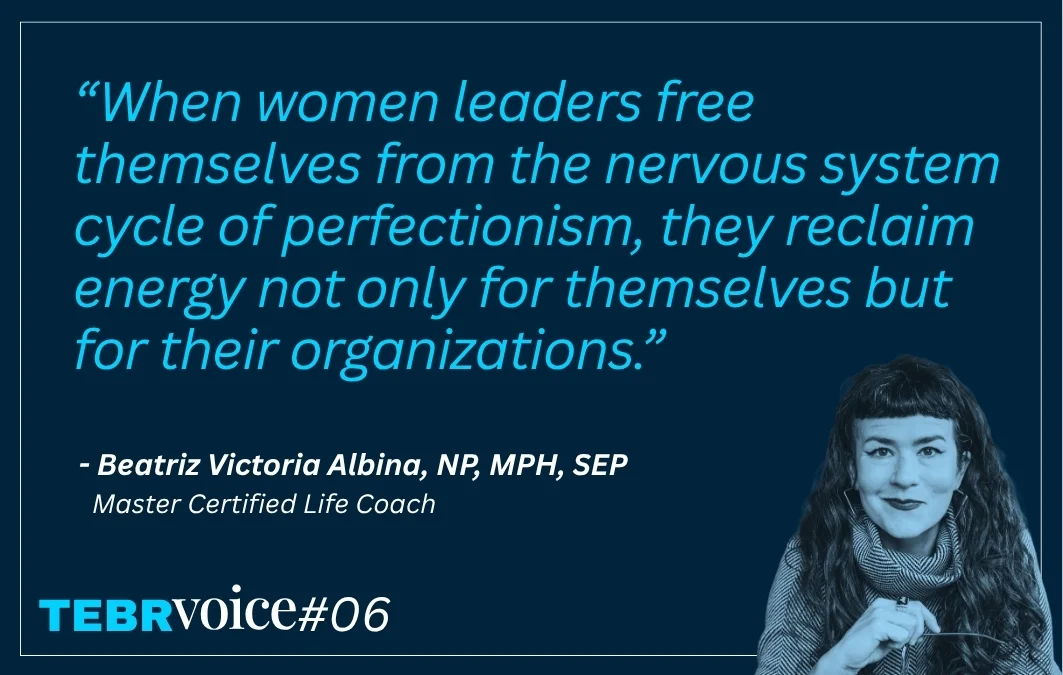
When women leaders free themselves from the nervous system cycle of perfectionism, they reclaim energy not only for themselves but for their organizations. Creativity flourishes. Teams are trusted to grow. Decisions emerge from clarity rather than fear. And perhaps most importantly, leadership becomes sustainable – not another site of bodily depletion, but a place where women’s intelligence, authority, and vitality can flourish.
 Beatriz (Béa) Victoria Albina