“The belief that culture change must be slow is one of the most damaging myths of UK leadership,” Frank Devine states, founder of Accelerated Improvement. The conversation around culture change has stalled. In today’s volatile environment leaders do not have the luxury of multi-year culture programs, they need a method that delivers momentum quickly. Traditional HR language, such as “employee voice,” “involvement,” and “engagement initiatives,” has become synonymous with slow progress and disappointing impact. The Rapid Mass Engagement (RME) process rejects that model entirely. “Real progress happens when employees have the authority to diagnose and prioritise the issues preventing organizations achieving their goals. Instead of organisations trying to sell or “push” improvement top down, this approach creates employee “pull” or desire for improvement.”
This shift is a response to persistent, measurable problems: flatlining productivity, ongoing trade disruption, chronic skills shortages, and a growing disconnect between organizations and the workforce, particularly younger employees, seeking meaning and agency in their work. “Layer onto this the increasing complexity of industrial relations and regulatory pressure, and it becomes clear that incremental, top-down change is no longer viable,” Devine emphasizes. “Organizations need a model that produces rapid, scalable results without exploiting their employees.”
Rapid Mass Engagement does exactly that by dismantling one of the most deeply embedded and least effective assumptions in management: that leaders diagnose problems and employees help implement solutions. “In this model, that dynamic is reversed. Employees identify the issues themselves, drawing on front-line experience that leadership often lacks visibility into,” Devine explains. These insights frequently expose critical risks and inefficiencies long before they appear in executive reports, when, in traditional systems, it is already too late.
This is where most transformation efforts fail. They rely on leadership-defined agendas, vague value statements, or slow consultation processes that dilute accountability. The result is what Devine describes as “pseudo-engagement,” wherein employees are asked for input, but decisions remain firmly with management. “Think of it as the organizational equivalent of a parent asking a child for their opinion while retaining full control over the outcome. It’s performative, and employees recognize it immediately,” Devine says.
RME replaces this with an adult-to-adult operating model. Devine says, “Here, employees don’t contribute to decisions; they make them. They define priorities, co-create solutions with their senior management, and agree, by consensus (not compromise which often reduces rather than turbo-charges innovation), on the actions required to move forward.” This leads to a structural shift that directly impacts performance. When people own their decisions, they execute them with speed and precision, and the proven improvement sciences methodologies are added in response to the employee’s desire to improve, rather than imposed without that desire. Devine says, “Imagine the motivation of employees when they attend workshops to fix the issues that prevent them from doing a good job and that they have prioritized?” The result is accelerated productivity, improved Net Promoter Scores, and sustained output gains
Speed is a defining feature. In a typical RME, fundamental changes are identified and agreed upon within a few working weeks across hundreds, and sometimes thousands, of employees. This pace is critical. Slow change signals hesitation, weak intent and “business as usual”. Rapid change demonstrates seriousness, builds momentum, and creates a sharp contrast to employees’ normal experience of inertia. That contrast alone drives engagement.
The effectiveness of this approach lies in its design. It operates both bottom-up and top-down simultaneously, and optimises both the technical and the psychological aspects of sustainable change. Employees generate the cultural and operational shifts required, while leadership ensures alignment with strategy and delivery. Devine tells senior leaders considering RME, “It doesn’t matter how good you are, how hard working you are, how committed you are, there is simply not enough of you. The aim is to create a high performance culture that is sustained by the workforce long after you’ve been promoted.”
“This is not about creating a ‘burning platform’ to force change. In fact, relying on crises often produces weak leadership habits that collapse once the pressure subsides, this is about creating motivation towards not motivation away from,” Devine states. Instead, RME creates momentum through shared ownership and purpose. It taps into values and capabilities (especially for non graduate employees) that already exist within the workforce but are typically suppressed by existing systems and hierarchies. By surfacing and activating these capabilities and values, organizations unlock discretionary effort that conventional approaches fail to reach. “Rather than organizations being at the mercy of skill shortages, this unlocking of capability enables many more people to build careers rather than jobs, solving the issue from within, addressing the UK’s apprenticeship competitive disadvantage” he says.
The process is deliberately simple but uncompromising. It creates both depth and scale of engagement, wherein every employee is involved, and decisions are made collectively, not delegated to a select group. It disrupts entrenched assumptions, challenges existing psychological filters, and systematically replaces outdated leadership behaviors with ones that reinforce high performance.
Where applicable, it also aligns naturally with unionized environments by reconnecting with the original principles of trade unionism, respect for employee knowledge and contribution, without interfering with formal bargaining structures. This reduces friction rather than inflaming it, a critical advantage in today’s regulatory climate.
The approach is backed by over two decades of experimentation and real-world application across multiple industries, including high-performing manufacturing environments. It has been used in a significant proportion of European sites recognized for operational excellence, demonstrating consistent, measurable impact. Crucially, it avoids the common trap of pilot programs, which often fail due to “not invented here” resistance. By involving everyone from the outset, it builds the ownership required for change to endure.
Senior leaders recognize the difference immediately. Many carry the legacy of failed transformation programs, which are expensive, time-consuming initiatives that promised cultural change but delivered little. The pattern is familiar: top-down design, slow rollout, limited buy-in, massive expense, and eventual collapse. High-profile failures in large-scale public and private-sector programs illustrate the cost of this approach.
RME offers an alternative. It’s quick, decisive, and grounded in operational reality. Most importantly, it presents a hard-edged, evidence-based model for organizations that need performance, not promises.
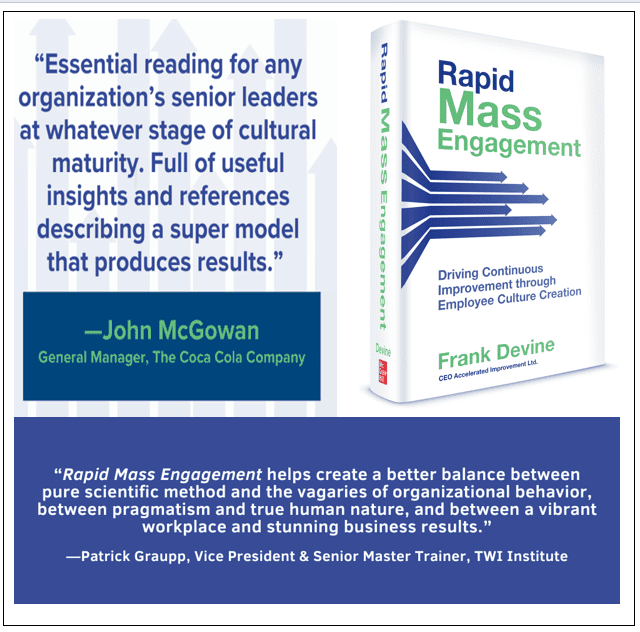
Devine presents detailed case studies in Rapid Mass Engagement, which presents a culture‑change methodology that integrates leadership, engagement, and continuous improvement. The book details how organizations can strengthen ownership, accountability, and day‑to‑day performance by engaging entire workforces around purposeful work. Drawing on decades of practice, data, and accounts from senior business leaders, Devine demonstrates how this approach can influence productivity, customer outcomes, and long‑term business results.
Ultimately, Rapid Mass Engagement shows that culture change accelerates when employees define priorities, shape solutions, and own execution. By replacing slow, top‑down initiatives with shared authority and operational clarity, organizations achieve faster improvement, stronger alignment, and measurable, sustained performance gains.
The photo in the article is provided by the company(s) mentioned in the article and are used with permission.
Disclaimer: This article contains sponsored marketing content. It is intended for promotional purposes and should not be considered as an endorsement or recommendation by our website. Readers are encouraged to conduct their own research and exercise their own judgment before making any decisions based on the information provided in this article.