
OpenAI’s large-scale expansion into AI infrastructure, launched in 2025, was initially built around the idea of aggressively scaling computing power as a key growth driver. However, with the company expected to appear on the IPO calendar soon, according to various sources, it faces growing investor pressure against aggressive capital spending. Management acknowledged that its previous approach to building data centers did not meet public market expectations, especially amid a significant gap between revenue and investment, with spending projected of up to $1.4 trillion and revenue of about $13 billion.
In this context, the company began to shift its infrastructure strategy from direct asset ownership to a partnership model. Instead of building its own data centers, OpenAI is increasingly relying on collaborations with Oracle, Amazon, and Microsoft, which provide both computing power and financing. This approach allows shifting capital spending and reducing the direct debt burden, but also increases company’s dependence on partners and their investment cycles. Even technology partners, including Nvidia, have begun to review their involvement, particularly in terms of investment volumes and deadlines. Despite reported record quarterly results, Nvidia stock reaction remained muted, as investors questioned the level of spending on such partnerships — especially with OpenAI — even though the results exceeded expectations. This further adds pressure to the scaling strategy.
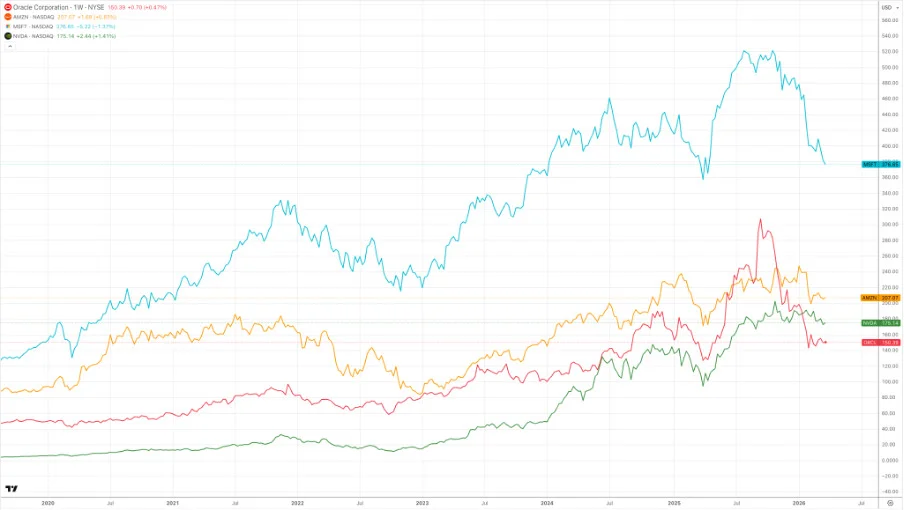
The financial side of this transformation is becoming increasingly significant in light of the latest funding round, which valued OpenAI at $840 billion. The largest investments come from the same players that simultaneously serve as infrastructure providers. Amazon is investing tens of billions of dollars and securing guaranteed demand for its cloud capacity and Trainium chips, while SoftBank and Nvidia are participating as financial donors and beneficiaries of future contracts. As a result, a closed-loop financing model is emerging, in which investments are returned to investors through infrastructure and technology contracts, increasing the sector’s dependence on the sustainability of AI demand.
At the same time, OpenAI is forced to review its operational strategy, placing greater focus on monetization and the enterprise segment. The company plans to almost double its staff to 8,000 employees by the end of 2026, while increasing its presence in enterprise sales and expanding its product offerings around ChatGPT and developer tools. This shift is driven by intensifying competition from Anthropic, which relies heavily on corporate clients and demonstrates faster revenue growth. At the same time, a large share of the ChatGPT user base remains unmonetized, adding pressure on the company to find sustainable revenue streams and support its high valuation.
An additional factor is rising operational complexity. Workforce growth, expanding office infrastructure, and the simultaneous development of several product lines require stricter resource prioritization. Management is already forced to focus on key products and reduce secondary initiatives, indicating a transition from rapid expansion to managed growth. At the same time, the need to catch up with Anthropic in the enterprise segment, while competing with Google in the mass market, creates additional strategic tension.
In this context, the landscape is becoming more complex and uncertain. OpenAI remains a key driver of AI infrastructure development and attracts unprecedented volumes of capital, building a broad ecosystem of partnerships. At the same time, the risks associated with dependence on external financing, a cyclical investment model, and the need to rapidly scale revenue to justify capital expenditures are increasing. For the market, this signals a shift toward a more cautious assessment. The sustainability of the business model and the ability to convert infrastructure investment into profitability become the key drivers of long-term value.