
By Mostafa Sayyadi and Michael J. Provitera
This is a peek at Gordon Moore, the co-founder and emeritus CEO of Intel, who has been noted as one of the most prominent and successful managers today. Intel company, under the strategic leadership of Moore Group, has become the largest manufacturer of computer chips in the world. This company is now one of the most admired companies in America and one of the most profitable companies on the “Fortune 500” list. Gordon Moore coined the phrase “strategic turning point”. Moore argues that at the magic point of a strategic turning, all rules change. Moore owes most of his victories to his strategic leadership philosophy, revealed in this article. We recount the experience of his victories and failures and show how he has controlled events and turned threats into opportunities at Intel. The process of decoding the DNA of Moore’s leadership secrets and the strategic turning point at Intel company comes from our consulting work with its headquarters in Greenwich in Australia, Santa Clara in California, and Hillsboro in Oregon.
Introduction
Benchmarking is a reliable way to do things better. When experience is carefully analyzed, we can learn from it to create better systems. We identify Gordon Moore’s strategic leadership laws and the strategic turning point, which contains a story.
Gordon Moore believes that a manager´s first responsibility is to protect his economic enterprise against the threat of competitors. According to him, a strategic turning point is any company that is considering a transformation of some kind. The transformation can be a success or failure depending on the strategic turning points in the process.1 Moore argues that a strategic turning point may be caused by competition, or it could be created by leaders of the organization to instill motivation, teamwork, and strategic management.2
Toshiba Memory Corporation, the Japanese maker of “computer memory”, placed Intel at a strategic turning point.3 Intel was forced to stop making “memory chips” and move to make “microprocessors”. This technology narrowed the field for traditional mainframe manufacturers.
Before Reaching the Strategic Turning Point
At the beginning of the computer industry, it was established in the “vertical method”.4,5 In this way, every computer company treated others like the owner of a row of houses on the street.6 All the sellers would be found and would offer a complete computer package to a potential buyer. He also had all the technology at his disposal without having the right to choose other people’s products. The shortcoming was that customers had to rely on the seller company for a long time after choosing the first one. The vertical method continued for a decade.7 After that, microprocessors arrived, and the construction of a personal computer based on this technology created a “tenfold” transformative force.
With the placement of microprocessors in the computer industry, the costs decreased dramatically and made the personal computer a suitable tool for work in the office and at home. Over time, this transformation caused a shift in the entire industry and made it “horizontal”. In the horizontal method, no company owned everything. The customer got the right to choose and buy different parts of the computer and several ready-made application software from different manufacturers and stores. Therefore, since the 1980s, the computer supply process has changed from vertical to horizontal. First, personal computers, then large, shared computers, and finally the entire industry became horizontal. Since the last years of this decade, large companies that worked in a vertical way were forced to reduce their workforce and rebuild their organizational structure, and at the same time, new actors entered the field.
With the progress of this relocation process, the companies that were victorious in the old vertical system gradually faced failures. On the other hand, this transformation provided an opportunity for a number of newcomers to excel. Compaq was placed on top of the “Fortune 500” list.
Intel’s Strategic Turning Point
Over time, Intel took the leadership of the microprocessor market and Microsoft took the leadership of the operating system market. There are five critical laws that could be a strong reflection of a strategic turning point for organizations:
- Follow the Boston Consulting Group market share and product performance model and be honest about your product’s placement along those parameters.
- In the hyper-competitive world, only the emergence of new and outstanding technology will provide key opportunities.
- Push-pull pricing will only work if demand and supply are in your favor.
- Inertia drives up costs, be relentless in keeping costs down.
- Be relentless in keeping costs down.
Memory makers in Japan came into the field in the early 1980s.8 At that time, there was a shortage of chips in the market. The managers of “Hewlett-Packard” argued that the quality of Japanese-made memory is much better than American products. As a competitive inflection point, the Japanese seized the entire semiconductor market in one decade.
Intel raised the quality and reduced costs. In 1981, Intel’s second product, the microprocessor, was used in the personal computer manufactured by IBM.9 Intel established several new factories in strategic locations. By the fall of 1984, everything changed, and with intense competition from high-quality, cheap, and mass-produced products in Japan, Intel lost for a long time in the “memory chip” field. Intel was losing its revenues to the competition.
Leading an organization through a “strategic inflection point” is like marching in unknown territory. On occasion, the rules of business are unfamiliar or not yet formed. Organizations must work hard to overcome this stage. Gordon Moore says:
When we chose and advertised the slogan “Intel, the microprocessor manufacturer” in 1986, we wanted to show that we plan to be number one in the industry.
Peter Drucker, a leader in management education development and the author of several well-known management books, argues that a key activity is the complete transfer of resources from previous businesses to new businesses, including the organization’s ideas. Human capital, encompassing knowledge, skills, and experience, is at the forefront of Intel’s success.10
Any organization that has a dynamic culture and can deal with constructive discussion while controlling disturbances is a capable and adaptable organization.
Gordon Moore allocated resources to build the corporate culture by moving resources to achieve strategic goals. From his point of view, the strategy of the organization is formed from such actions instead of following traditional methods. Traditional strategic planning is less consistent with the real world of the organization.11 Strategic actions are the steps that Intel has taken and indicate their long-term desire and goal, which is based upon intangible capital such as human capital and social capital.
Reaching the “strategic turning point” provides visible and effective strategic actions.12 Managers react on time or earlier to increase positive and lasting actions. Doing the right thing and pursuing a strategic goal is very difficult but Moore led the organization with a clear and simple strategic direction.
Frederick Winslow Taylor once talked about the one-best way to lead and manage, and many organizations espouse these beliefs today. However, it is not easy to get people to think about the best way unless they see a clear and attractive path for them. Today, we are faced with an unclear future, yet people are expected to accept new and unprecedented missions together and work hard in an uncertain environment. Continuous improvement is very important as organizations attempt to secure their future. Senior leaders find it difficult to have direct contact with their employees. Hence, talking to individuals, groups, and departments can help improve strategic initiatives.
Intel shows adaptive behavior. Any organization that has a dynamic culture and can deal with constructive discussion while controlling disturbances is a capable and adaptable organization.
Moore’s Strategic Leadership Laws: Moore’s Heritage in Strategic Leadership
Survival is possible. Being in the middle, maybe. However, it is not possible to achieve unprecedented profits and produce productions that will get the best awards for the company. But now, Intel has become one of the leaders of the world’s industries. The four main factors that caused this to happen are:
- More income (by selling more productions)
- Fewer costs (reduction of costs by 10% over several years)
- More quality and speed (with attention and emphasis on product and management)
- Maximum alliance with Google and Microsoft (finding ways to complement each other)
Gordon Moore changed the minds of people inside the Intel organization forever. He did this with awareness and initiative.
However, if you want to know how Moore made Intel successful, you will find all the answers in his strategic leadership laws. Gordon Moore changed the minds of people inside the Intel organization forever. He did this with awareness and initiative. Moore was not a leader who used his superior position as a tool to force people to obey him and rule over them. On the contrary, he came to the field by relying on the facts and intelligence he had in conversations with people.
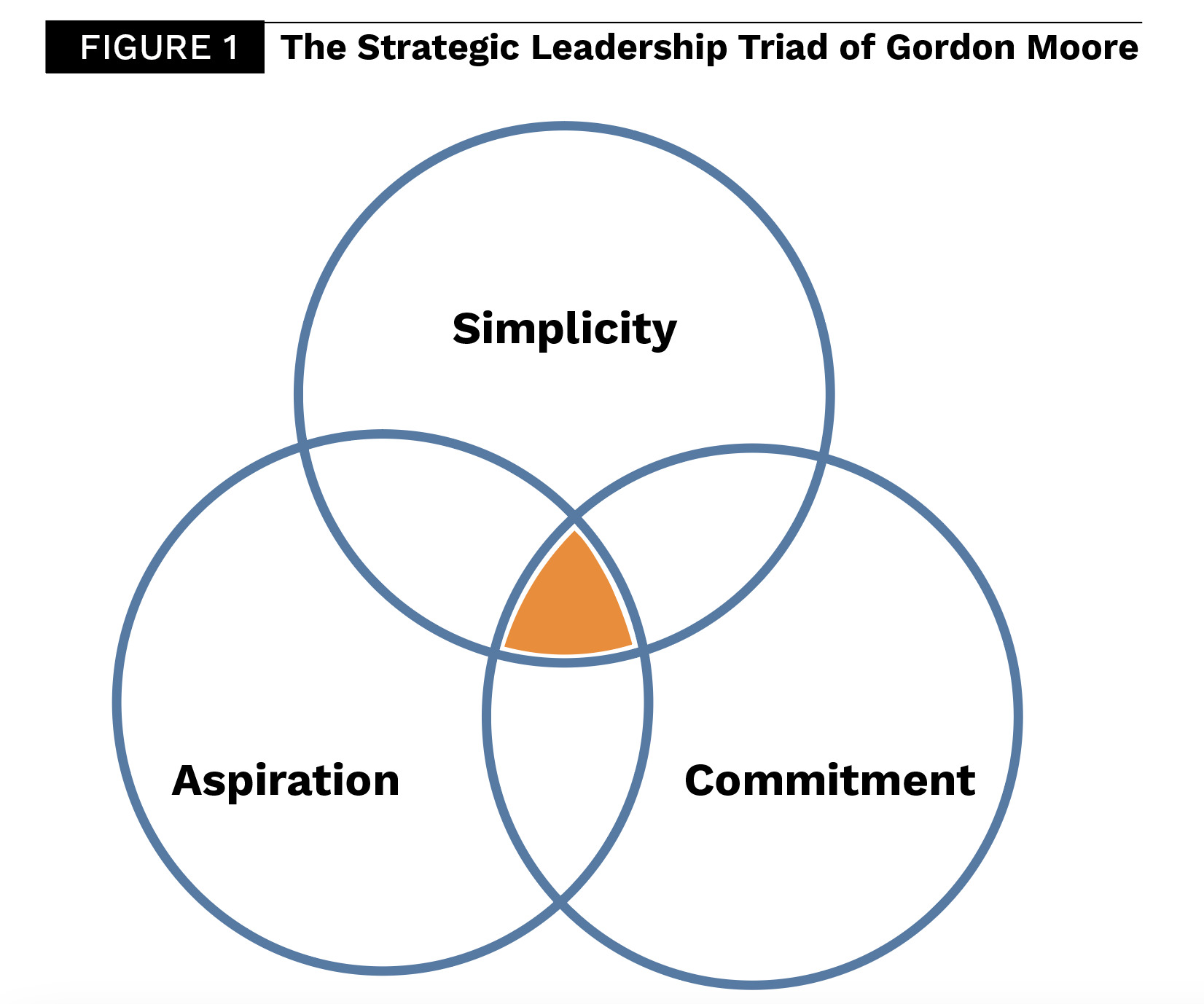
Moore’s strategic leadership laws are a combination of simplicity, commitment, and aspiration.13 This strategic leadership, which has infiltrated Intel employees around the world, can be summarized as:
- Set big but achievable goals
- Make the role and level of responsibility clear to everyone
- Be quick but efficient
- Examine the growth and progress of the work
- Evaluate work results based on reality
Simplicity: The issues that many companies face in making fundamental changes are very complex. Things like a multi-cultural organizational alliance, inter-organizational teams made up of members who speak different languages, and production, purchase, and design plans are not simple. But employees and managers at Intel clarify and simplify complex matters for those around them, and in every meeting, they look for a point that everyone can agree upon. Moore also taught executives at Intel to consider listening to be an important factor in good leadership and success. In particular, Moore learned from anyone who has valid information to help Intel. His position in the company or society was no longer important to him.
Commitment: Commitment has certainly been a part of large and small actions and activities around the world. However, in our consulting experience with Intel headquarters in Greenwich in Australia, Santa Clara in California, and Hillsboro in Oregon, we have found that no company uses this concept as extensively and efficiently as Intel.
Aspiration: Making a commitment and acting on it is not enough; the next important word in Intel’s vocabulary is aspiration. Intel is strengthened because Moore has taught the next generation of Intel managers to give power and authority to employees at all levels by gathering information and creating inter-working teams, but big decisions should always be made in the CEO’s office. With the help of each other, Intel employees dismantled the existing physical and cultural barriers from Europe to Asia and North America with a new spirit and an attitude of harmony and integration. The result is a different company with the centrality of Santa Clara in California, which contains the true meaning and concept of globalization. They intended to revive the company, but they achieved something more than that. New productions are designed with the best ideas from different regions in a collaborative way. Communication plans are prepared with a commercial brand and an identity. Plans related to human resources are integrated and centralized and represent organizational standards, not regional ones.
In Conclusion
The strategic turning point is a pivotal time for an organization. Intel is both competitive and victorious. Intel survived the challenges faced by its competitors by focusing on microprocessors. As a result, “Intel” became one of the largest semi-media manufacturers in the world. The key success factor for Intel is that they fell forward over and over again. There were enduring periods of confusion, trial and error, and chaos. This is tantamount to a strategic turning point and organizations must deal with the messy middle when engaging in change efforts. This article also proves that authentic leadership coupled with persistence is one of the best strategic leadership methods for an organization. Intel’s calculated risk-taking is a characteristic sign of this company’s action and effort in achieving profitable and sustainable growth. Now, by showing the transformation in the process of bold action and the production of new products, Intel seeks to conquer the hearts and minds of customers across the globe.