By Matteo Valléro – Editorialist & Columnist, Italy
From mechanical engineering to conquering municipalities worldwide. A journey through the commercial strategies of an Italian champion that, despite being integrated into a foreign industrial giant, continues to export pure Italian know-how.
There is a fundamental misconception internationally when discussing “Made in Italy”. People often mistake an enterprise’s corporate ownership for its productive and cultural soul. In this era of a hyper-connected economy, capital travels fast and carries no passport; however, know-how—that unique blend of engineering intuition, functional design, and manufacturing precision—remains deeply anchored to the territory where it was born. This is the true essence of contemporary Italian excellence: a force capable of attracting foreign investment precisely to preserve and scale an exquisitely local genius on a global level.
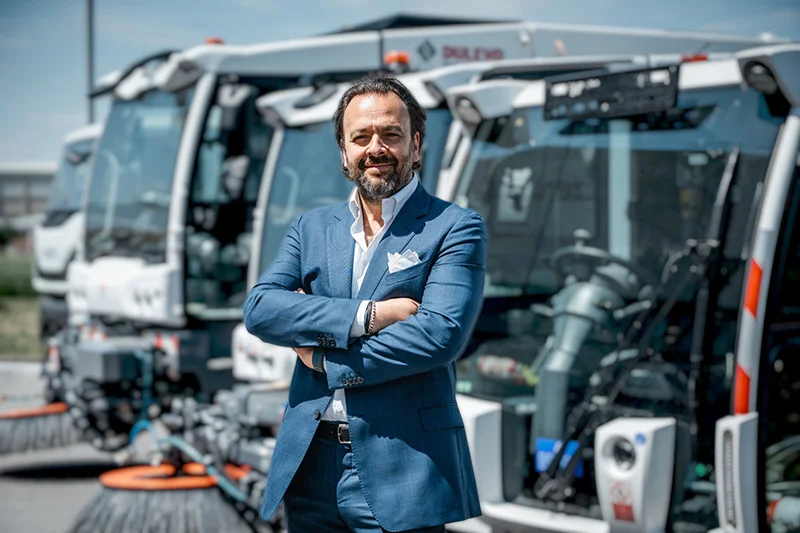
An emblematic case study of this dynamic is Dulevo, an Emilia-based company and global leader in the production of sweeping machines for urban and industrial cleaning. The significance of this brand is such that the Challenge podcast decided to dedicate unprecedented attention to it, producing two full episodes. While in a previous episode we listened to Managing Director Maurizio Giansiracusa break down its operational and leadership logic, today the focus shifts to the delicate and crucial front of international markets. The protagonist is Umberto Maria Cini, the company’s Sales & Marketing VP.
Dulevo’s recent history is marked by a pivotal milestone: its entry into a large and prestigious French industrial group, Fayat. This acquisition, far from diluting the company’s identity, has amplified its firepower, proving that true Italian identity does not fear acquisitions but leverages them as a springboard to dominate the market.
Mr. Cini, Dulevo represents a historic pillar of Italian mechanical engineering and is today an integral part of a solid French group. For an international audience fascinated by Italy, what does “Made in Italy” concretely mean in your sector today? How do you keep this engineering DNA intact and maximize its value within a multinational dimension?
“Dulevo has always been synonymous with Italian identity, and it has remained so even after its acquisition by the Fayat group. The group is founded on three core values, the first of which is autonomy. They have fully respected this principle, allowing Dulevo to maintain its corporate culture completely intact. Personally, I believe that the greatest expression of Italian identity lies in our ability to innovate, to remain agile in competitive environments that are sometimes highly rigid, and to deliver class-leading quality and performance.
Furthermore, Italian companies possess a unique, defining trait: passion. They reflect the character of the people inside them, driven by the strength and enthusiasm to be recognized as global leaders. These characteristics have always defined Dulevo and continue to do so today. The international group that acquired us has done nothing but reinforce this, granting us full autonomy in line with their values.
The group’s other two values are audacity and courage. We bring the audacity of being Italian to the market with courage: we present distinct products that establish themselves through innovation and their capacity to represent a positive ‘delta’ over the competition. This is an element we maintain regardless of management changes, precisely because it is deeply embedded in our corporate culture .”
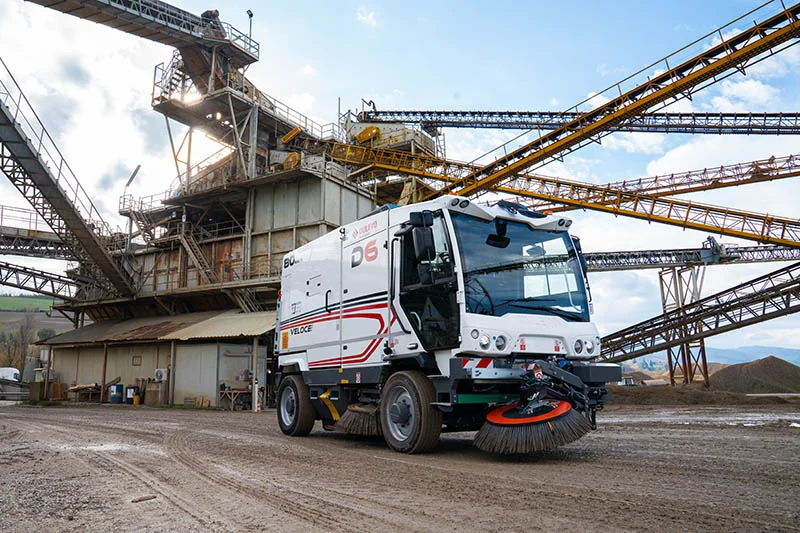
Selling a sweeping machine destined for the streets of a major metropolis or an industrial hub is vastly different from selling a fast-moving consumer good. It is a highly complex B2B process where clients are not just looking for a machine, but for a reliable, long-lasting solution capable of driving down maintenance costs. In this scenario, the role of Sales & Marketing extends far beyond mere commercial persuasion; it requires a profound ability to translate engineering excellence into a language of value that resonates across all latitudes.
In the heavy machinery and urban maintenance market, the sales cycle is long, complex, and frequently involves public administrations or large contractors. How do you structure a marketing and sales strategy capable of communicating the high added value and precision of Italian manufacturing to a global audience, moving past a race-to-the-bottom price logic?
“This is a question that could fill an entire treatise because it involves a complex journey. It certainly begins with brand positioning. We Italians are exceptionally skilled at positioning ourselves in the premium segment: our brand equity is perceived as—and actually is—very high. This is the baseline first step for everything we do worldwide.
From there, we navigate complex realities because, as the saying goes, ‘different countries, different realities’. Broadly speaking, the common denominator is the ability to understand the specific needs of the target market and identify the optimal application to address the customer’s requirement. Evidentially, this is not a purely commercial response, but a solution achieved through sophisticated engineering and highly complex technical relationships that sequentially involve technical departments, purchasing departments, and ultimately municipal authorities.
It is a process that can take years. Given that we are a global brand, the hardest part is helping those who manage public tenders—which are frequently dictated by price—understand that highly refined technical solutions naturally command a higher price point than the competition.”
Communicating reliability alone is no longer enough. Cities across the globe are undergoing an unprecedented ecological transition. The watchwords for modern municipalities are zero emissions, fine particle reduction, and smart mobility. The urban cleaning industry is called upon to respond with next-generation electric vehicles, transforming an environmental necessity into an extraordinary business opportunity. This is exactly where Italian intuition plays its most vital game.
Global metropolises demand increasingly stringent environmental standards: electrification, noise reduction, and absolute control over fine particles. From your privileged vantage point, how do you capture these emerging market needs, and how does sustainable innovation translate into your primary commercial lever to conquer new shares of the international market?
“The ‘zero emissions’ goal for electric vehicles is not a one-size-fits-all answer to the needs of different municipalities. The crucial pressure points are actually the reduction of fine particles and noise pollution, alongside, of course, the adoption of electric powertrains.
Dulevo represents absolute excellence here, as we offer technological solutions featuring proprietary filters—developed entirely in-house by Dulevo—that eliminate 99.5% of all fine particles, ensuring an elite tier of eco-friendliness. Indeed, numerous global studies confirm that a massive portion of air pollution stems directly from fine particles accumulated on the asphalt.
Added to this is minimized noise pollution, achieved through technological systems that deliver high performance without generating elevated noise levels. Another fundamental parameter in this transition is the Life Cycle Assessment, which evaluates the product’s entire life cycle: it is through this assessment that we concretely measure the true environmental footprint of the vehicle over its entire operational lifespan .”
The lesson that emerges from examining the commercial and identity-driven logic of this company is clear: Italian manufacturing does not need to erect fences to protect its value. On the contrary, it is precisely when our country opens up to international financial architectures that its human and technological capital achieves its maximum potential. Success is not determined by the flag flying over the factory roof, but by the intelligence of those who design, the care of those who assemble, and the vision of those who introduce that product to the world.