As climate change accelerates and global technological demands grow, young scientists and engineers are emerging as influential actors in international cooperation. Across regions as distant as Obninsk in Russia, Argentina, Bolivia, and Brazil, youth programmes associated with Rosatom are helping build new channels of dialogue through education, innovation, and scientific exchange.
Together, these initiatives reflect a broader trend: science increasingly serves as a bridge across borders at a time when diplomatic relations are strained and the world urgently needs inclusive, evidence-based collaboration.
Several international initiatives supported by Rosatom, including Impact Team 2050, the Obninsk Tech Leadership Academy, and the Global HackAtom student championship, bring together early-career scientists to collaborate on shared challenges such as clean energy, climate adaptation, and equitable technological development.
While the programmes differ in format and geography, they share a common premise: that young professionals can drive cooperation more effectively when they learn from one another directly, outside of political frameworks.
In Obninsk, home to the world’s first nuclear power plant, the Obninsk Tech Leadership Academy has become a hub for international training and dialogue. The programme welcomes young specialists from various regions to learn project management, communication, and technical skills relevant to modern energy systems.
One of its flagship initiatives, the [in]Visible Power Female Leadership Camp, focuses on empowering young women in STEM. The camp combines mentoring, workshops and technical visits, emphasising leadership grounded not only in expertise but also in ethics, cultural awareness, and social responsibility.
“Leadership in science is as much about empathy and awareness as it is about expertise,” said the programme curator Darya Kalenbet. “The camp enables participants to define their own paths and recognise how cross-cultural collaboration can strengthen the global scientific community.”
The Academy’s participants stay connected through collaborative projects, forming an emerging global network of young professionals committed to sustainable development.
Ahead of the UN Climate Conference COP30 in Brazil, Impact Team 2050 launched a series of youth-focused events across Latin America designed to spark dialogue on the role of nuclear technologies in sustainability.
These activities included hackathons, local youth conferences and thematic forums in Argentina, Bolivia and Brazil. Participants explored solutions to regional challenges such as water scarcity, environmental protection and energy access, engaging researchers, students, community leaders and environmental activists.
Discussions ranged from small modular reactors and nuclear medicine to food security and climate mitigation demonstrating how young people in the region view technology as integral to long-term climate strategies.
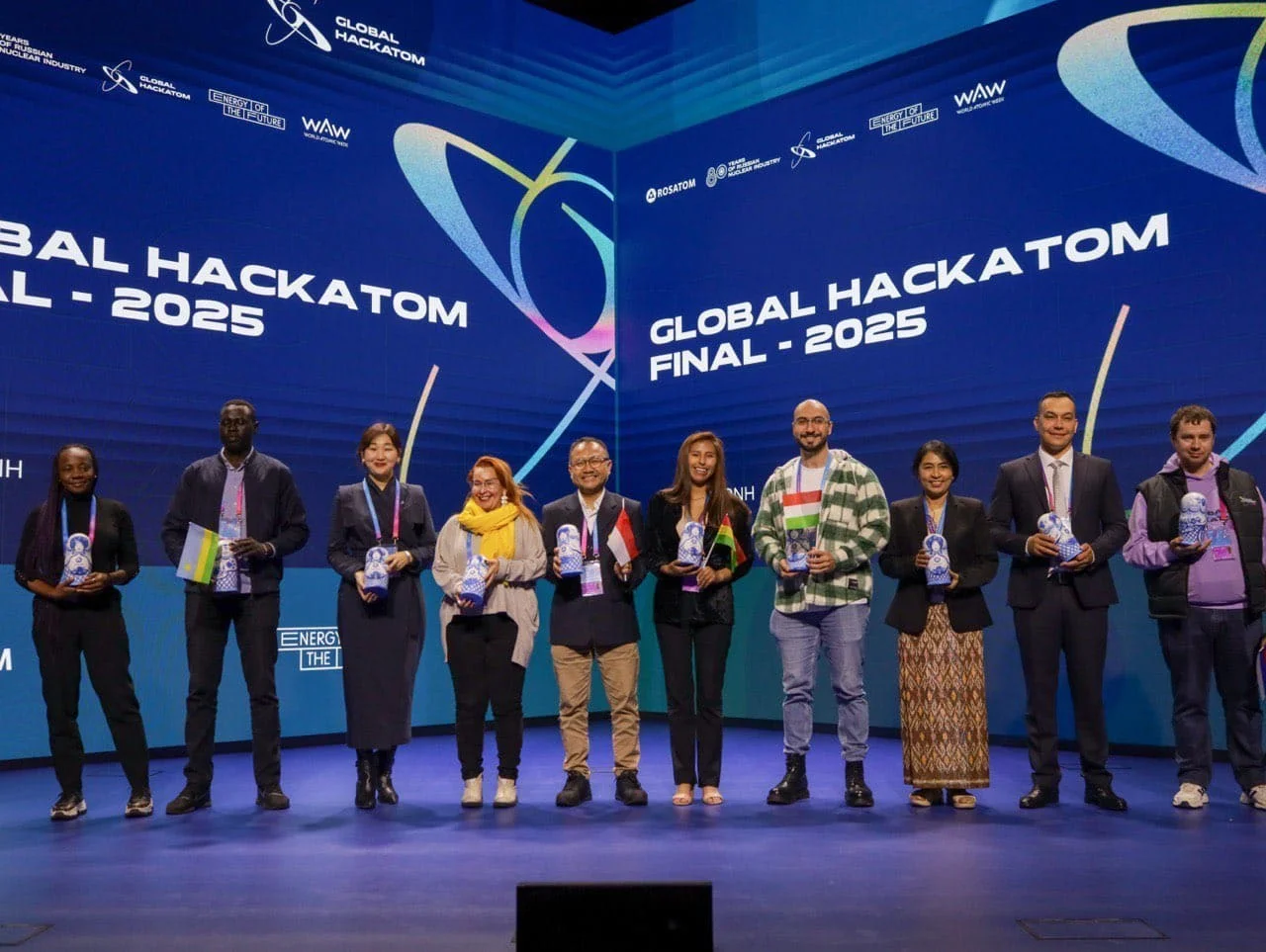
In addition to these initiatives, the anniversary year for the Russian nuclear industry saw the first-ever Global HackAtom, a 24-hour international student championship focused on applying nuclear and related technologies to real-world problems.
Launched in a global format in 2025, the programme included national rounds in ten countries, among them Bolivia, Brazil, Indonesia, Kazakhstan, Namibia and Russia, with more than 650 students taking part.
The final stage, held in Moscow during World Atomic Week, challenged participants to propose future-oriented concepts in space exploration powered by nuclear technologies. Projects included ideas for interplanetary travel, modular space reactors and technological infrastructure for deep-space missions.
The 2025 championship was won by TUPI Tech, a Brazilian team that developed a conceptual modular reactor for space applications, a project widely praised for its creative integration of engineering and scientific vision.
Across all these initiatives, a common thread emerges: science as a shared language. Instead of exporting ready-made solutions, the programmes encourage mutual learning and exchange of perspectives among young engineers, environmental activists, scientists and community leaders.
The focus on youth engagement – with many participants being women in STEM – supports broader goals of inclusion, diversity and equitable capacity building in global science and technology.
As global challenges become more complex, cooperation in areas such as clean energy and technological innovation becomes essential. These youth-driven programmes demonstrate how scientific collaboration can create spaces for constructive dialogue even in times of geopolitical tension.
By bridging cultures, disciplines and regions, initiatives like Impact Team 2050, the Obninsk Tech Leadership Academy and Global HackAtom highlight the role of young scientists as informal diplomats advancing not only technological solutions, but also understanding, empathy and shared purpose.