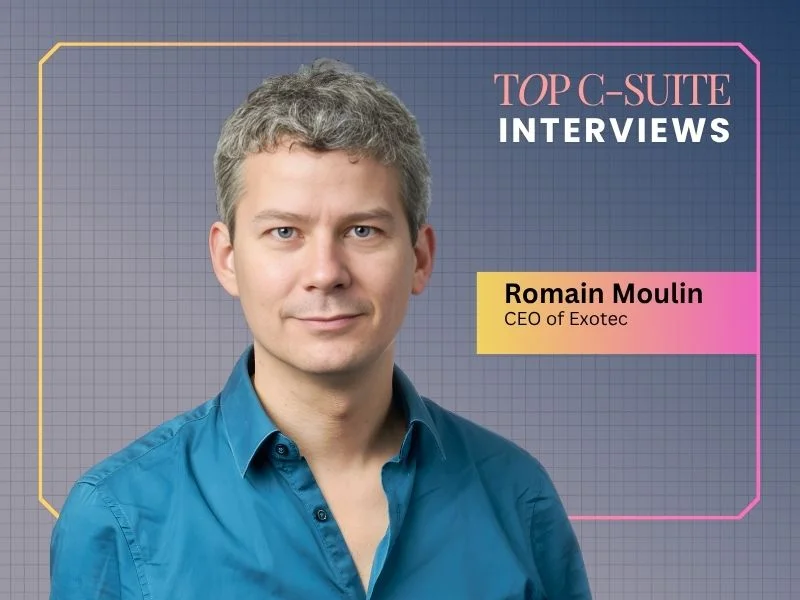
Interview with Romain Moulin of Exotec
Robotics continues to evolve as one of the most transformative forces in modern industry. In this interview, Romain Moulin shares his lifelong passion for machines and his perspective on how innovation, leadership, and automation are shaping the future. He highlights the importance of curiosity, technical excellence, and strategic vision in driving sustainable progress.
What first sparked your interest in robotics, and how has that passion evolved throughout your career?
I’ve been fascinated by machines for as long as I can remember. As a child, I spent hours building with LEGO Technic, and growing up near a factory only deepened that curiosity. When I was 14, I watched the French Robotics Cup on E=M6 and thought, “One day, I’m going to do that.” Every year after that, I’d stay up late on the night it aired, imagining the robot I would have built. At 20, I finally competed, and that same passion has stayed with me ever since. Even today, I still love designing new mechanisms – just last night, I modelled a robotic finger in Onshape to improve how our system grabs bins.
Having worked in both technical and leadership roles, how do you balance engineering expertise with the demands of leading people and organisations?
In my role as CEO, I’ve found it’s really a 50–50 balance. My strong technical background is both a strength and a potential weakness. If you lean entirely to one side, it doesn’t work: you either end up with a company that’s poorly managed operationally, or one led by a CFO who doesn’t fully grasp how the product should resonate with the market. In the end, a technology company’s success depends on aligning what’s technically possible with what the market truly needs, and every leader in the organisation has to understand that.
In your experience, what qualities are most important for leaders in the robotics sector to cultivate in order to drive sustainable innovation?
Curiosity is key. The robotics sector is evolving at an incredibly rapid pace, from advances in AI and perception to new materials and manufacturing methods. Leaders need to constantly look beyond their own organisation and stay engaged with the broader ecosystem. It is about keeping a ‘Day 1 mindset,’ as Jeff Bezos says: never assume the work is done and always question how things could be improved.
Leaders need to constantly look beyond their own organisation and stay engaged with the broader ecosystem.
Strong technical acumen is just as critical. In robotics, every innovation sits at the intersection of hardware, software and logistics, and understanding those connections is what allows leaders to make the right decisions. Sustainable innovation comes from leaders who can combine deep engineering insight with strategic vision, ensuring that technological progress translates into real-world, practical, scalable solutions.
How do you view the current state of robotics in Europe, and what forces are shaping its development?
Automation has deep roots in Europe, especially in Germany and Austria, who have long excelled in the field. Today, as robotics increasingly relies on software, data, and mathematics, France has a real opportunity to play a larger role in this new phase of automation.
However, we still face challenges in building a stronger industrial ecosystem, particularly when it comes to suppliers. At the same time, competition from China is evolving, with manufacturers expanding their presence through broader product portfolios and increased global reach. The key for Europe will be to leverage its engineering excellence while developing a more agile and connected industrial network that can compete on both innovation and scale.
What lessons from your career stand out when it comes to managing growth in industries where technology moves faster than regulation and adoption?
In our industry, regulation and adoption are keeping pace with technological progress. Within warehouses, regulation remains pragmatic and supportive, which gives us the freedom to innovate and design systems exactly as we envision them. And on the adoption side, the response has been excellent.
This is why growth in robotics is ultimately about discipline: delivering innovation at a pace the market can absorb, while keeping quality, reliability and consistency at the core.
The real challenge is not regulatory or societal resistance, but execution – by scaling technology reliably and ensuring every customer benefits from the same level of performance. This is why growth in robotics is ultimately about discipline: delivering innovation at a pace the market can absorb, while keeping quality, reliability and consistency at the core.
An example of this is the next generation Skypod, which builds on the success of the original system by delivering higher performance, increased storage density, and advanced software capabilities. These improvements enable seamless fleet management, reduced downtime, and allow customers to conveniently scale operations with greater efficiency.
As automation and robotics become more widespread, what do you see as the implications for the future of work and workforce skills?
Low-skilled labour in warehouses will continue to decline, but in reality, these are jobs that many people no longer want to do, given their physically demanding, repetitive, and often high-risk nature. At the same time, automation is creating new opportunities for skilled roles, particularly in maintenance, system operations, and engineering.
Education and training will be essential to bridge that transition. Without strong investment in technical education, we risk facing a significant shortage of maintenance technicians and engineers. The future of work in logistics will depend on how effectively we prepare people for these higher-value, technology-driven roles.
Looking ahead, how do you imagine robotics transforming supply chains and industries globally over the next decade?
Warehouses will become fully automated, but not with humanoid robots: the future of logistics is about efficiency, not imitation. We will see increasingly intelligent and adaptive systems, like the Skypod, that boost throughput and maximise storage density, enabling warehouses to handle greater volumes within the same footprint.
Automation will extend beyond the warehouse as well, connecting production, transportation, and fulfilment into a continuous, data-driven supply chain. The coming years will be defined by how well companies integrate robotics into the broader flow of goods, creating resilient networks that are faster and more flexible.