

By A.J. Thoresen
AI can make organisations move faster, but speed without direction scales weak assumptions, wrong priorities and flawed decisions as efficiently as good ones.
AI can make bad decisions happen sooner because it does not determine whether the underlying goal is worth pursuing. It can analyse, optimise, automate and scale, but those capabilities operate inside choices already made about purpose, priorities, data and trade-offs. As a programme governance and transformation leader on large-scale projects, I have seen the same principle repeatedly: execution quality cannot rescue a wrong direction. AI raises these stakes further because it compresses the distance between a decision and its consequences. Effectiveness therefore must come first. It sets the direction; efficiency refines the journey.
What Happens When We Start in the Wrong Order?
Productivity and efficiency are often treated as if they mean the same thing. They do not. Productivity tells us how much we produce. Efficiency asks how well we use time, tools and resources. But effectiveness asks the more fundamental question: are we doing the right thing in the first place?
A team can execute a plan flawlessly and still fail if the plan never should have been approved. A business can perfect its operations and still misread what customers need. In construction, a project can be delivered with impressive control over time and cost, but if the design itself is wrong, execution cannot rescue it.
This is the trap. When direction is weak, efficiency does not correct the problem. It can deepen it further.
Modern organisations are particularly vulnerable because what is meaningful can be replaced by what is measurable. Cost often becomes a proxy for value. Speed can be treated as a proxy for progress. Output becomes a proxy for impact. Performance can visibly improve while the underlying purpose becomes less clear.
Efficiency is very powerful, but it cannot decide whether a system is worth improving. That is the role of effectiveness. It sets the direction first; it strategizes. Only then does efficiency refine the journey. Both are important, but the right order has even greater ripple effects.
What Does AI Magnify?
AI does not create this tension, but it increases the speed and reach of its consequences.
The appeal seems obvious: instant access, speed, low cost, greater scale and what looks like continuous optimisation. If used correctly from the start, these are real advantages. But AI can also perfect a process that should not exist, follow the wrong design or process, optimise a target that is poorly chosen or reduce a cost that was protecting something valuable.
For example, healthcare shows the distinction clearly. AI-assisted triage can improve patient flow, and robotic systems can increase precision. But faster treatment is not automatically better treatment. If a system becomes too focused on throughput, it can miss context, empathy or the quality of the outcome.
The same applies in manufacturing. AI can identify defects, reorganise steps and help a production line improve continuously. Yet none of that creates value if the product itself is unnecessary, unsafe for people or unwanted by the market.
This is why AI should be understood as an amplifier of processes, not a compass. It can sharpen, extend and accelerate what we ask it to do. It cannot decide what an organisation should ultimately serve and pursue.
A weak decision once travelled at human speed; with artificial intelligence, it can now travel far faster, repeat at scale and spread before anyone questions whether the original assumption was sound or the underlying purpose was misunderstood.
Recent developments show how easily this can happen. Meta has acknowledged mistakes in its rapid AI-centred workforce transformation amid major restructuring and layoffs, while Ford brought experienced engineers back after finding that AI and automated systems alone were not delivering the quality it expected. In both cases, the lesson is not to retreat from AI, but to recognise that speed, automation and organisational change still need judgement, experience and the right order.
What Should Leaders Ask Before They Automate?
It is interesting that even Elon Musk has admitted learning this lesson the hard way. Describing his five-step approach to process improvement, he starts by questioning requirements, then deleting what is unnecessary, simplifying and optimising, accelerating only after those steps, and automating last. He also admitted that he had personally made the mistake of going backwards through all five steps multiple times: “I automated, accelerated, simplified, and then deleted.”
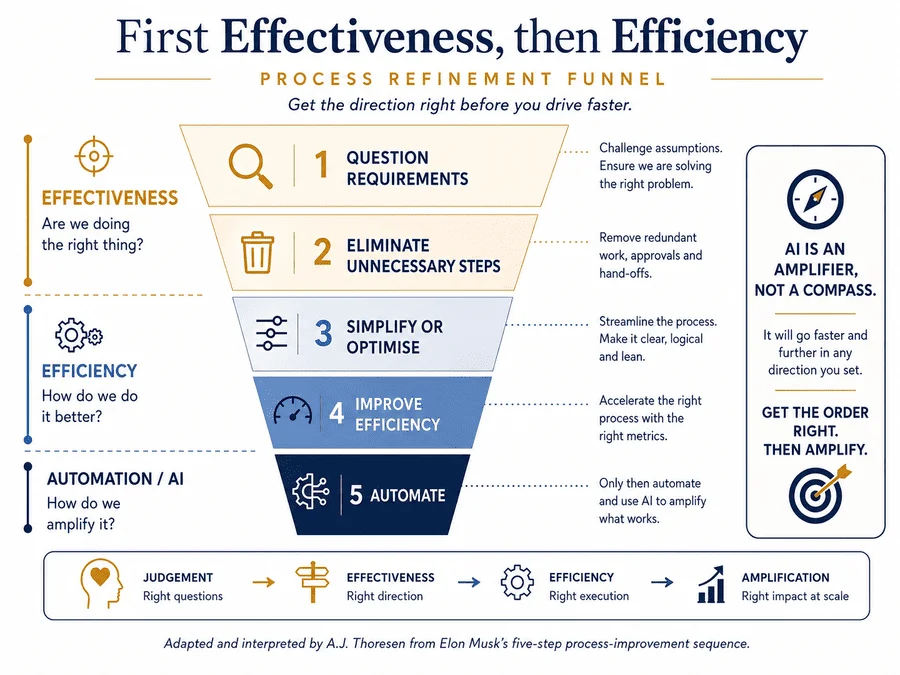
And here is the trick: the order matters more than the names of the individual steps.
The lesson is broader than manufacturing. Automation should be the end of a rigorous reasoning process, not the beginning of one.
Before AI touches a material process, leaders should ask:
- What outcome are we actually trying to achieve?
- Which assumptions and requirements should be challenged first?
- What could be lost if we optimise existing processes without questioning fundamentals?
- Where must human judgement and accountability remain?
- How do we know that speed makes work better?
These questions are not arguments against AI. They are what make serious adoption possible.
Instant access to new capabilities can tempt us to begin with optimisation before asking the deeper questions. Get the assumptions wrong in the first place, and you lose effectiveness.
What Remains Human When AI Gets Faster?
The biggest risk is not that AI will make organisations less rational. It may make them extremely rational about the wrong objective.
A model can optimise what we define, but leadership still determines what is worth defining. It decides what counts as success, which trade-offs are acceptable and what should never be reduced to a metric.
Not everything that matters will appear in the data. Trust, judgement, care, long-term resilience and human consequences are often hardest to measure precisely when they matter most. Fundamental questions are worth revisiting more often than we think, especially as we live in an increasingly fast-paced environment. So review your assumptions as well as your judgements, because both determine whether we get the order right. If we want real improvements in productivity, we should start with effectiveness and only then move to efficiency.
The organisations that benefit most from AI may not be those that move fastest. They may be those that know what deserves acceleration only after exercising sound judgement.
Effectiveness gives technology direction. Efficiency gives it force. When both are aligned, acceleration becomes a gift. When they are not, speed only deepens the mistake.
In the age of AI, the question is no longer simply how fast we can go. It is whether we are heading the right way.
Direction, not speed, still defines the path.
 A.J. Thoresen is the author of