

By Jacques Bughin
If you’re thinking we can understand the rise of frontier AI firms by analogy with earlier technology superstars, you might want to think again.
The technology giants Google, Apple, Facebook, Amazon, and Microsoft were the defining symbols of corporate growth in their era. So it follows, doesn’t it, that we can view the meteoric rise of today’s frontier AI firms as just a rerun of the same processes that powered GAFAM? Well actually, no, because these firms are not simply scaling faster than GAFAM; they are operating under entirely different economic laws.
1. The rise of the superstar firms
Roughly 15 years ago, a new acronym progressively entered the vocabulary of investors, economists, policymakers, and corporate strategists: GAFAM. Google, Apple, Facebook, Amazon, and Microsoft were increasingly viewed not simply as successful technology firms, but as a fundamentally new organizational species. They appeared capable of combining extraordinary growth, global scale, near-zero marginal distribution costs, ecosystem lock-in, and profitability levels that industrial-era corporations struggled to replicate.
The GAFAM firms rewrote the economic logic of growth in the internet era.
At the time, economists developed entire theories around “superstar firms” to explain why digital technologies increasingly concentrated value into a small number of dominant players. The prevailing explanation revolved around software scalability and network effects. Once digital platforms achieved sufficient scale, growth often became self-reinforcing. More users generated more data, more data improved products, better products attracted more users, and scale itself reinforced dominance. The internet appeared to create a form of capitalism where a small number of firms could achieve almost planetary operating leverage.
The GAFAM firms rewrote the economic logic of growth in the internet era. Microsoft standardized enterprise computing globally before extending into productivity software, servers, developer ecosystems, and eventually cloud infrastructure. Amazon transformed logistics and commerce before becoming the backbone of the cloud economy through AWS. Google became the infrastructure layer for information discovery and digital advertising. Meta connected billions of humans into a single global social graph monetized through attention. Apple created one of the most profitable hardware–software ecosystems in history.
At the time, these firms appeared historically unique. Their growth curves seemed almost impossible relative to industrial-era corporations. Yet despite how extraordinary the GAFAM era appeared, something even more unusual may now be emerging, because the trajectories associated with Anthropic and OpenAI are not simply steeper versions of the GAFAM curves. They may represent a fundamentally different architecture of scale altogether.
 2. The arrival of the frontier AI firms
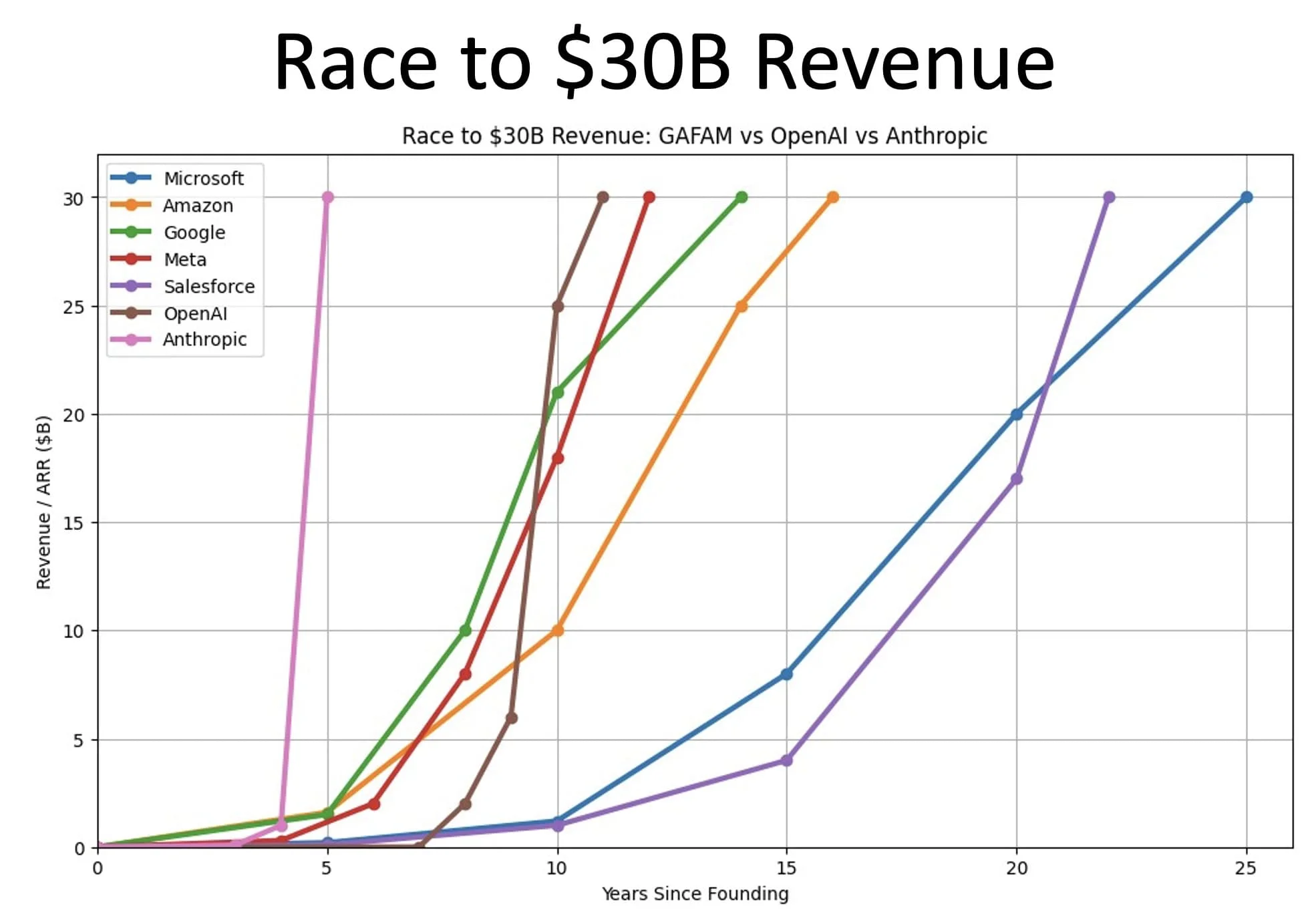
To understand how abnormal the current frontier AI trajectory is, it is useful to compare the time required for the greatest technology firms in history to approach roughly $30 billion in annual revenue.
Microsoft, founded in 1975, required roughly 25 years to cross that threshold as enterprise computing standardized globally. Amazon, founded in 1994, required approximately 16 years to scale from books into logistics and cloud infrastructure. Google reached comparable levels in roughly 13 to 14 years as search advertising became the monetization engine of the internet economy. Meta approached the same scale in roughly 11 to 12 years as mobile social advertising exploded globally. Apple required decades tied to hardware manufacturing cycles. Salesforce, the foundational enterprise of the software-as-a-service architecture, required more than 20 years to expand from tens of millions toward the $30 billion range.
Anthropic appears on a trajectory to traverse a comparable range in less than five years. OpenAI may not be far behind.
The instinctive explanation is obvious: AI is revolutionary; adoption is faster. And the technology creates more value. But this interpretation is still too superficial, because it treats frontier AI as merely another software category. What may actually be emerging is a structural transformation in how firms scale economically.
The GAFAM firms ultimately scaled through human participation. Google scaled because more humans searched the web. Meta scaled because more humans interacted socially online. Amazon scaled because more humans shifted commerce digitally. Microsoft scaled because more employees used enterprise software. Apple scaled because more consumers entered the smartphone ecosystem. Even the greatest internet platforms in history remained fundamentally tied to human activity growth.
Frontier AI may be different. Anthropic and OpenAI increasingly do not merely monetize human participation; they monetize cognition itself. That distinction changes everything.
3. Why frontier AI firms scale differently
3.1. The past compounds
When Salesforce was founded in 1999, the enterprise technology sector operated under a perpetual licensing and on-premise infrastructure model. Establishing browser-based enterprise software required convincing corporate buyers to accept an entirely unproven operating paradigm. Storing proprietary enterprise data on remote servers was considered risky. Subscription-based pricing models lacked institutional legitimacy. APIs were immature. Enterprise cloud procurement barely existed. Consequently, Salesforce had to execute two enormous tasks simultaneously: building the company itself and validating the cloud computing category itself. Expanding revenue required the manual construction of global sales organizations, implementation ecosystems, cloud trust, category-by-category product expansion, and prolonged customer education cycles. This was the unavoidable cost of establishing a new computing architecture.
Frontier AI firms face almost none of these historical frictions. Anthropic did not need to legitimize cloud infrastructure. OpenAI did not need to establish global procurement frameworks or educate developers on the usefulness of APIs. That systemic architecture already existed.
Frontier AI firms are scaling on top of a digital economy that previous generations spent decades building.
Previous generations had to build both the rails and the train simultaneously. Frontier AI firms are scaling on top of a digital economy that previous generations spent decades building. AWS already exists. Azure already exists. Cloud procurement already exists. Developer ecosystems already exist. Global APIs already exist. Usage-based billing already exists. Enterprise trust in remote infrastructure already exists. This distinction matters enormously because it compresses the historical cycle between invention and planetary adoption. Previous technological revolutions required simultaneous development of technology, infrastructure, standards, organizational trust, and ecosystem coordination. Frontier AI largely bypasses those phases because the deployment layer already exists. Anthropic is not scaling inside an immature technological frontier. It is scaling inside a fully operational digital economy already optimized for cloud-native consumption.
3.2. The three new laws of scale
Yet the real significance of frontier AI may not simply be that these firms benefit from the effort laid out by GAFAM companies. It may be that they scale through a fundamentally different economic engine. Understanding that shift requires identifying the new laws of scale emerging underneath the frontier AI economy.
Horizontal technological compounding
Traditional software enterprises scaled through sequential adjacency expansion. Growth was achieved by building or acquiring distinct product lines targeting separate functions or departments. Microsoft expanded from operating systems into productivity and cloud infrastructure. Google expanded from search into advertising, maps, mobile, and video. Salesforce expanded from CRM into marketing, analytics, service, and collaboration. Each adjacent market required dedicated product organizations, customer acquisition strategies, integrations, and years of organizational scaling.
Growth was additive. Frontier AI systems behave differently because they are not bounded applications. They are general-purpose reasoning systems. Cognition sits upstream of almost every enterprise workflow. Consequently, an incremental upgrade to the core model’s reasoning capacity immediately improves downstream performance across multiple domains simultaneously. A single improvement in the model enhances software engineering, legal review, customer support, financial analysis, enterprise search, procurement, analytics, research, and operational workflows all at once. Product improvement therefore no longer merely deepens one category position; it continuously enlarges the addressable market itself.
Execution-based monetization
Traditional software monetized access. Revenue scaled through users, seats, licenses, subscriptions, or advertising impressions generated by humans interacting with digital systems. Because seat-based software correlated directly with employee headcount, it faced a structural ceiling dictated by organizational size.
AI changes the monetization unit itself; frontier AI increasingly monetizes execution. The system is no longer simply facilitating human output. It increasingly executes portions of workflows directly, including coding, synthesis, customer support, legal review, procurement, compliance, classification, analytics, and operational coordination. Revenue therefore scales with operational throughput rather than organizational headcount.
This distinction is profound because software historically captured only a relatively small fraction of enterprise expenditure. Labor remained the dominant cost base across most industries.
AI increasingly penetrates the labor layer itself. That is why the Anthropic curve appears almost detached from historical precedent. The company is not merely participating in the software economy; it increasingly participates in the execution economy.
Frictionless compression
Historically, platform shifts required decades for markets to establish dominant designs, standard pricing structures, ecosystem coordination, and enterprise trust. Today, capability breakthroughs can diffuse globally almost instantly, because frontier AI providers deploy their models through already-established hyperscale cloud providers using consumption-based billing systems.
The historical cycle between invention and deployment therefore collapses dramatically. This compression reduces the time available for competitors, incumbents, and regulators to adapt to shifts in market leadership. Leadership positions that historically required 15 years to establish may now emerge in two. This creates a much more unstable and accelerated form of capitalism than previous technology eras.

4. Implications for competition
If these new scaling laws continue to hold, competition itself may increasingly change. The internet era was dominated by networks, aggregation, distribution, and interfaces. The frontier AI era may increasingly be dominated by orchestration, execution authority, workflow control, enterprise reasoning, and autonomous operational systems.
Historically, software firms controlled value because humans interacted directly with applications through user interfaces. Autonomous systems do not care about dashboards. They care about permissions, APIs, orchestration logic, workflow sequencing, and access to systems of record. This means future strategic moats may shift away from interface-heavy applications and toward ownership of execution flows. The most powerful firms of the next decade may therefore not be the firms with the broadest software suites. They may be the firms controlling enterprise coordination, operational trust, workflow orchestration, proprietary data loops, and continuously improving execution systems. The implication for incumbents is profound. Many enterprises still treat AI as a feature enhancement layered onto existing workflows. But the deeper transformation may be architectural rather than incremental. The firms that win may not simply add AI to products. They may redesign workflows entirely around autonomous execution.
The implications for investors are equally significant, because traditional software valuation frameworks may become increasingly incomplete. The SaaS era rewarded recurring subscriptions, seat expansion, retention, and operating leverage. Frontier AI introduces a fundamentally different dynamic where revenue scales with cognitive throughput and operational dependency rather than simply with user growth. This creates much larger potential markets, but also much larger uncertainty around where durable value ultimately settles.
During major technological transitions, the initial firms capturing market share are not always the firms retaining long-term economic value. As the frontier AI industry matures, value may stabilize across distinct layers of the technology stack, including compute infrastructure, foundational models, workflow orchestration layers, verticalized enterprise applications, proprietary enterprise datasets, or execution ownership itself. The strategic question may therefore no longer be who owns the application; it may increasingly become who owns the execution layer.
For managers, the implications are immediate. Future competitive advantage may increasingly depend on orchestration capabilities, proprietary operational data, workflow integration, trust systems, and organizational ability to redesign work itself. The most important lesson from Anthropic and OpenAI may therefore not be that AI firms grow faster than the GAFAM firms. It may be that the architecture of economic scale itself is changing again.
The GAFAM era organized digital activity. The frontier AI era may increasingly organize economic execution itself.