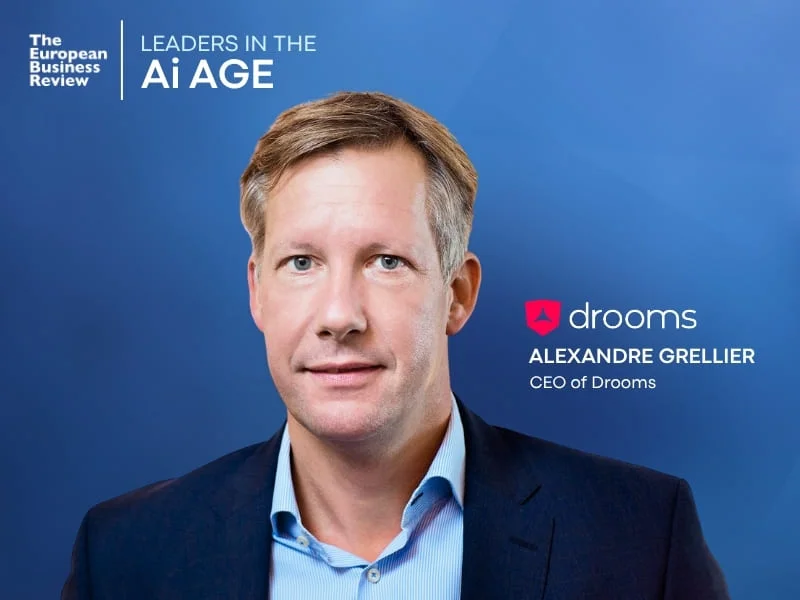
Drooms CEO Alexandre Grellier explains where AI can accelerate transactions, why traceability matters, and why human judgement remains indispensable.
Due diligence has moved from physical data rooms and manual document review to platforms capable of analysing thousands of files in seconds. Yet faster access to information does not necessarily produce better decisions—particularly when users cannot verify how an AI system reached its answer.
Alexandre Grellier, CEO of due diligence platform Drooms, believes companies should treat AI as they would a junior analyst: capable of carrying out valuable work at speed, but still requiring direction, verification and experienced human judgement.
The New Junior
Just like a new entry-level employee, AI cannot be fully independent in its work and is unable to make bold, innovative decisions. This technology needs highly detailed instructions to operate properly. In addition, it must be provided with reliable source material and appropriate access and permissions. Its performance depends on the quality of its instructions, the reliability of its source material and the information it is authorised to access.
Even when companies provide their AI tools with all the necessary information and permissions, these tools can still make mistakes with potentially serious consequences. “Juniors can make mistakes, and sometimes pretty heavy mistakes. AI is the same,” said Grellier.
The CEO of Drooms has witnessed the radical change due diligence processes have undergone over the past few decades. In the early 2000s, analysts had to spend weeks going through countless binders in dusty basements, taking notes by hand and heavily relying on their memory before starting their analyses. In 2003, Grellier, together with his business partner Jan Hoffmeister (now exited), decided to launch Drooms to offer companies virtual data rooms (VDRs) accessible from anywhere in the world. However, professionals remained sceptical. “When I started talking to lawyers and other friends, they said, ‘Alex, you’re completely crazy. Nobody will ever do due diligence on a screen’,” Grellier recalls.
The predictions proved to be wrong, and Drooms has since grown into an established European data room platform. Like others in the sector, the company recently had to adapt to the rise of AI.
“The cumbersome, repetitive, boring work will go away, but those parts where you really need your brain, to think, evaluate and decide, will not.” .
While Grellier is well aware of the many benefits this technology offers, he also warns businesses against relying too heavily on it. AI can instantly process large volumes of data, significantly speeding up due diligence and giving smaller companies that cannot afford large teams of analysts a significant advantage. However, it still requires human oversight. “What I see is that people believe that with AI, you can do magic. This is something I’m completely against,” Grellier said. “The cumbersome, repetitive, boring work will go away, but those parts where you really need your brain, to think, evaluate and decide, will not.”

The Traceability Problem
One of AI’s most significant limitations is its tendency to provide answers regardless of whether it has reliable sources to back them up. In addition, when humans point out mistakes, AI tools often try to smooth over the gap by generating other, often incorrect, answers, a highly risky behaviour when analysing information before a major transaction. This is why tracing AI answers back to their source documents has become crucial.
Deal teams should verify that the documents used by AI are current and complete, whether conflicting information exists elsewhere, and whether the system has interpreted the information correctly.
In August 2026, Drooms launched “Drooms Intelligence,” which allows deal teams to generate reports and talk to an entire data room and receive answers linked to the underlying source documents.
Human oversight is also required by law in some cases. Article 26 of the EU AI Act mandates that deployers of high-risk AI systems “assign human oversight to natural persons who have the necessary competence, training and authority, as well as the necessary support.” Although document-analysis tools used in due diligence will not necessarily qualify as high-risk systems, their classification depends on their intended purpose and context of use. The provision nevertheless reflects a broader principle: consequential applications of AI require appropriate human oversight.
Some technology providers are therefore introducing traceability tools that allow users to verify AI-generated answers. For instance, in August 2026, Drooms launched “Drooms Intelligence,” which allows deal teams to generate reports and talk to an entire data room and receive answers linked to the underlying source documents.
Beyond human oversight, EU companies must also consider sovereignty issues of data residency, provider jurisdiction, and confidentiality.
The Confidentiality Problem
EU companies should exercise caution when using popular public generative AI tools and US-headquartered cloud providers for due diligence. Depending on the provider, service configuration and contractual arrangements, sensitive information may be processed or stored outside the EU or become subject to additional jurisdictions.
Before using AI engines that are not headquartered in the EU, businesses should research where their data is processed and stored, which jurisdiction the provider falls under, and what contractual protections are in place.
On March 23, 2018, U.S. President Donald Trump signed the Cloud Act into law, clarifying that providers subject to U.S. jurisdiction may be required to produce data covered by valid U.S. legal process, even when that data is stored outside the U.S.
This is one reason some European businesses prefer EU-based providers when seeking greater control over data residency and closer alignment with European data-protection requirements. “European players […] need a platform they can trust,” Grellier said. “They want to work with a European platform, [so that they can be] sure that their sensitive data are treated in the way those data should be treated.”
As an increasing number of companies continue to rely heavily on AI, accountability has become crucial.
The Human Advantage
While AI systems can analyse large volumes of data and generate a detailed answer in a matter of seconds, they cannot accept responsibility for how that answer affects a transaction. This is why companies are now placing greater value on responsibility and accountability throughout the due diligence process.
Grellier reports that many of Drooms’ clients still have his personal phone number, underscoring the importance of having someone to turn to in case of problems or concerns. “There are a lot of our customers who still have my private mobile phone number, and who can call me anytime. And they do,” said Grellier.
Human judgement is also becoming more valuable. AI systems are generally designed to respond to users’ instructions rather than exercise independent professional judgement or challenge the commercial assumptions behind a request. Due diligence professionals, on the other hand, can carefully assess each situation, offering new perspectives and targeted solutions that can help clients save time and money.

What The Future Holds
At present, due diligence is expected to remain a crucial part of the global business landscape. Expanding regulatory, disclosure and risk-management requirements can increase the volume of information examined during complex transactions.
Grellier believes this is becoming a problem, especially within the EU. “We need to go back to normal amounts of information to make decent decisions, and to make the world less complicated.”
Paradoxically, the fact that AI can now process a high volume of data at increasing speed may not reduce the due diligence burden, but instead encourage organisations to request and process even more information.
Traceability and auditability are expected to become increasingly important as human work will likely shift towards interpretation, challenge, risk assessment, and decision-making.
According to Grellier, AI may eventually handle certain standardised and lower-risk tasks with limited intervention. Human accountability would nevertheless remain necessary wherever findings require interpretation or affect consequential transaction decisions. Despite this, traceability and auditability are expected to become increasingly important as human work will likely shift towards interpretation, challenge, risk assessment, and decision-making.
Even though AI has begun to reshape the due diligence sector, it is far from flawless. Companies are encouraged to avoid placing their full trust in AI and instead to see it as a new junior employee, capable of valuable work at speed but still requiring clear instructions, source verification and appropriate human review. At present, it appears that the future of due diligence will not be determined merely by how quickly AI processes data and generates answers, but by whether professionals can verify, interpret, and act on them with confidence.