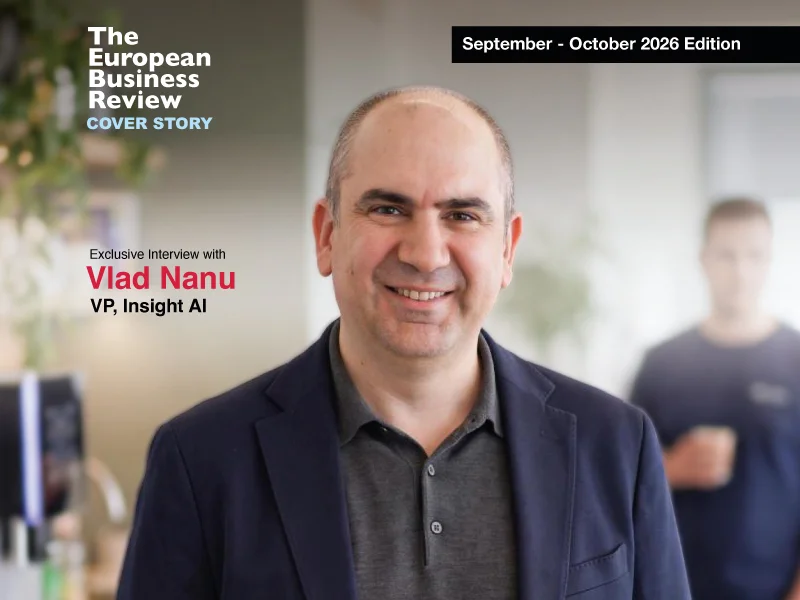
Vlad Nanu on human superpowers, original thinking and staying competitive when every company runs on the same models
When Insight Enterprises introduced Insight AI, it made itself the first proving ground. The Fortune 500 Solutions Integrator became what Vlad Nanu calls client zero: 14,000 teammates across more than 20 countries, every department, every language — “the perfect environment to test a new technology at scale” — with the tools opened to everyone.
To date, teammates have built more than 7,000 personal AI agents — working automations for their daily tasks, one for roughly every second person in the company. “The adoption happened much faster than people thought,” says Nanu, VP, Insight AI. “People use AI daily, and through tailored automations they make themselves more productive. So, when we looked at the numbers and talked to people, we realised that actually people like it, people see value in it. And if they see value in it, that means their output is actually becoming better.”
We recently sat down with Vlad Nanu for a conversation about successful AI adoption, tech-augmented human superpowers, and a decisive question: when everyone’s AI thinks the same, where does your edge come from?
A tech founder’s view of a hyped technology
Nanu’s perspective is shaped by having built a technology business himself. In 2009, he co-founded Amdaris, a Bristol-headquartered software development firm with delivery centres across Europe, and as co-CEO, grew it into one of the UK’s fastest-growing technology companies before its acquisition by Insight Enterprises in 2023. Today, he is the VP of Insight AI, the group’s dedicated suite of AI services and expertise designed to address the most common barriers to value realization.
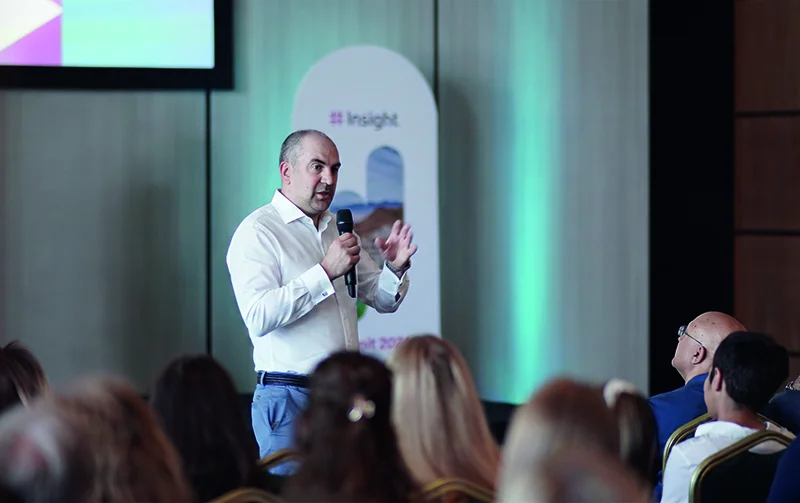
In advising clients, Nanu draws on his background as a founder: “Being a founder, you appreciate every single minute of your time, and you appreciate the relationship you have with your customers,” he says. “Your word, your commitment to the client, is on the line.”
With 25 years of experience in tech, Nanu has worked through several technology cycles — Web 2.0, smartphones, cloud. “Cloud and mobile were more relevant for technologists. AI is comparable to the creation of the internet — everybody has a chance to feel it. It’s making more waves,” he says.
The waves tend to reach Nanu early. Insight has been a Microsoft partner for over 25 years, and relationships like this mean he often knows what is coming before the market does. “Every time there is a new technology development at Microsoft, they will share it with us, and we work out a strategy on how it might change the life of our clients. We have early exposure, so we know what’s coming.”
The problems AI should and should not solve
Leaders are eager to adopt AI in all parts of the organisation, but Nanu sees that as ineffective and wasteful: “A lot of the time, the problem is actually much easier to solve with a classical piece of software, where you don’t need AI — because it’s cheaper and more precise.”
Traditional software is deterministic: two plus two equals four, every time. AI is not. So the starting question is never where the company can use AI but, as Nanu frames it, “what’s the business problem which we can solve in a non-deterministic way?”
Traditional software is deterministic: two plus two equals four, every time. AI is not. So the starting question is never where the company can use AI.
His method for finding those problems is to look for contradictions: places where a business is trying to do two things that are mutually exclusive. One of Insight AI’s clients, a logistics firm supplying urgent engineering parts, receives thousands of emails per day and has committed to answering each within thirty minutes. Meeting that standard manually would require hundreds of teammates. The company has five. That is a contradiction — and, in Nanu’s framework, a signal that AI belongs there. An agent now reads and sorts every email, drafts replies, and escalates to humans only the messages that genuinely need human judgement — allowing a company of five to deliver services and compete as if they had hundreds of teammates.
AI augmentation outperforms layoffs
In Nanu’s view, the best financial outcome of AI lies in boosting and augmenting the skills of teammates and organisations — well before any salary savings. “It’s not about replacing humans, it’s about bringing superpowers to the humans,” he says.
“We can build a project using AI five times faster and five times cheaper. We’re still growing both revenue and profitability and teammate numbers. AI didn’t shrink the organisation, it made the organisation bigger. With AI and humans, one plus one equals eleven,” as Nanu puts it.
That equation also holds at the top of organisations. Tasks Nanu once delegated for lack of time, he now does himself with AI — and the result stays closer to his intentions: “We’re shortening the chain of command. Every time a message passes from one person to another, it gets diluted. Now the consistency stays the same, and I can achieve much more.”
Nanu points out that the entry point to AI agents is well-known to many organisations. Anyone working in Microsoft 365, for example, can start building personal agents in Copilot or Copilot Studio — the superpowers begin with tools they already pay for.
When everyone thinks the same, nobody competes
Augmentation comes with a condition, though — critical and creative thinking has become more important than ever: “It doesn’t matter what LLM you use — you might get different words, but you get exactly the same reasoning behind them. All the models were trained on pretty much the same data.”
A company that uncritically adopts AI out of the box synchronises its thinking with every competitor that did the same. “If everybody is thinking the same, how will companies compete with each other?” Without critical and creative thinking, companies risk producing a sea of sameness.
In Nanu’s analysis, the humans are the competitive engine itself, because divergent thinking is the one input the models cannot supply. “We need humans to create new ways of doing stuff, new ways of working, new ways of thinking. Mono-thinking is by nature incompatible with human beings.”
Hallucination is a documentation problem
A central fear in AI adoption is hallucination — that the AI simply makes things up. That is, as Nanu points out, more often an issue related to a lack of context and documentation.
“We need humans to create new ways of doing stuff, new ways of working, new ways of thinking. Mono-thinking is by nature incompatible with human beings.”
Documenting how the business actually works — what he calls business ontology — and feeding it to the AI as context is essential. Restrictions alone, in his view, make a poor guardrail. Nanu advises starting with agents that are deep and narrow: a generalist agent that can do everything can also be hijacked. Agents should be governed the way any organisation governs people; nobody hands a junior teammate the company’s trade secrets. That is also how Insight rolled out AI to its own 14,000 teammates: inside protected GPT environments built on Azure OpenAI, where no data ever left the company.
Good documentation has multiple benefits. The knowledge of how work moves between departments usually lives in people’s heads, and it leaves when they do. Agents built on documented ontology retain it. “People move jobs, people leave, people retire, and sometimes you have these gaps in skills,” Nanu says. Done properly, enterprise AI becomes institutional memory that outlasts any individual teammate.
Four phases from pilot to platform
Nanu and Insight AI work with four phases when they consult on AI adoption.
- It starts with discover — finding the contradiction, and testing whether AI can plausibly deliver value there. His team then builds a working prototype in around five days, and the client calculates the return. “It’s important that customers calculate their own ROI.”
- If the numbers hold, design follows: guardrails, cybersecurity, access control, governance — because however clever the agent feels, “there is no human behind it. This is a computer program, and it has to be designed in the right way.”
- Then build: this time an enterprise-grade solution, in practice usually several narrow agents working together, supported by conventional software.
- Finally manage: deployment and production. Nanu is agnostic about where the agents run: Azure AI Foundry, on-premise, or hosted elsewhere. The reasoning behind every decision the agent takes is logged and audited, so humans can understand why it did what it did. Then the loop returns to discover for the next contradiction.

The next frontiers in AI
In the coming years, Nanu expects that we’ll see more AI integration running between companies. “When you fly from London to Paris, you believe the person who took you from A to B is the pilot. The reality is there are at least forty companies involved in that flight” — and the passenger never feels it, because those companies coordinate constantly. Most modern businesses are interlinked this way, in construction, finance, software development. The agents now being built inside departments will, he argues, eventually work across company boundaries, freeing teammates from some of the coordination that today requires enormous effort.
Looking three to five years out, Nanu expects the market to sort into three groups: companies that largely avoid AI and survive in niches; companies that adopt AI off the shelf and discover they now think identically to every competitor that did the same; and companies that put AI to work inside a point of view of their own. The middle, he warns, will be the most uncomfortable place to compete from — maximum cost, minimum differentiation.
Nanu’s advice to leaders is to treat AI as an exceptionally capable tool and simultaneously “never become dependent on the tools”: the winners will be the organisations whose people were allowed to do the thinking that machines can’t. “Their brains will have to work really hard, in a good way,” Nanu concludes.
The technology functions as an audit. It automates the repetitive work, and in doing so it exposes everything else: how well the business is documented, how its leaders think about people — and whether, once the machines all think alike, the company has any thinking of its own.