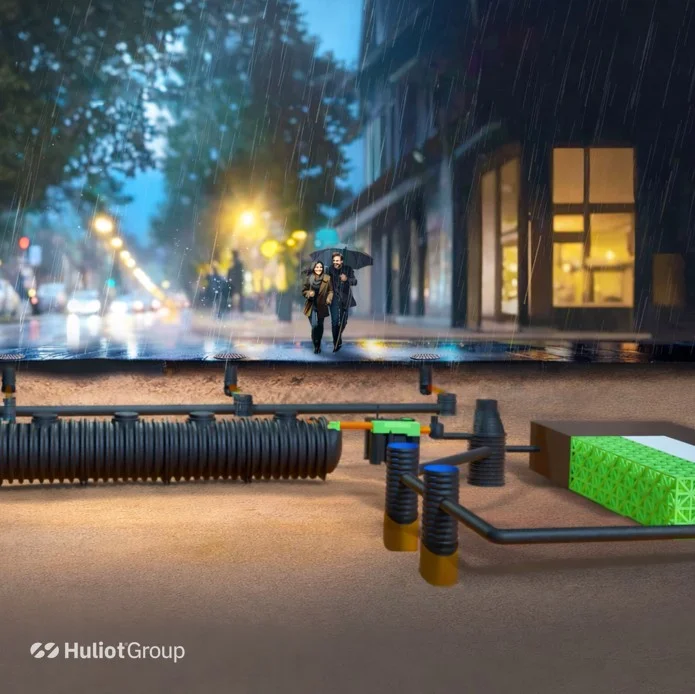
In business, leadership is often associated with visibility. Bold strategies, charismatic executives and headline-grabbing innovation tend to dominate the conversation. Yet many of the most resilient organizations are built on decisions that attract little attention at the time they are made.
This paradox is especially clear in sectors where success is measured by absence rather than presence. Infrastructure, and particularly water and drainage systems, offers a compelling lens through which to examine this kind of leadership. These systems rarely appear in annual reports or public narratives, but when they fail, the impact is immediate, costly and highly visible.
The leadership challenge, therefore, lies in designing for continuity rather than recognition.
Urban water and drainage networks depend on components that are largely invisible to the public eye. Pipes, access chambers and maintenance points operate below ground, quietly supporting daily life. Their effectiveness is not judged by how innovative they appear, but by how consistently they perform over time.
This reality forces leaders to adopt a long-term mindset. Decisions made during the design and planning stages can influence operational reliability for decades. Choosing systems based solely on initial cost often leads to hidden liabilities: difficult maintenance, premature deterioration and higher lifecycle expenses. In contrast, leadership grounded in lifecycle thinking prioritizes durability, accessibility and system integrity.
One of the most overlooked aspects of infrastructure leadership is the role of access. Manholes and inspection chambers may seem like minor technical details, yet they determine how easily networks can be inspected, maintained and adapted. When access is poorly designed, even small issues escalate into major disruptions. When it is thoughtfully integrated, systems remain stable, safe and controllable.
Organizations operating globally in this space, such as Huliot Group, exemplify how leadership decisions translate into infrastructure reliability. By focusing on system-level performance rather than isolated components, they reflect a broader management principle: resilience is built through consistency, not through isolated innovation.
Materials selection further illustrates this point. Traditional construction solutions have long favored heavy, rigid materials that are familiar but not always optimal. Advances in polymer-based systems have introduced alternatives that reduce installation time, improve durability and lower environmental impact. Opting for these solutions requires leadership willing to challenge convention in favor of long-term value.
This shift is not merely technical. It signals a broader strategic orientation toward sustainability, operational efficiency and risk reduction. Leaders who embrace such choices recognize that resilience is not achieved through redundancy alone, but through intelligent design.
Trust plays a central role in this equation. Public infrastructure is built on an implicit social contract: systems must work reliably, even when no one is paying attention. Maintaining that trust depends on leadership decisions that prioritize prevention over reaction and long-term performance over short-term optics.
The lessons extend beyond infrastructure. In any organization, the most critical leadership decisions often concern processes, systems and capabilities that remain out of sight. They rarely generate immediate recognition, but they determine whether an organization can withstand pressure, scale responsibly and adapt to change.
In an era defined by uncertainty and complexity, designing for the unseen may be one of the most underappreciated leadership skills. Those who master it build not only robust systems, but enduring institutions.