

By the Association for Business Psychology Industry Insights Team
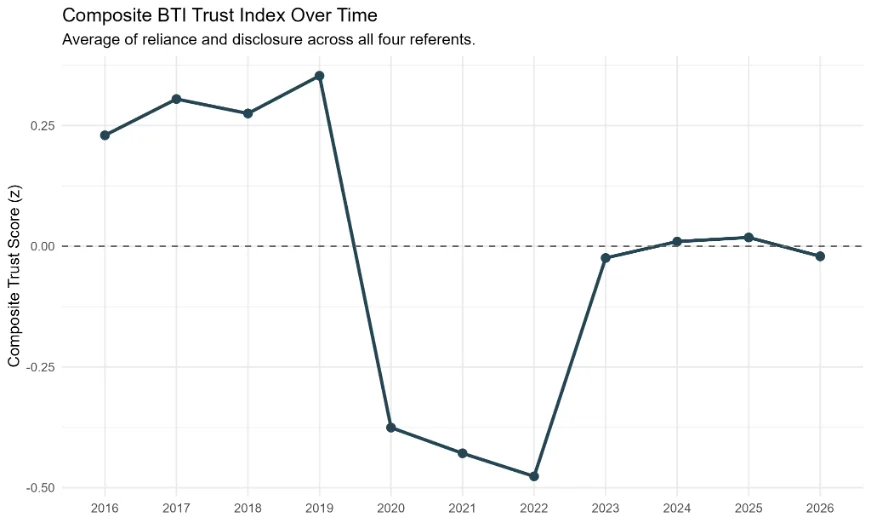
Evidence from 27,361 employee reviews from 2016 to 2026 shows a pattern of positive trust, steep deterioration after 2019, and recovery to a more neutral baseline.
Employees judge trust at work through everyday evidence: how decisions are made, how systems operate and whether promises are kept. We are the Association for Business Psychology’s Industry Insights Team, bringing together business psychologists, researchers and practitioners. Our analysis of 27,361 English-language Glassdoor reviews from 12,696 employers between 2016 and 2026 shows that trust followed a more complex trajectory: it weakened sharply during 2020–2022, recovered only to an approximately neutral baseline, and became increasingly dependent on whether organisational systems are fair, reliable and explainable.
Why Did Trust Weaken and Only Partly Recover?
The wider ABP research programme reviewed academic and organisational evidence, while a dedicated white paper analysed unprompted employee voice using theory-led trust measures and inductive topic modelling. Employees rarely wrote about trust as an abstract topic. They wrote about leaders who did not follow through, inconsistent decisions, unsafe speaking-up environments and systems that made work harder.
The fact that trust did not emerge as a separate topic does not mean it was missing from the analysis. It shows that employees describe the evidence on which trust is based rather than the concept itself. This is why unprompted voice adds value alongside surveys: it reveals which experiences employees themselves consider worth recording, without requiring them to interpret those experiences through a question labelled ‘trust’.
The pattern over the decade had three distinct phases. Trust language was net positive and broadly stable from 2016 to 2019. It then fell sharply, reaching its lowest point in 2022. From 2023 it recovered, but only to approximately neutral by 2026 – not to its earlier positive level.
Six separately constructed breakdown signals – low collaboration, reduced psychological safety, disengagement, emotional labour, burnout and manager role strain – followed the same pattern. By 2026, only 34-45 per cent of the 2019-2022 deterioration had been recovered, and none had returned to its earlier baseline.
The finding is not that every organisation has suffered a uniform decline. Glassdoor reviews are self-selected and the analysis identifies patterns rather than proving causation. The important insight is that apparent stability can conceal a weaker psychological contract. Neutral is not the same as trusted. Employees may still be more cautious about what they believe, share and give to their organisation.
Why Can’t Supportive Colleagues Make Up for Poor Organisational Systems?
Trust is often treated as interpersonal: the quality of the team or the relationship with a line manager. Those relationships matter greatly to wellbeing. However, in our analysis, they were not the strongest predictors of overall employer ratings.
When the four trust referents were considered together, institutional trust was the strongest unique predictor of overall employer rating (β = 0.30), followed by technology trust (β = 0.25) and manager trust (β = 0.18). Colleague trust contributed little additional explanatory power once these other forms of trust were taken into account. Across the wider BTI model, the trust measures accounted for 42 per cent of the variation in employer ratings.
This does not mean colleagues are unimportant. It suggests that a supportive team cannot fully compensate for unclear, inconsistent or poorly designed organisational systems. Employees can value their peers while judging the employer poorly because policies change without explanation, promotion processes feel inconsistent or digital systems cannot be challenged.
The topics employees chose to praise also shifted. Supportive-team and workplace-culture comments accounted for 34.3 per cent of positive sentences in 2016, but 29.2 per cent in 2026. Positive attention moved towards compensation and flexible working. This suggests an employment relationship becoming less relational and more transactional: employees may value colleagues while evaluating the organisation increasingly through the material and institutional deal it provides.
The practical implication is that team-building and manager training, although useful, cannot repair a system-level problem. Leaders need to examine policy consistency, organisational follow-through, data governance and the transparency of decisions. Asking managers to compensate for flawed systems through better conversations is neither fair nor likely to work.
How Can Greater Control Produce Less Trust?
A central paradox is that organisations often respond to uncertainty by increasing control. Remote and hybrid work accelerated the use of productivity analytics, monitoring tools and automated management systems. These technologies can provide useful information and reduce genuine operational risk.
Yet opaque or disproportionate monitoring can be experienced as evidence that employees are not trusted, potentially reducing autonomy, raising concerns about privacy and fairness, and making people more guarded. Leaders then receive less candour and may conclude that even more oversight is required.
AI makes the tension especially visible. Fewer than four in every 1,000 reviews mentioned AI-related technology in 2016; by 2025, more than 42 did. At the same time, the proportion of AI mentions appearing in positive text fell from 84 per cent in 2019 to 45 per cent in 2020 and was 45.7 per cent in 2026. Greater visibility has therefore not been accompanied by more positive employee commentary, suggesting that familiarity alone should not be assumed to produce confidence.
This creates the potential for a self-reinforcing cycle: uncertainty prompts greater control; control may signal mistrust; employees become more guarded; and reduced candour creates further uncertainty. The solution is not to remove every control. It is to make controls proportionate, transparent and open to challenge. The same principle applies to AI-supported decisions: technical consistency is not enough if employees cannot understand the logic, identify accountability or appeal an outcome.
What Does It Mean to Design for Trust?
Trust should be treated as a requirement for organisational design, not as an outcome to be measured after implementation. Before changing a process, policy or technology, leaders should test whether employees can understand it, experience it as fair and speak honestly about its effects.
Four practical tests help translate that principle into action:
- Explain the criteria, data and decision logic that affect employees.
- Provide a credible route to question, correct or appeal an outcome.
- Check that incentives, resources and manager expectations support public promises.
- Use employee voice before, during and after change – and close the feedback loop.
| Decision area | Conventional question | Trust-design question |
| Performance | Is the process efficient and consistent? | Will employees understand the criteria and experience them as fair? |
| AI and monitoring | Does it improve accuracy, visibility or control? | Is data use transparent, proportionate and open to challenge? |
| Employee listening | Did the score improve after implementation? | Were employees involved early, and can they see what changed? |
Table 1. Applying trust as a design requirement.
A single trust score may conceal whether the problem sits with colleagues, managers, the institution or technology. Measurement should therefore distinguish between these levels and combine prompted survey questions with spontaneous employee voice. The most important warning signs may appear in stories about fairness, follow-through or systems rather than in response to a question labelled ‘trust’.
What Should Leaders Take Forward?
The research does not support a simple claim that trust is declining everywhere. The research points instead to trust becoming more conditional, more systemic and more contested. Leaders will not rebuild it by communicating more. They must make trust reasonable through fair and explainable systems, transparent technology, consistent follow-through and decisions that employees can question without penalty. As AI becomes more embedded in work, designing for trust will become a core condition of successful change.
 The Association for Business Psychology Industry Insights Team brings together business psychologists, researchers and practitioners to examine emerging workplace issues. Its 2026 reports combined a review of academic and organisational evidence with analysis of 27,361 employee reviews, focusing on trust, organisational systems, employee experience and technology.