

By Justin Pennington
Agility depends less on asking people to adapt than on designing organisations that can sense, decide and respond in time.
On 1 June 2009, Air France flight 447 fatally crashed into the Atlantic. The loss of reliable airspeed information caused the autopilot and autothrust to disconnect. Subsequently, the pilot flying made repeated nose-up inputs; the aircraft climbed, slowed and entered a stall from which the crew did not recover[1]. The accident had many interacting causes, but it illustrates a wider systems lesson.
Under uncertainty, an action that instinctively feels like a way to restore control can actually produce the opposite result.
In most cases, the phrase ‘organisational agility’ has become shorthand for becoming more competitive by moving faster than their competitors. It’s referred to as both a noun (think ‘agile’ operating models) and a verb (‘our cultural aspiration must be agile’). This, as it turns out, is an oversimplification. Because when we combine the ever-increasing complexity of operating environments with an accelerated need to change, the resulting tension can increase the risk of unintended consequences.
When the instinct for control becomes the risk
Organisations often follow a similar pathology. Consider a new regulation, a competitor’s move, or a technological shift, all of which raise uncertainty and surface a perceived risk. The first move by an experienced leader can be to respond in ways that have served them well in the past.
Once a significant trigger event has surfaced, hierarchy becomes the organising principle to respond. Decision-making is pulled upwards, increasing the number of approvals required by individuals to act. Everything appears to be going well, and management feels they have sufficient visibility and information to respond. However, over time, employees near the point of action find that their ability to respond is delayed, as decisions take longer to make and the information filtered up through the organisation’s hierarchical layers is insufficient to support local innovation. In the end, senior leaders have more and more decisions to make, with less time, and naturally less information (Figure 1).
Figure 1: The reinforcing systems loop of tightening control working against agility.
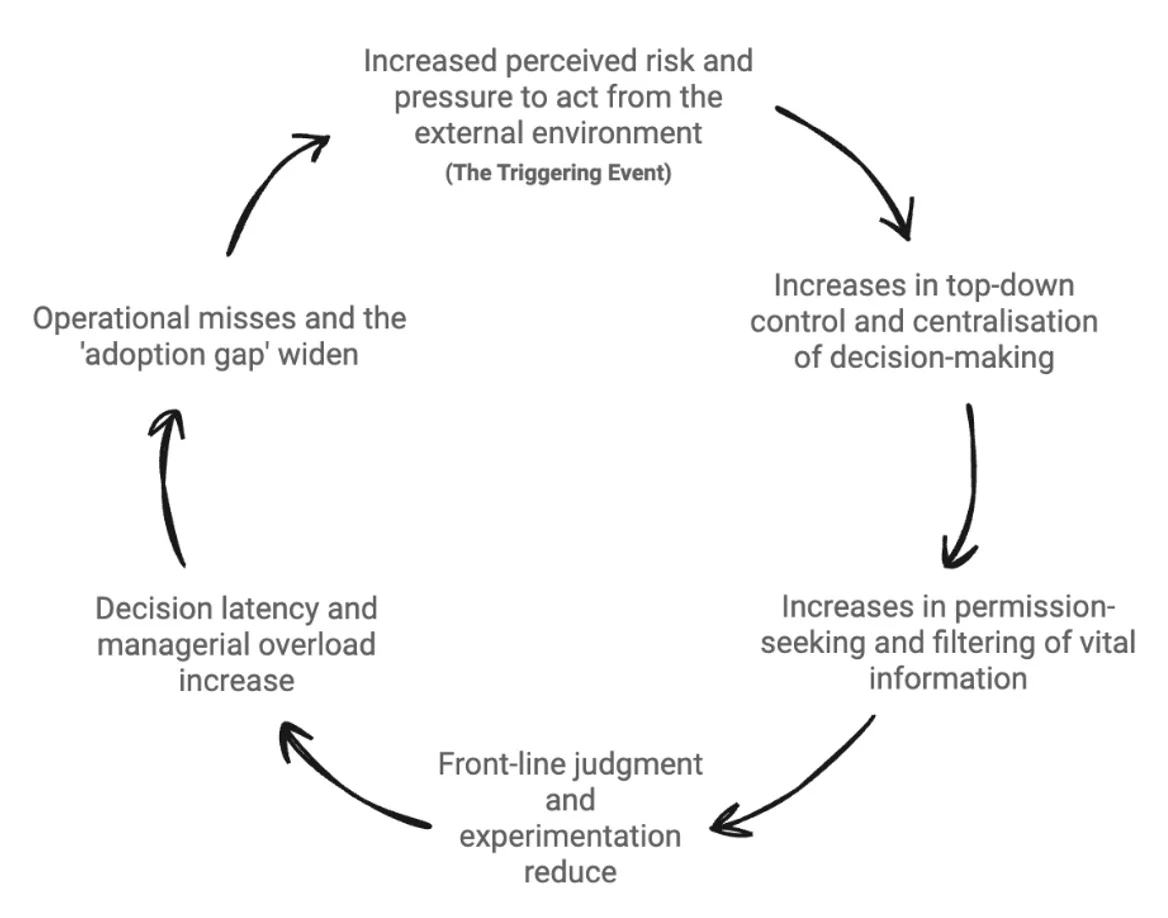
The loop in Figure 1 shows the reinforcing dependency, which is, in part, a characteristic of the Shifting the Burden system archetype. Centralising decisions relieves the immediate concern but does not strengthen the organisation’s capacity to handle future complexity. These effects compound over time. As local judgment is progressively eroded by relying on others, a few managers become a total bottleneck to progress. Performance declines, increasing perceived risk, which in turn increases centralisation.
Agility is a property of the system
Organisations often describe agility as a characteristic of individuals or teams. Employees are encouraged to ‘embrace change’ and ‘become more entrepreneurial’. Instead, Cappelli and Nehmeh describe ‘sustainable agility’ as more of a structural property – the capacity to adapt repeatedly without eroding the foundations needed for future adaptation.[2] This fits sensibly with another systems axiom espoused by Peter Senge, that ‘structures drive behaviour’. In other words, leaders must design sustainable agility into the organisation and not expect people to develop sustainability merely by adopting aspirational, abstract terms.
When we speak of adapting to an operating environment, we are talking about a wider variety of situations that the organisation needs to respond to. Cybernetics pioneer Stafford Beer developed the Viable System Model to explain what adaptive capacity requires. Individual operational units need enough autonomy to regulate the work they understand, while coordination mechanisms manage their interdependence. Senior management provides coordination but does not absorb every operational decision. When dealing with many different circumstances, forcing them through a narrow group of decision-makers can actually decrease a firm’s agility.
It’s not about the speed of individual parts. It’s about the quality of the connections, how information is processed, and how decisions are made through those connections to enable coordinated action.
Design governance for response
Many organisations describe their culture beautifully. They proclaim empowerment, collaboration and innovation, but the real test arrives with the first unexpected problem on Monday morning. That difference is the Adoption Gap: the distance between how an organisation says it works and the behaviour its systems actually produce.
Strategic risk cannot be assessed in isolation from the governance system responsible for responding to it. An organisation may identify a threat and fund an appropriate strategy, yet still fail because its decision and information systems cannot act in time. As change accelerates, response capability becomes part of the risk itself.
Breaking this pattern does not require removing hierarchy. The challenge is to determine what should be controlled centrally and what can be governed and managed near the point of work.
Establish clear decision-making boundaries for individual teams and how they will coordinate with each other. Establish when escalation is required, and ensure that strategic context flows down, routine local details are handled at the edge, and material risks, anomalies, and opportunities are escalated upwards.
Governance should enable experiments in a controlled environment to convert uncertainty into evidence, thereby avoiding exposure of the whole organisation to unknown risk.
Measuring response time within an organisation is a key indicator of its strategic risk performance. For senior management, checking the number of approval layers within an organisation and the time it takes for information to reach the correct decision-maker are critical indicators. This reveals whether further measures strengthen or weaken the organisation’s response.
Conclusion
Agility is the ability of the total organisational system to sense, decide and respond in due time without exhausting its ability to change again. It requires a balance between senior management control and the distribution of authority and responsibility.
When market uncertainty is rising, leaders should resist the instinctive urge to pull decisions up. This may provide temporary reassurance, but at the expense of local judgment and information flows, which are crucial for rapid decision-making. Governance means distributing authority, amplifying material signals, and rendering small experiments safe.
In volatile markets, this is no longer a choice. It is a matter of survival.
 Justin Pennington