
By Christoph Williams
Can learning permanently change how people think, not just what they know? Experimental learning uses psychology to make that transformation possible.
Organizations need learning experiences that produce lasting behavioral change, not temporary knowledge gains. Experimental learning achieves this by immersing participants in live psychological experiments that challenge assumptions and reshape decision-making through firsthand experience. In this second article of the series (read Part 1 of this article series), Christoph Williams, a Chartered Occupational Psychologist and Senior Manager of Talent & Organisational Development at Tate & Lyle, examines how this emerging approach can strengthen leadership, collaboration, and organizational performance.
What is experimental learning?
Experimental learning is a distinct form of experiential learning that submerges delegates into “live” psychological experiments as active subjects. Although each experiment targets a specific topic, they can be delivered sequentially (or in parallel) to provide a cumulative learning experience.
The approach is particularly effective because the learning experiences are reinforced by the experimental outcomes. As the latter are a result of the delegates own behaviours, it adds additional salience and face validity to the evidence.
Learning through discovery
The aim is not to instruct or manipulate the delegates. It is to provide sufficient critical mass for individual change through the provision of learning opportunities, experimental evidence and reflection spaces so delegates choose to change their beliefs or assumptions and “shift” their mindsets. This may be associated with moments of insight (the “ahah” experience), as they draw their own conclusions to create personal meaning. In this way, learning emerges through discovery, not instruction.
Set-up and facilitation
Whilst performing as subjects, the delegates will not know the precise purpose of each activity until fully debriefed, so appropriate positioning, contracting, informed participation and psychological safety is required.
Although structured in design, flexible facilitation allows specific learning points to be addressed as they arise within the group. This tailoring may appear opportunistic to the delegates but is usually the result of the design, as common issues tend to arise across participant groups.
An example is the use of “hot seats”, where a delegate works one to one with a facilitator, in front of the group to deep dive and explore their personal challenges and learnings. This exploits the social aspects of learning, allowing the group to explore and create meaning from their shared individual and group learning experiences. This also helps to strengthen the groups sense of belonging, identity and mutual support.
An example: Group Dynamics and Leadership
To bring the concept of experimental learning to life, here is an example design concerning groups dynamics and leadership styles (see figure 1).
Firstly, various pictures (red positive images and blue negative images) are positioned though out the venue (e.g. reception desk and rest rooms) to create a subliminal priming effect. Upon arrival, delegates are given white boiler suits to wear and asked to leave all communication devices (e.g. phones, laptops) to one side. This helps to remove visible signs of status\personal identify, requires delegates to relinquish some control and prevents distraction. The group is then split into two, based upon their perception of time, which is also related to personality (Hauser, et al 2009), to create the red team (with an angrier temperament and task focus orientation) and the blue team (with more passive temperament and people focused orientation). Importantly, the delegates are not aware of this difference and are provided with red and blue sashes to visibly reflect their “preference” group membership.
Both teams spend 10 minutes to create their team’s name, values, logo and strapline to represent what they stand for. This helps to create a sense of group identity and belonging. A random person (e.g. hotel receptionist) is brought into the room and publicly assigned the role of a judge. The groups then complete a competitive task, using red and blue items in the room to visibly drive up a red\blue bar charts representing their team performance. In reality, the groups actions have no impact upon the performance graph, and the result are staged to be a draw. The judge is then asked to determine the winning group… usually always red, as humans have a bias towards red (Elkan 2009).
The groups are then asked to provide a rationale for how their actions drove the performance graph and flip chart their feelings towards their own in-group and the out-group. This highlights how inter-group competition leads to increased within group cohesion and in-group/out group bias, in addition to positively impacting performance.
The natural leaders that have emerged are then taken out of their “preference” group, swapped around (i.e. sashes exchanged) and inserted into the other group. They are also briefed to be particularly naturally preference orientated (i.e. the red “task” group is now led by a lassie-faire people leader and the blue “people” group by a dictatorial task master). Another short task is completed before a debrief of reflections on what it is like to be led by someone with a different personal preference, which will have become very apparent by this stage.
Figure 1: Example design for group dynamics and leadership
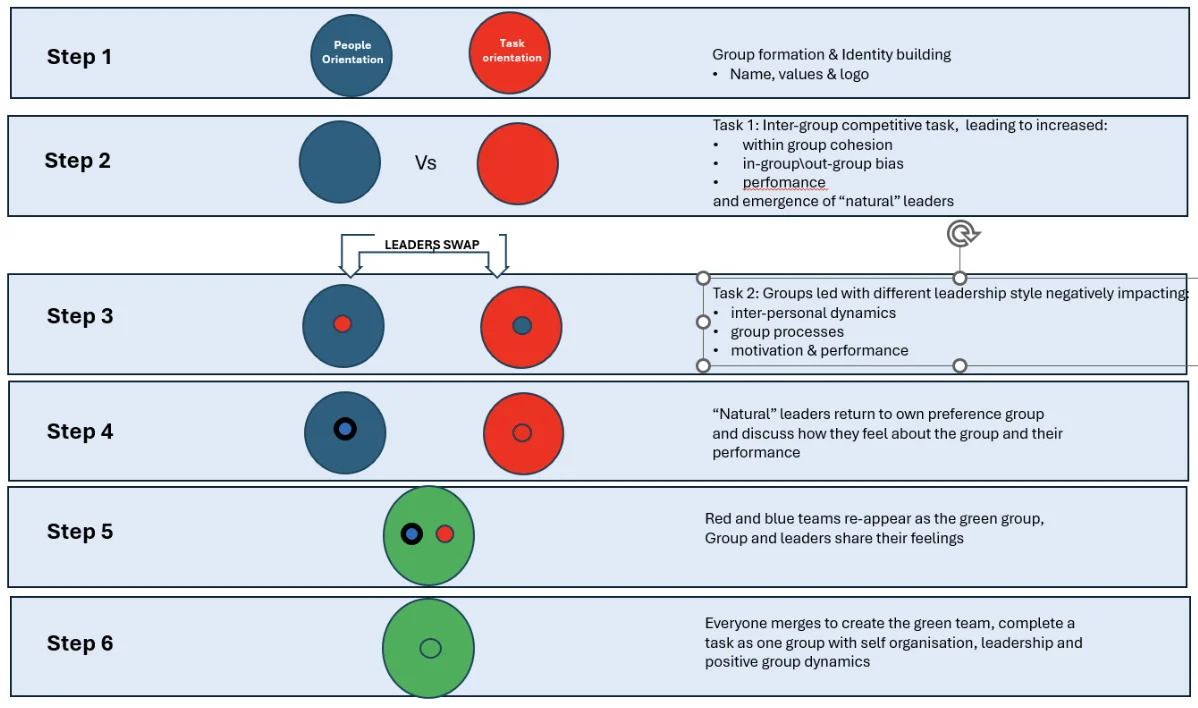
The leaders then return to their original “preference” group and are asked to describe how they feel about the group’s membership and how they performed in the previous task when they led them. The leaders then stay in the room whilst the other delegates leave, only to return back into the room as the green sash wearing group. A debrief follows, exploring how the delegates thoughts and feelings changed during the experience and the implications of these insights for employees, during periods of organisation restructures resulting in changes of group membership and leadership.
Then all delegates become the green group, with the opportunity to select a clear leader, self-organise and work on a task with a clear goal. This is followed by a debrief on how this impacted upon the group dynamics and effectiveness.
A final debrief then takes place during which all components of the experiment are revealed. Delegates then discuss and explore the implications of their new insights for the workplace and use these to craft their personal development objectives.
Table 2: Key learnings
| Topic | Learning Outcome | Evidence | Relevance for the workplace |
| Human bias | Everyone has unconscious biases that affect their judgements | Demonstrated by the judge identifying the reds as winners | Understanding we naturally have biases is the first step to addressing them |
| Spurious correlations | Humans are hard wired to create meaning out of co-incidences and may develop rituals & superstitions | The groups actions really had no impact on the performance chart | Beware of how you create meaning out of spurious correlations. Revisit organisational rituals and ways of working |
| Group formation, cohesion, bias, competition and performance | The importance of group identity & purpose for belonging, motivation and performance. Inter-group competition increases in-group cohesion, performance and bias but reduces inter-group collaboration | Red and Blue team creation and competition activity increases groups sense of cohesion, task effort and results in more favourable characteristics attributed to in-group than out-group | Relevant for organisational design & processes, performance management goal\ KPI setting & reporting |
| Leadership style | The impact of leadership style and group working preferences on team dynamics. Development of leadership empathy | Disruption to group dynamics, norms and performance caused by the change in leadership and style | Impact of changing leaders and group membership on group dynamics and performance.
|
| Optimising group performance | How a clear group purpose, goal and positive leadership can impact group belonging, performance and wellbeing | Working effectively as the green team | How to successfully set up and lead teams to optimise performance. |
This approach can also be combined with bio and\or neurofeedback “state” management training. This involves a mixture of mindfulness, meditation, hypnosis and guided visualisation combined with a visual or auditory signal of various psychological and physiological measures of arousal (e.g. electroencephalogram measures of attention, focus, relaxation and\or heart rate, galvanic skin response, etc). Delegates are encouraged to “tune in” and become more aware of their personal resting state and then learn how to control it under pressure to stay in a “challenge” rather than a “threat” state, the former being associated with better performance outcomes (Hase 2025). Guided visualisation can be used to prepare delegates for future challenges and pressure situations (e.g. “compression” presentations where preparation time is shortened and the audience assertively push back, zombie escape challenges, etc) used to provide practice sessions during which delegates learn to better control and optimise the use of their psychological and physiological resources when performing under pressure. How they perceive and appraise situations as either a challenge or threat can also be explored along with “approach” and “avoidance” goal setting (Turner 2014), all in support of building resilience and optimising performance.
The use of “state” management may even facilitate mindset shifts, as there is some evidence that state management practices facilitate brain plasticity through greater myelination and neurogenesis (Krishnakumar, 2015).
The experimental learning approach is proving highly versatile and is being applied to a growing number of other topics including the impact of mindset on performance, human bias and group creativity and pre-existing beliefs on perception. Experimental learning has the potential to transform not just what people know, but how they perceive and interpret reality, themselves and ultimately choose to behave.
 Christoph Williams