
By Lola Herrero Amo and Diane Hirschenhaut
When a restaurant becomes more than a meal — how the best hospitality venues build emotional loyalty that outlasts any single disappointing dish.
Think about your favourite restaurant. The one you keep going back to, year after year, even when the experience falters. Chances are, you have a story attached to it. A birthday. A grandmother’s chocolate fondant. Or even your first broken heart. That emotional attachment isn’t accidental. It is the result of a deliberate, cumulative process that the best hospitality brands build over time. This applied research introduces a new framework for understanding how restaurants evolve from service providers into venues so emotionally integrated into their guests’ lives that occasional shortcomings are forgiven, and loyalty becomes almost unconditional and remarkably resilient.
Why do restaurants shape a neighbourhood’s identity?
Restaurants do far more than feed people. In tourism-driven environments, they act as catalysts for territorial identity, commercial revitalization, and social cohesion. Economists describe this as a multiplier effect: each job or euro of spending generated in hospitality stimulates further employment and demand in the businesses around it. The effect is measurable (Moretti, 2010).
In Megève, the opening of iconic venues such as the Hibou Blanc helped reposition the resort in the premium segment. Between 2017 and 2023, average property prices in the village rose from €6,544 to €10,540 per square meter; an increase of 61 percent, well ahead of comparable neighboring villages; and the steepest acceleration coincided with the wave of new food-and-beverage openings.[1] In Deauville, new gastronomic players strengthened the city’s “Parisian by the sea” identity at a moment when post-pandemic demand for second homes was reshaping the coastal market.
But the most striking case is the Café Charlot. More than a brasserie, it has become a symbol of Parisian identity, both a local anchor for neighbourhood regulars and a global showcase amplified by Instagram and the international press. Indeed, the terrace functions as what Goffman (1959) called a “scene of recognition”, where being seen participates in the construction of social and symbolic capital (Bourdieu, 1986). Thus, Café Charlot does not merely serve brunch, it stages identity.
This attachment is not merely anecdotal. Some 96 percent of Parisians say they frequent café terraces, and 92 percent consider them essential to the city’s international image[2], a cultural centrality so profound that Parisian café culture has been proposed for UNESCO intangible-heritage status. In the right context, a hospitality venue stops being a business and becomes a monument.
“A guest who nostalgically recalls a chocolate fondant shared with their grandmother five years ago will return despite a disappointing meal — because the venue embodies memory, continuity, and emotional safety.”
How Does a Restaurant Become a “Safe Place”?
The Safe Place is not built overnight. It follows a progressive trajectory through four distinct stages: foundations, identity, community, and trust.
Figure 1: The Safe Place Theory: four stages of hospitality brand development (Hirschenhaut, 2025)
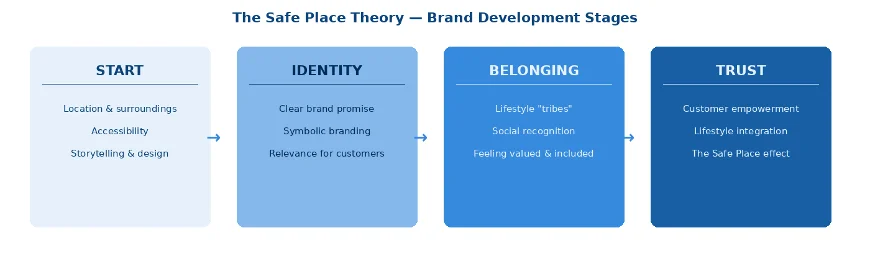
The Safe Place unfolds through four stages, detailed below. Megève’s village center restaurants operate here: the same families return every winter, not out of habit, but because the venue has become part of their collective memory. This loyalty can be referred to the marketing concept of brand tribalism (Cova & Cova, 2002). Research on marketing effectiveness supports this logic: around 60% of brand-building efforts should focus on long-term emotional connection, rather than short-term sales activation[3]. The reason is simple: a rising defection rate is the clearest predictor of eroding profitability. (Reichheld, 1996)
The four stage of brand loyalty in Hospitality:
- Foundations = Differentiation is physical and narrative (cf. the setting, the concept and the design).
- Identity = Symbolic Capital where values and meanings resonate beyond the plate, sustaining a consistent brand promise. The Branded venue embodies more than just a physical or aesthetic appearance.
- Community = Guests become part of a tribe bound by shared rituals and belonging. As Neumeier puts it in The Brand Flip, “the basic unit of measurement is not the segment but the tribe.” Moreover, customers seek to be recognized as belonging to the tribe within a “third place” (Oldenburg, 1999).
- Trust = The brand is no longer simply consumed; it becomes part of the customer’s personal identity. Hospitality is a human-centered business in which operational errors are inevitable; what distinguishes a Safe Place is that its customers forgive them. Loyalty here is remarkably resilient.
One nuance matters here. As Byron Sharp reminds us, buyers are rarely monogamous: they are “polygamously loyal”, maintaining repertoires of familiar brands[4]. The Safe Place’s real achievement is therefore not exclusivity but primacy — becoming the default within that repertoire, the table guests gravitate back to through memory, distinctive cues, and consistent quality. In this sense, as Nobel laureate Daniel Kahneman observed, “We do not choose between experiences, but between memories of experiences”, a principle that hospitality brands instinctively exploit when they engineer moments worth remembering.[5]
How can managers apply the Safe Place Framework?
The practical implications are significant. A restaurant operating within the Safe Place framework should structure its offer around four behavioural levers of the EAST framework: make the experience Easy, Attractive, Social, and Timely.[6]
Figure 2: The EAST Framework applied to hospitality loyalty (Hirschenhaut, 2025)
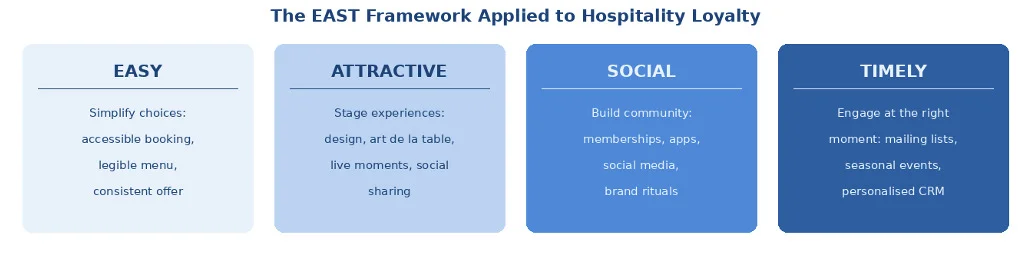
Key takeaway: The EAST framework applied to hospitality:
- Easy = Simplify choices (accessibility, a legible menu, seamless booking, clear concept and consistent offer).
- Attractive = Stage appealing experiences (design, “art de la table”, live moments). The venue’s brand equity must be memorable, recognizable, and distinctive.
- Social = Foster belonging (community rituals, social media, memberships, perceived exclusivity). Indeed, Marty Neumeier reminds brands in The Brand Gap, “Never forget that your consumers are your best promoters.”
- Timely = Engage guests at the right moment to build lasting memories and associations. As philosopher Avishag Zafrani argues, memory is never a mere trace of the past. It ‘doubles’ experience, keeping certain images active long after the moment itself has gone.
It also means shifting from one-way storytelling to story framing: rather than imposing a narrative, the venue offers a stage on which customers co-create meaning (Pine & Gilmore, 1999)— and, increasingly, broadcast it. Every photo shared from a terrace turns a consumer into a co-producer of the brand’s symbolic value.
Beyond operations, the Safe Place theory also has implications for destination management. Restaurants that have reached this stage function as strategic resort assets (c.f. the equivalent of monuments). They anchor visitor itineraries, reinforce place identity, and generate multiplier effects on employment and real estate. Megève’s emblematic venues, Deauville’s gastronomic flagships, and the Café Charlot in Paris all demonstrate how a single hospitality brand can shape an entire territory’s competitive positioning.
What are the risks when a restaurant becomes a Destination?
The same dynamics that generate emotional loyalty and territorial attractiveness also produce gentrification, land inflation, and the gradual exclusion of long-term residents. The Marais offers the clearest illustration: the success of venues like Café Charlot has contributed to the very touristification that now threatens the neighbourhood’s social diversity, in a city where residential prices have risen roughly tenfold over four decades.[7]
In Megève, rising property values driven partly by gastronomic repositioning converge with repositioning coinciding with mounting pressure on residents and seasonal workers and with a climate context of steadily declining Alpine snow cover, raising hard questions about local accessibility and long-term sustainability. [8]
One of the learned lessons of this research is not that restaurants should be less ambitious, but that ambition requires governance. When a restaurant becomes part of a destination’s identity, its decisions are no longer purely private. They shape who belongs and who is priced out of belonging.
This is what Zukin (1995) called the “symbolic economy”: culture and aesthetics become engines of real estate value, gradually pricing out the very communities that gave a place its character.
“A restaurant cannot be understood as a simple economic fact. It is an intervention in a complex web of identity, social, and spatial dynamics — calling for balanced public policy and increased responsibility from private actors.”
Conclusion
The best operators already know this intuitively. The most loyal customers are not just customers. They are an engaged part of that place. For managers, the lesson is simple to state and demanding to live: build memories, not just menus. For destinations, the lesson is bigger still: a beloved restaurant can lift an entire territory — and with that power comes responsibility for the neighbours it prices in or out. The Safe Place is never built by the restaurant alone. It is built with every guest who walks through the door, and it belongs, in part, to all of them.
About the Authors
 Dr Lola Herrero Amo is since 2013 Associate Professor at ESCP Business School, at the ESCP Innovation and Entrepreneurial Transformation Institute (Say Institute). Her academic and professional career has been developed in the fields of social innovations and sustainable tourism, developing as principal researcher/director international cooperation for development projects and consultancy missions, mainly in LatAm funded by public and private institutions. Since 2021 she is director of the PROFESSORSHIP “ESCP Business School as academic partner for RIU Hotels & Resorts“.
 Diane Hirschenhaut holds an MSc in Hospitality and Tourism Management from ESCP Business School (2025), where her thesis introduced the Safe Place Theory. A London School of Economics alumna in Brand Strategy, she joins NYU’s Gallatin School of Individualized Study in autumn 2026, pursuing an MA at the intersection of hospitality, urban development, and cultural identity — examining how symbolic belonging, once anchored in a place and captured by a brand, generates measurable real estate and urban value.
References
-
Bourdieu, P. (1986). The forms of capital. In J. G. Richardson (Ed.), Handbook of theory and research for the sociology of education. Greenwood Press.
-
Cova, B., & Cova, V. (2002). “Tribal Marketing: The Tribalisation of Society and Its Impact on the Conduct of Marketing”. European Journal of Marketing, 36(5/6), 595–620.
-
Cova, B., & Dalli, D. (2009). “Working Consumers: The Next Step in Marketing Theory?” Marketing Theory, 9(3), 315–339.
-
Goffman, E. (1959). The presentation of self in everyday life. Doubleday.
-
Holt, D. B. (2004). How Brands Become Icons. Harvard Business School Press.
-
Kahneman, D. (2011). Thinking, fast and slow. Farrar, Straus and Giroux.
-
Moretti, E. (2010). “Local Multipliers”. American Economic Review, 100(2), 373–377.
-
Neumeier, M. (2006). The Brand Gap: How to Bridge the Distance Between Business Strategy and Design (Rev. ed.). New Riders.
-
Neumeier, M. (2015). The Brand Flip: Why Customers Now Run Companies and How to Profit From It. New Riders.
-
Oldenburg, R. (1999). The Great Good Place. Marlowe & Company.
-
Pine, B. J., & Gilmore, J. H. (1999). The experience economy: Work is theatre and every business a stage. Harvard Business School Press.
-
Reichheld, F. F. (1996). “Learning from Customer Defections”. Harvard Business Review, 74(2), 56–69.
-
Zafrani, A. (2023). Philosophie du souvenir : le temps et son double. Presses Universitaires de France.
-
Zukin, S. (1995). The cultures of cities. Blackwell.