
Expanding into a new market often looks simple on a spreadsheet. Hire one person in Germany. Add a sales lead in Canada. Build a small support team in Singapore. Then the legal, payroll, tax, benefits, and employment contract questions arrive.
That is usually when companies start comparing employer of record providers.
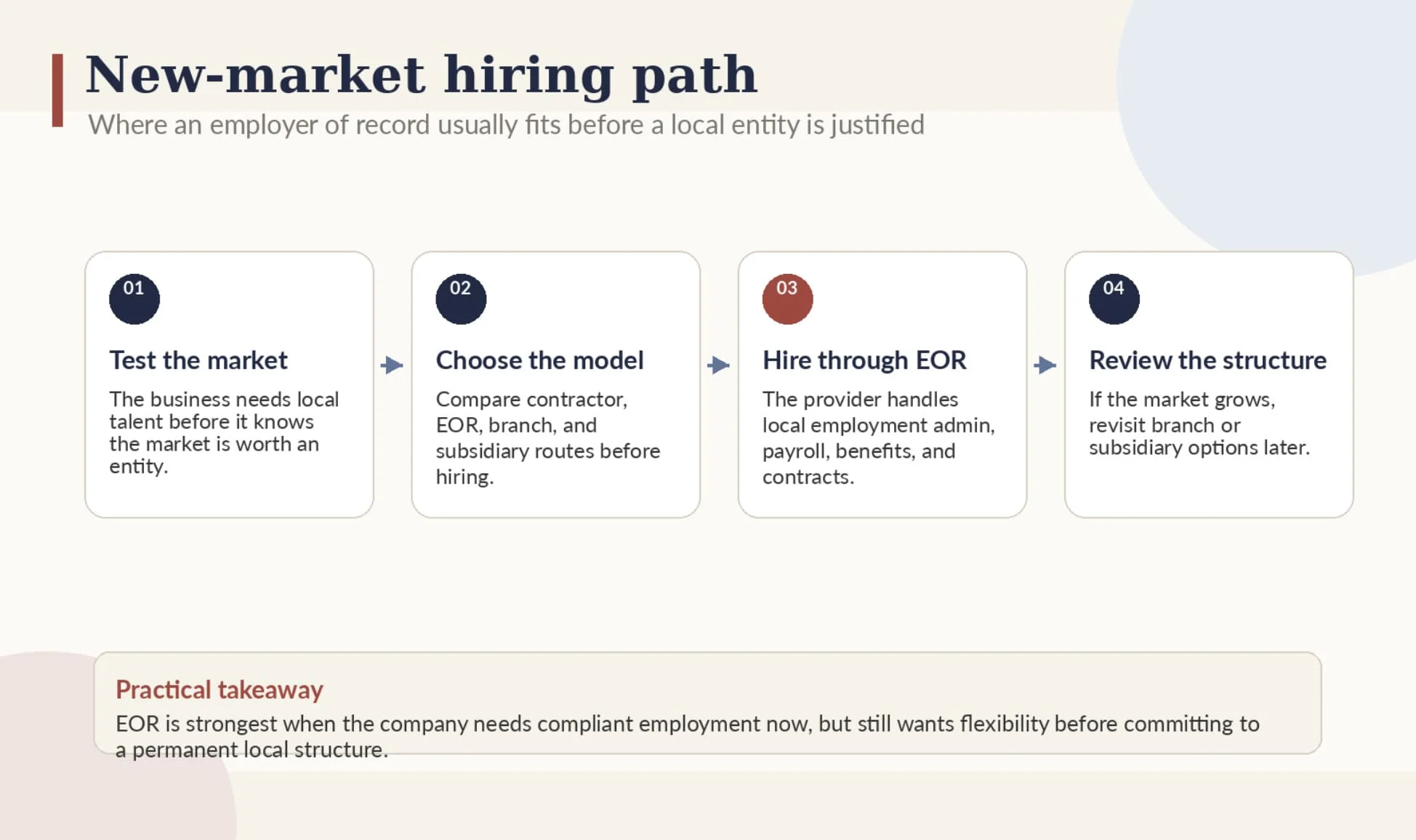
An employer of record, or EOR, lets a business hire employees in another country without setting up a local legal entity first. The provider becomes the legal employer for administrative purposes, while the company still manages the employee’s day-to-day work.
For businesses testing new markets, that can be a practical middle route. It avoids rushing into a local entity before the market has been proven, while still giving employees a proper local employment setup.
But choosing an EOR provider shouldn’t come down to country count alone. A company hiring one employee in one country has different needs from a business building teams across five regions at once. The right fit depends on speed, market complexity, payroll reliability, and how much support HR, finance, and legal teams need behind the scenes.
What to check before choosing an EOR provider
Before shortlisting providers, make sure the company is solving the right problem. If the business is still comparing a branch vs subsidiary structure, or deciding between a PEO vs EOR, settle that first. The employment model shapes everything that follows.
When reviewing EOR providers, look closely at:
- Country coverage in the markets you actually need, not just the largest global number.
- Local compliance support for contracts, benefits, tax, termination rules, and statutory requirements.
- Payroll reliability, especially if you are hiring across currencies and pay cycles.
- Employee experience during onboarding, benefits setup, documentation, and support.
- Integrations with your existing HR, finance, payroll, and workforce management systems.
A polished platform helps, but the provider’s local employment infrastructure matters more. New-market entry gets expensive when the setup looks fine at the start and then creates payroll, compliance, or employee experience issues six months later.
1. Globalization Partners
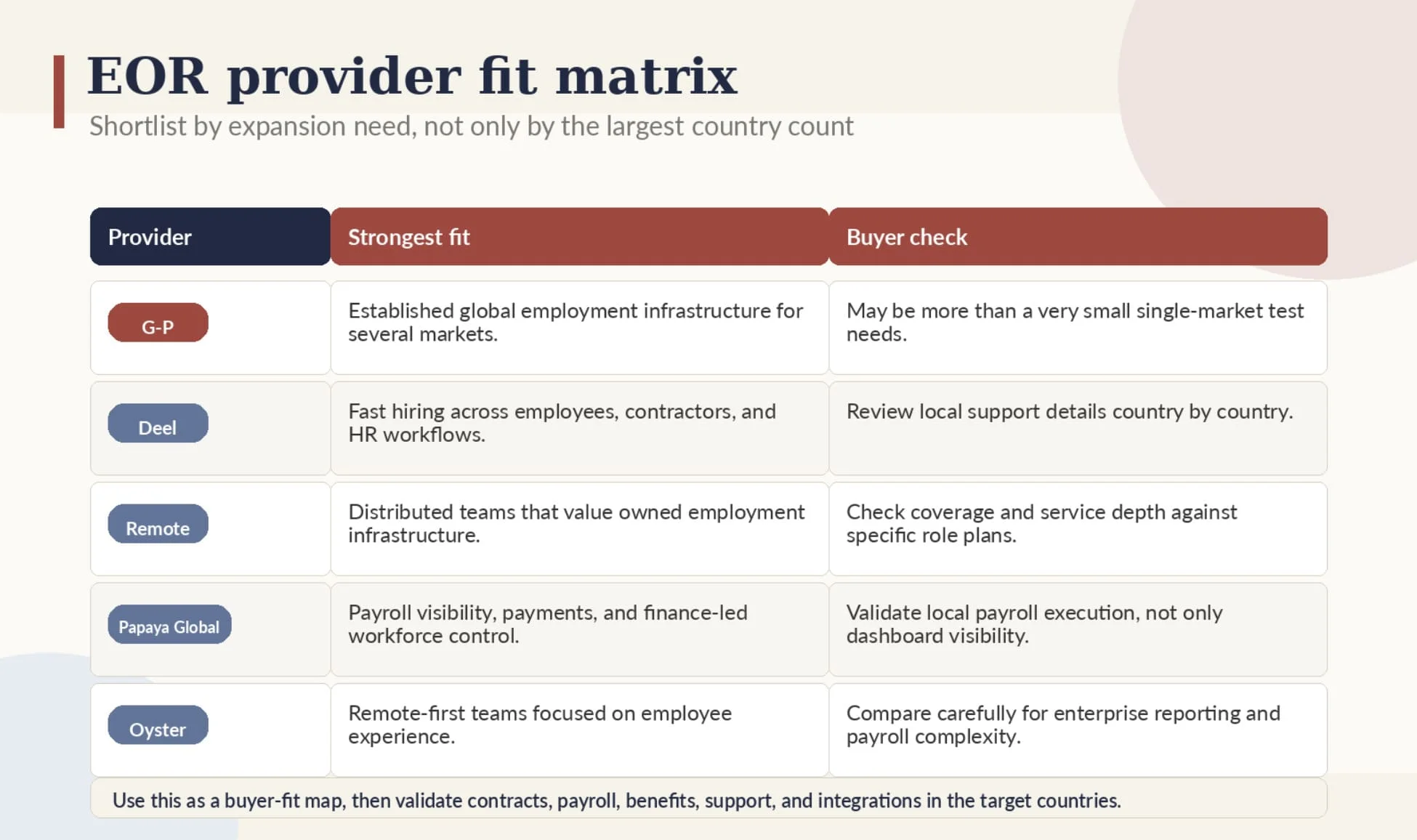
Best for: Companies entering multiple markets with compliance and workforce infrastructure as a priority.
Globalization Partners is a strong option for companies that want an established global employment platform rather than a narrow single-country hiring workaround. It supports companies that need to hire, onboard, manage, and pay global teams without creating local entities first.
The fit is especially relevant for businesses entering several markets at once. HR teams usually need local employment guidance, country-specific onboarding, benefits administration, payroll management, and a system that can keep workforce data connected as the company expands.
G-P’s employer of record solutions are built around that kind of international hiring setup. It may be more than a very small business needs for one familiar market, but it deserves early consideration when global hiring is part of a longer expansion strategy.
2. Deel
Best for: Fast-growing companies managing both employees and contractors internationally.
Deel suits companies that want a broad platform for international workforce management. Teams can manage EOR employees, contractors, payroll, HR workflows, and compliance processes from one place.
That makes it useful for startups and scaleups hiring quickly across borders while still refining their operating model. But buyers should still examine local details country by country, especially around employment support, benefits, and more complex contract or termination issues.
3. Remote
Best for: Distributed companies that care about owned employment infrastructure.
Remote is often considered by companies that want clarity around how international employees are legally employed. Its positioning emphasizes global employment infrastructure, local contracts, taxes, benefits, payroll, and compliance, with a particular focus on owned infrastructure.
That can matter in regulated or operationally sensitive markets. Still, buyers need to compare coverage and service depth against the specific countries, role types, and support expectations involved.
4. Papaya Global
Best for: Companies that need stronger payroll and payment visibility.
Papaya Global is a good option for companies that see global hiring as part of a broader payroll and workforce payments challenge. It positions itself around global payroll, payments, contractor management, and employer of record support.
That makes it useful for finance and HR teams that need more visibility across international worker costs. The key question is market-level execution. A clean dashboard is helpful, but local payroll accuracy and support are what employees will feel first.
5. Oyster
Best for: Remote-first teams that want a people-focused EOR experience.
Oyster is commonly associated with remote-first hiring and distributed team building. Its platform supports companies hiring, paying, and managing employees across many countries, with an emphasis on employee experience and responsible global employment.
That makes it a useful fit for companies entering new markets to access specialized talent rather than opening a full commercial operation immediately. Larger companies with complex payroll architecture or strict reporting requirements should compare it carefully against more enterprise-oriented platforms.
Choosing the right EOR for new-market entry
The best EOR provider is the one that matches the company’s expansion pattern.
A business testing one market may need speed, clear pricing, and simple onboarding. A company hiring across Europe, North America, and APAC will need stronger compliance processes, payroll coordination, integrations, and reporting. A team converting contractors into employees will have a different set of risks again.
Before signing, ask providers how they handle local contracts, benefits, employee questions, payroll corrections, termination support, data integrations, and country-specific compliance updates. Also ask what happens if the company later decides to set up its own entity.
New-market entry already comes with enough uncertainty. The employment setup should reduce that uncertainty, not add a new layer of operational guesswork.
Disclaimer: This article contains sponsored marketing content. It is intended for promotional purposes and should not be considered as an endorsement or recommendation by our website. Readers are encouraged to conduct their own research and exercise their own judgment before making any decisions based on the information provided in this article.