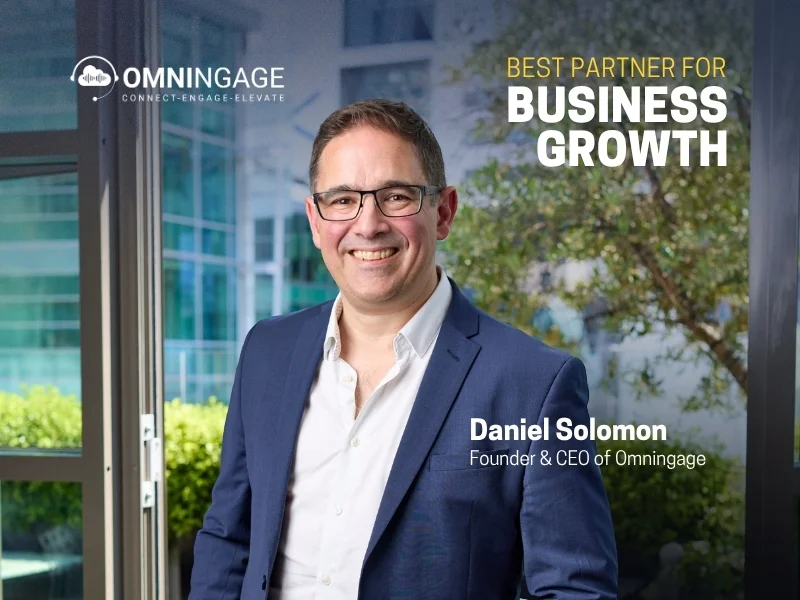
Interview with Daniel Solomon of Omningage
Smooth your adoption of Amazon Connect with an AWS-native layer that focuses the customer experience on outcomes, not architecture.
Even though Amazon Connect held promise for organisations looking to hone their customer experience performance, many of them were finding it challenging to bring it all together to get to the results they had envisaged. Enter Omningage, with its AI-leveraging tool Omni‑TrAIna. CEO Daniel Solomon describes the philosophy, vision, and practice of the company’s Connect-boosting offering.
What an honour to have you with us today, Mr Solomon! You founded Omningage to address gaps in Amazon Connect implementations. What were the most critical shortcomings you observed early on? How did they shape your initial offering?
When Amazon Connect was still maturing, the platform promise was clear, but many organisations struggled with the practical “last mile”: stitching together agent workflows, knowledge, reporting, and integrations into something usable at speed. We kept seeing teams drowning in tabs and handoffs, with operational insight lagging behind what supervisors needed in real time. That pushed us to build an AWS‑native layer focused on the day‑to‑day agent and supervisor experience—clean, integrated desktops, analytics, and accelerators that make Connect easier to adopt without losing its flexibility. In short, we built to remove friction, so customers could focus on outcomes rather than architecture.
Your platform philosophy emphasises simplicity and usability. How do you balance building powerful functionality while avoiding the complexity that often plagues CX tools?
We start with the workflow, not the feature list. If a capability doesn’t reduce clicks, context switching, or after‑contact admin, it’s not “simple” in the way the market needs. Our approach is a single‑pane experience that embeds Amazon Connect capabilities alongside customer context, cases, and the systems an agent actually uses. We keep power through configurability—widgets and integrations that can be adapted by role—rather than forcing every customer into a heavyweight one‑size‑fits‑all UI. And we lean on AWS services to do the heavy lifting behind the scenes, so the agent experience stays calm and consistent.
Looking back, what have been the defining moments in Omningage’s evolution from a specialist integrator into an AI-driven customer-experience partner?
Building Omni‑TrAIna reinforced our belief that the next wave is AI embedded directly in frontline workflows, not bolted on as another tool.
Two moments stand out. First, re‑engineering everything to be 100 per cent AWS‑native with Amazon Connect at the core gave us a scalable foundation and a repeatable delivery model. Second, moving from “better desktops” to “better outcomes”—through managed services, quality automation, and AI coaching—shifted the conversation from implementation to continuous performance improvement. Rocket CCaaS accelerated that further by productising speed‑to‑value for SMBs, while still keeping an enterprise-grade core. Most recently, building Omni‑TrAIna reinforced our belief that the next wave is AI embedded directly in frontline workflows, not bolted on as another tool.
How important is your relationship with Amazon Web Services in shaping your roadmap? Where do you see the biggest opportunities within that ecosystem?
AWS is fundamental, because Amazon Connect is evolving quickly into an AI‑first customer engagement platform, and our roadmap is designed to move in lockstep with that direction. The biggest opportunities sit where generative AI meets real operations: agent assistance that retrieves knowledge and recommends next best actions, automated summaries that cut after‑call work, and performance evaluation at scale using conversational analytics. What excites me is the ecosystem’s pace. AWS keeps pushing native capabilities, and partners like us can turn them into packaged outcomes that customers can adopt quickly. The winners will be those who combine AWS innovation with governance, change management, and measurable KPIs, so AI becomes a habit rather than a pilot.

As organisations adopt AI at scale, how can they ensure they enhance efficiency without losing the human touch that underpins great customer experience? What role will platforms like Amazon Connect play in that future?
The key is to use AI to remove “busy work”—searching, summarising, and repetitive admin—so agents have more time and headspace for empathy, judgement, and relationship‑building. That means human‑in‑the‑loop by design: AI proposes and guides, while people stay accountable for sensitive decisions and tone. Platforms like Amazon Connect will act as the orchestration layer, bringing real‑time context, analytics, and automation into every channel while enforcing governance and compliance. In practice, the human touch improves when the system stops fighting the agent.
How is AI reshaping traditional software and IT services delivery models, particularly for systems integrators and CX specialists?
AI is moving the market from “projects” to “products plus operations”. Customers don’t just want a build; they want continuous optimisation, faster iteration, and proof that AI is delivering measurable impact in production. For integrators, that shifts value toward repeatable accelerators, managed services, and outcome‑based delivery where improvements are tracked over time, not declared at go‑live. It also raises the bar on data readiness and governance, because AI is only as useful as the knowledge and workflows it can safely act on. The best CX specialists will blend engineering, operations, and change management into one continuous model.
Despite all that, why do you think so many businesses still struggle to translate AI capabilities into consistent operational outcomes in contact centres?
Without clear guardrails and accountability, teams either block AI or deploy it too cautiously to matter.
Most failures aren’t about the model; they’re about the operating model. Organisations run long AI pilots without redesigning workflows, cleaning up knowledge sources, or agreeing what “success” means beyond a demo. Data fragmentation and inconsistent processes create brittle experiences, so agents don’t trust the outputs and adoption stalls. The second issue is governance; without clear guardrails and accountability, teams either block AI or deploy it too cautiously to matter. The path to outcomes is applying AI to the highest‑frequency friction points and measuring improvements in metrics like AHT, FCR, quality, and agent retention.
From your perspective, what are the most impactful, real-world AI use cases in customer engagement today, not just in theory but in production?
We’re seeing the biggest impact where AI removes friction from frontline work: real‑time agent assistance, instant post‑contact summaries, and automated quality/performance evaluation across far more than a small sample of interactions. A standout production use case is AI coaching and training—using real conversations to deliver daily, personalised feedback that accelerates readiness and reduces churn—and that’s exactly what our OmniTrAIna product is designed to do. It’s a practical example of humans and AI working in harmony: the AI handles consistency, speed, and pattern detection, while leaders focus on judgement, culture, and the moments that need a human touch. The next logical step is AI coaching that also trains and supports AI agents, with supervisors overseeing the end‑to‑end operation across both human and AI workforces.

Do you think the industry is moving toward greater accountability for outcomes rather than just technology delivery? What does that mean for partners and vendors?
Absolutely. Buyers are tired of “implementation complete” when the operating reality hasn’t improved. Outcome accountability means partners must commit to measurable targets, provide transparency through ongoing reviews, and keep optimising after go‑live rather than disappearing. It also changes vendor expectations: the most valuable platforms will prove ROI through built‑in analytics and automation, not just features. For us, that’s why managed services, continuous improvement, and AI‑driven insights are as important as delivery, because the market is increasingly paying for results, not rhetoric.
As you look ahead to 2026, what are the key strategic priorities for Omningage, particularly in terms of geographic expansion and deepening alignment with AWS?
In 2026 we’re doubling down on two priorities: scaling our go‑to‑market into North America and deepening alignment with AWS’s AI‑first Amazon Connect agenda. That means taking our repeatable QuickStart and managed service models to new markets, while expanding our ecosystem motion through co‑sell and AWS programmes. Product-wise, we’re focused on embedding AI into everyday operations—especially with Omni‑TrAIna—so customers get continuous coaching and performance uplift, not just automation. The north star is simple: faster time‑to‑value, stronger operational outcomes, and a platform approach that scales from SMB to enterprise.