
Data protection has moved from a compliance checkbox to a core business concern. Since the General Data Protection Regulation came into force in 2018, European businesses and any organization handling EU residents’ personal data have faced binding obligations regarding how that data is stored, processed, and transferred. Cloud infrastructure sits at the center of these obligations — and choosing the wrong hosting environment can expose a business to significant legal and financial risk.
This guide covers what GDPR means in practice for businesses selecting cloud or VPS hosting, which technical and contractual requirements matter most, and how to evaluate providers effectively.
Why Hosting Infrastructure Is a GDPR Issue
The GDPR does not regulate only what companies do with personal data — it also governs where that data resides and who has access to it. When a business stores customer data on a third-party server, the hosting provider becomes a data processor under the regulation. This creates a formal legal relationship that must be documented through a Data Processing Agreement (DPA).
Beyond the contractual dimension, the physical location of the server determines which legal jurisdiction applies to the data. Servers located within the European Economic Area are subject to EU law by default. Servers located outside the EEA — including in the United States, even with providers that have EU subsidiaries — may be subject to foreign surveillance laws that conflict with GDPR requirements.
Data Residency: Why Server Location Matters
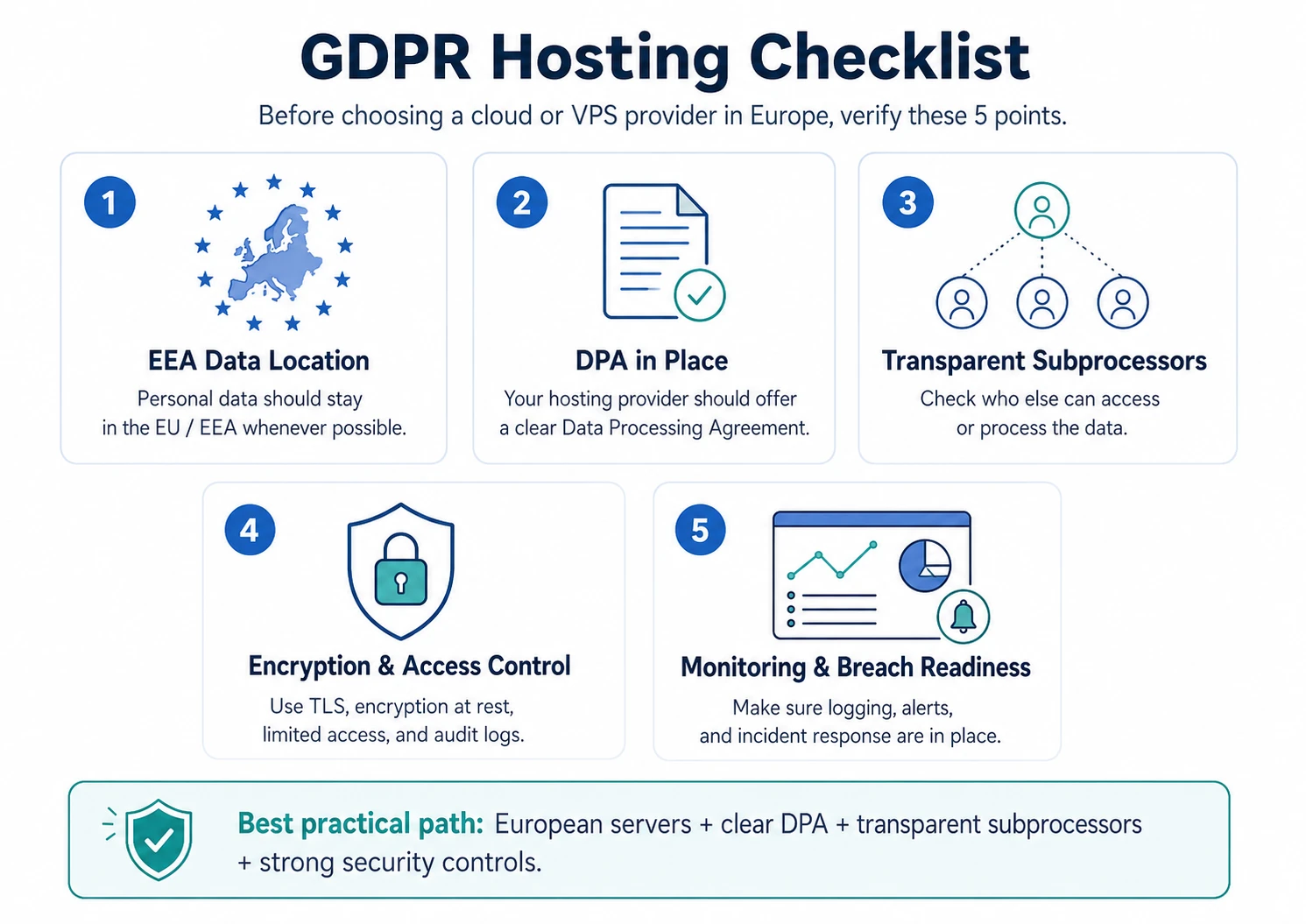
One of the most direct ways to simplify GDPR compliance is to ensure that personal data never leaves the EEA. Hosting infrastructure on European soil eliminates the need to rely on adequacy decisions, Standard Contractual Clauses, or Binding Corporate Rules to legitimize cross-border data transfers — all of which add legal complexity and administrative overhead.
The invalidation of the EU-US Privacy Shield in 2020 and the ongoing scrutiny of its successor framework have reinforced this point. Businesses that depend on transatlantic data flows carry a compliance risk that those operating entirely within the EEA do not.
Choosing a hosting provider with data centers in established EU jurisdictions — Germany, the Netherlands, France, or the Nordic countries — provides a straightforward baseline for data residency compliance. The Netherlands, in particular, has become a preferred location for European hosting due to its robust connectivity infrastructure, stable legal environment, and strong tradition of data protection enforcement.
Technical Requirements for GDPR-Compliant Hosting
The GDPR does not prescribe specific technologies, but it does require that personal data be protected through appropriate technical and organizational measures. In the context of cloud hosting, this translates into several concrete expectations.
Encryption
Data must be protected both in transit and at rest. In transit, this means enforcing TLS across all connections. At rest, disk-level or volume-level encryption ensures that physical access to storage media does not result in data exposure. Businesses should verify that their hosting provider supports encryption at rest and understand whether key management is handled by the provider or the client.
Access Controls and Audit Logging
GDPR requires that access to personal data be limited to those with a legitimate need. On a VPS, this means implementing strict SSH access policies, disabling root login where possible, and maintaining audit logs of access events. These logs serve both as a security measure and as documentation in the event of a supervisory authority inquiry.
Breach Notification Readiness
Under Article 33 of the GDPR, data controllers must notify the relevant supervisory authority within 72 hours of becoming aware of a personal data breach. This timeline places a premium on monitoring infrastructure capable of detecting anomalies quickly. A hosting environment that provides access to server logs, network traffic data, and alerting tools is a practical requirement for meeting this obligation.
Evaluating Hosting Providers for GDPR Compliance
Not all providers that claim GDPR compliance offer the same level of assurance. When assessing options, businesses should look beyond marketing language and examine the following:
- Data Processing Agreement. A reputable provider will offer a DPA that clearly defines roles, data processing purposes, subprocessor relationships, and security commitments. The absence of a DPA, or a provider that is reluctant to sign one, is a disqualifying factor.
- Subprocessor transparency. Hosting providers often rely on third-party services for monitoring, support, or infrastructure components. The GDPR requires that data controllers be informed of subprocessors and that those subprocessors offer equivalent guarantees. Ask providers for their subprocessor list and verify that all parties are located within the EEA or covered by an adequacy decision.
- ISO 27001 certification. While not required by the GDPR, ISO 27001 certification indicates that a provider has implemented a structured information security management system subject to independent audit. It is a useful proxy for the “appropriate technical and organizational measures” standard the regulation requires.
- Data center location. Confirm the physical location of the servers where your data will be stored, not just the provider’s registered address. Some providers operate data centers outside the EEA while maintaining European offices.
Reliable VPS hosting with clearly documented data residency, transparent DPA terms, and European data center locations reduces both compliance risk and the administrative burden of ongoing GDPR management.
Offshore Hosting and GDPR: Understanding the Limits
The Description mentions offshore VPS options — a category worth addressing clearly. Offshore hosting, in the context of GDPR, refers to servers located outside the EEA. This does not automatically mean non-compliant, but it does require additional legal mechanisms to be in place.
If a business processes EU personal data on servers located in a third country, one of the following must apply: the destination country has received an EU adequacy decision, the transfer is covered by Standard Contractual Clauses approved by the European Commission, or the organization has implemented Binding Corporate Rules. Each of these mechanisms carries ongoing obligations and legal uncertainty that hosting within the EEA avoids entirely.
For most small and mid-sized businesses, the practical recommendation is straightforward: keep EU personal data within the EU. The compliance simplification outweighs any potential cost or performance advantages of offshore infrastructure.
Netherlands as a Hosting Location for European Businesses
The Netherlands occupies a central position in European internet infrastructure. The Amsterdam Internet Exchange (AMS-IX) is one of the largest internet exchange points in the world, providing excellent connectivity to markets across Europe. Dutch data protection law aligns fully with the GDPR, and the Dutch Data Protection Authority (Autoriteit Persoonsgegevens) is an active and well-resourced supervisory body.
For businesses prioritizing both performance and compliance, a Dutch data center offers a combination of low latency to major European markets, high network reliability, and a jurisdiction with a strong track record of data protection enforcement. https://bluevps.com/vps-netherlands provides VPS infrastructure hosted in the Netherlands, suitable for businesses that need European data residency with solid connectivity and clear compliance positioning.
Conclusion
GDPR compliance in cloud hosting is not achieved through a single decision — it is maintained through a combination of provider selection, contractual documentation, technical configuration, and ongoing monitoring. The hosting environment sets the foundation: a provider operating within the EEA, offering a clear DPA, transparent subprocessor relationships, and appropriate security measures significantly reduces the compliance burden on the business using it.
For European businesses, the clearest path to compliant infrastructure is also often the most practical one: European servers, European providers, and agreements that reflect the legal obligations both parties share under the regulation.