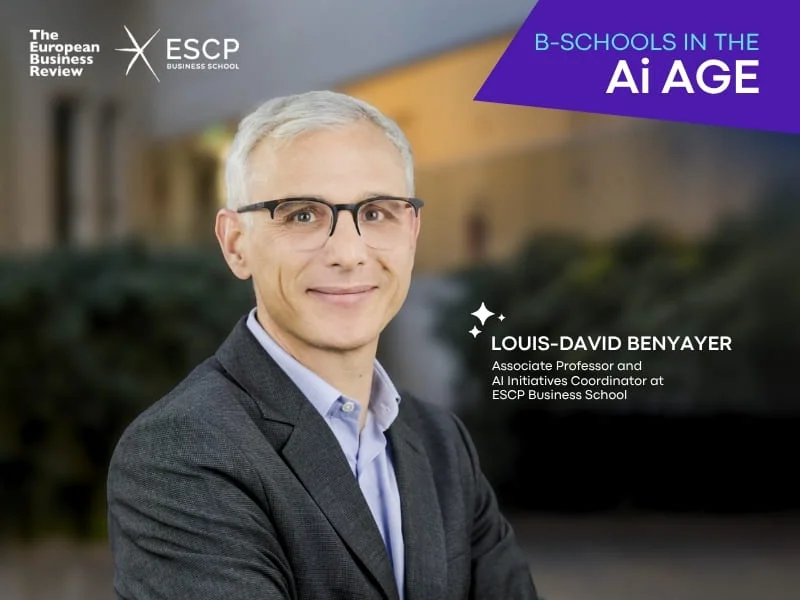
An interview with Louis-David Benyayer of ESCP Business School
Artificial intelligence is no longer a future-facing topic for business schools. It’s already reshaping how they operate. For Louis-David Benyayer, this shift is neither theoretical nor optional. At ESCP Business School, AI is not treated as a peripheral innovation or a curricular update. It is, as he puts it, “strategic.”
That conviction underpins a broader transformation. AI is influencing what students need to learn, how they learn, how they are assessed, and even how institutions define their role in a rapidly evolving landscape. ESCP’s response has been to engage directly with this complexity and accept both the opportunities and the unresolved tensions that come with it.
AI as a Strategic Driver of Institutional Transformation
For many business schools, technological change has historically meant incremental adaptation. New courses, updated modules, or specialised tracks. But AI challenges that model. At ESCP, the impact has been framed as structural, cutting across the institution rather than sitting within a single domain.
At ESCP, the impact has been framed as structural, cutting across the institution rather than sitting within a single domain.
The most immediate driver is the job market. AI is reorganising functions across industries, from HR to marketing to finance. Preparing students for this environment is no longer optional. They must not only understand the technology itself, but also its implications for non-technical roles.
Yet this is only one dimension. Generative AI is also transforming pedagogy. “We can no longer teach the same way, nor assess the same way,” Benyayer explains. Established practices are being fundamentally questioned. But at the same time, AI is also reshaping research. It’s both a subject of inquiry and a tool that changes how knowledge is produced. Beyond academia, institutional operations are increasingly influenced by automation and intelligent systems.
Taken together, these shifts require more than isolated initiatives. ESCP has responded with sustained investment in tools, training, and internal transformation, ensuring that students, faculty, and staff are all equipped to engage with AI directly.However, this engagement comes with a deliberate tension. ESCP’s approach is, in Benyayer’s words, “all in but cautious.”
The school has also developed frameworks such as Assessing in an AI Era, reflecting the need to rethink evaluation in a context where AI is ubiquitous. This includes revising student guidelines and addressing more complex challenges, such as the role of AI in thesis work. The process remains ongoing. “It’s not super easy,” Benyayer admits. “We combine several approaches—and we are still learning.”
Experimentation, Learning, and the Reinvention of the Classroom
If AI is transforming business education, ESCP’s response has been to treat the institution itself as a laboratory.
ESCP’s AI 1000 Champions programme, launched in September 2024, exemplifies this approach. One thousand participants—students, faculty, and staff—were given full access to AI tools and a year to experiment. Representing roughly 10% of the school community, they were tasked not just with using the technology, but with documenting what they learned. The result was a body of 150 to 200 experiments, reflecting the diversity of ESCP’s multi-campus, multi-programme environment. Rather than imposing a centralised strategy, the school adopted a decentralised model of discovery. Use cases emerged from different contexts, revealing what worked, what did not, and what might scale.
“Basically, what it brought is learning,” Benyayer says.
The programme provided a clearer understanding of AI’s practical applications while building a distributed network of experience across the institution. Faculty have introduced bots representing historical figures or simulated clients, allowing students to engage in negotiations, interviews, and presentations within realistic scenarios. But the deeper impact lies in the conversations these interactions generate. What does it mean to engage with a machine? To receive feedback from it? To rely on it as part of a learning process?
These questions shift the focus from tool usage to critical reflection.
At the same time, some of the most creative applications of AI have come from students themselves. In one course, ESCP invited students to take on a teaching role and share their own approaches to using generative AI with their peers. The outcome highlighted an important dynamic: in rapidly evolving technological contexts, knowledge is often distributed, not hierarchical. “We don’t care about the result,” Benyayer further explains. “We care about the process.”
Governance, Trade-offs, and the Future of AI in Education
As AI becomes more embedded in education, the conversation is shifting. Early debates framed the technology in binary terms as beneficial or harmful, transformative or disruptive. That framing is giving way to a more nuanced understanding.
“The questions are no longer yes or no,” Benyayer observes. “They are about trade-offs.”
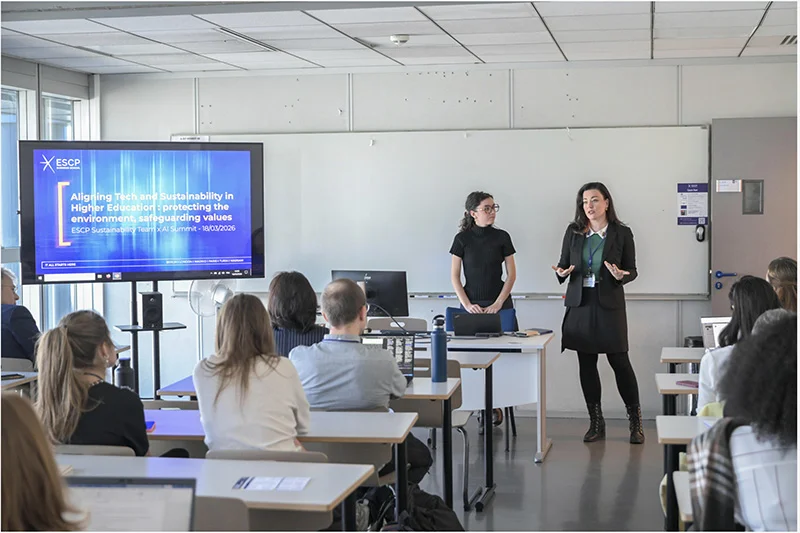
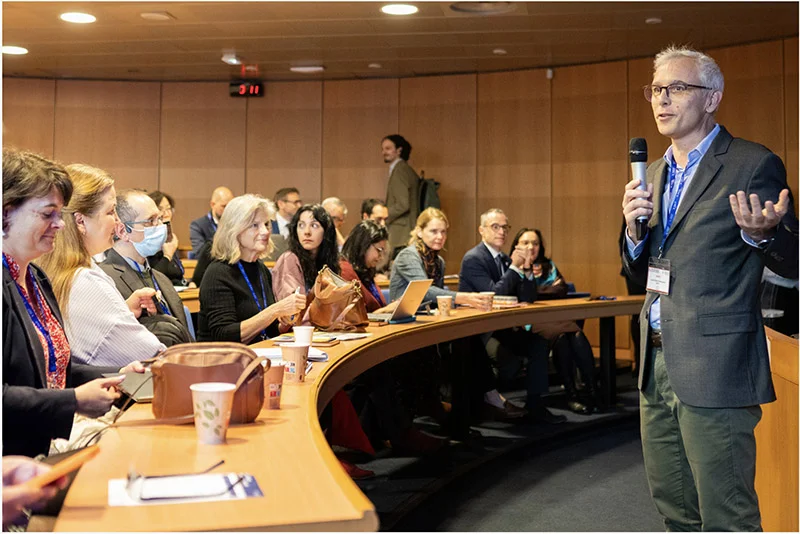
This shift was evident at the AI in Higher Education Summit 2026, hosted by ESCP in Paris. Bringing together educators, policymakers, and technology experts, the event reflected a growing maturity in how AI is being discussed, particularly in governance and sustainability.
Business schools operate within a global ecosystem, shaped by international students, faculty, accreditation bodies, and rankings.
Governance raises fundamental questions. Who decides how AI tools are used? At what level within institutions, across nations, or globally should those decisions be made? As AI systems become more influential, questions of control, accountability, and sovereignty become increasingly important.
Sustainability adds another layer. AI technologies require significant computational resources, raising concerns about energy consumption and environmental impact. As adoption scales, these issues become harder to ignore and harder to resolve.
Both themes highlight the limits of institutional action. Business schools operate within a global ecosystem, shaped by international students, faculty, accreditation bodies, and rankings. “We don’t have any other choice than collaborating at a global scale,” Benyayer says, explaining that not every organisation will take the same path. For some, AI will become central; for others, it may play a more limited role. What matters is that the decision is deliberate. “All answers can have a reason,” Benyayer notes. “But you need to decide.”
ESCP’s approach reflects both ambition and realism. It’s not a finished model yet, but an evolving process that combines experimentation, reflection, and collaboration. In the age of AI, business education is being redefined. For institutions willing to engage with that change, the challenge is not simply to adapt, but to rethink what learning itself should look like.
For Benyayer and his colleagues, that work is already underway.