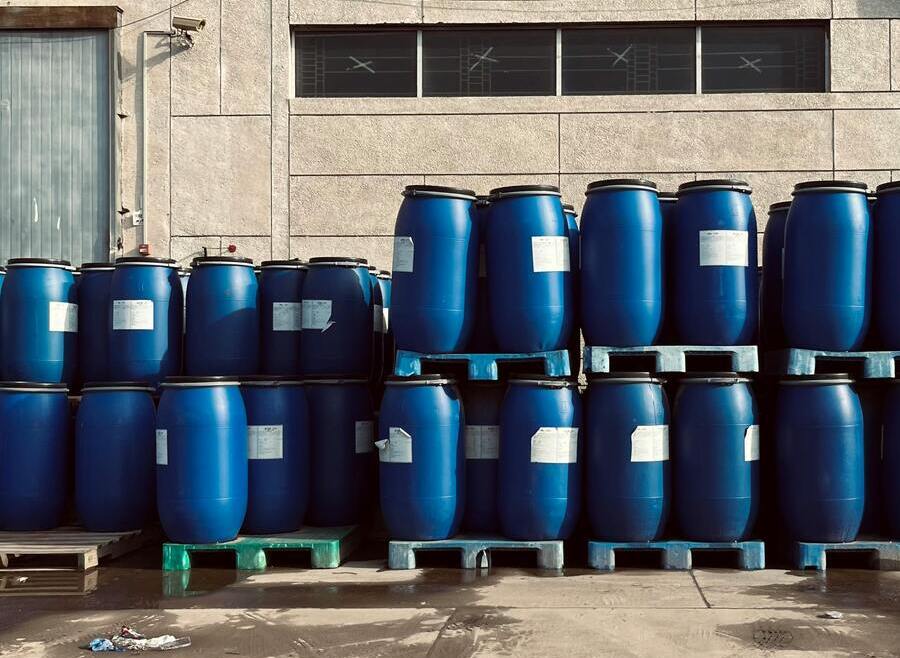
The management of hazardous substances is extremely important in industrial settings. The life and safety of workers is on the line, as is the company’s reputation and legal troubles. All settings, be it a manufacturing plant or construction site, can have chemicals that introduce a high level of risk.
Improper storage isn’t just about disorganisation, but the risk of fires that can wipe out an entire location, or toxic exposure that leads to permanent injuries. Increasingly, environmental damage is under public scrutiny, too.
To make sure that your facility meets safety standards, you can find more info on this website.
Storing incompatible chemicals in close proximity
One of the biggest mistakes is not properly segregating substances that are incompatible. When space is scarce, it is tempting to group the containers on size or accessibility, or sometimes just what shelf space is available in the moment, rather than the chemical properties.
Storing oxidisers near flammable liquids, or acids near bases, is a recipe for disaster. Yet it continues to happen. If a leak occurs, the resulting chemical reaction can produce intense heat, fire, or the release of toxic gases.
Proper segregation requires a good understanding of the Safety Data Sheets (SDS) for each and every substance that resides on-site. Dedicated storage cabinets for certain classes of chemicals and maintaining enough distance between reactive groups are what’s required.
Without these barriers, a small spill can soon escalate into an uncontrollable and devastating emergency. So, safety managers should account for how fire suppression agents like water or foam could accidentally trigger secondary reactions if they interact with certain stored hazards during an incident.
Inadequate secondary containment and spill control
Even when chemicals are stored in high-quality primary containers, the risk of a leak or puncture will always exist. It’s often the lack of secondary containment (e.g., bunded pallets or sump trays) that means that a single compromised drum can lead to hazardous liquids spreading all across the floor. Of course, this is a slip hazard, but worse than that, it could lead to chemicals entering drainage systems or contaminating the ground.
Implementing COSHH Regulations is precisely what helps businesses establish the right protocols to prevent these leaks from ever becoming environmental disasters. Secondary containment should be able to hold at least 110% of the largest container’s volume. This way, any spill is safely contained until it can be professionally neutralised and removed. Secondary containment should be seen more as a time buffer. It stops/delays environmental damage and liability until it’s fixed.
Poor ventilation and environmental control
Industrial chemicals are usually volatile, and this means they can release vapours at room temperature. When there’s inadequate ventilation around these storage spaces, vapours accumulate and become toxic and/or explosive. Certain chemicals are temperature-sensitive too, where excessive heat can cause internal pressure to build up in containers, leading to expansion or leaks.
Clearly, proper storage approaches should account for both airflow and climate. But importantly, flame-proof extraction systems must be used in the areas where flammable vapours are present, and storage units should be kept away from direct sunlight (or heat-generating machinery). IoT sensors here can help monitor the atmosphere, perhaps alerting the system when conditions are beginning to get to hot, or when certain vapour is detected.
Failing to maintain clear labelling and documentation
A chemical without a label is a danger because it’s an unknown – it also slow operations down, with it being replaced or investigated when it’s eventually needed or moved. In industrial spaces, labels are often damaged by spills and faded by UV light. If an emergency occurs, emergency responders and employees need to know precisely what they are dealing with when applying any first aid or firefighting techniques.
The guidelines set out by COSHH state that every hazardous substance should be clearly identified and its risks assessed. Workplaces need to keep an up-to-date registry of all the chemicals (labels aren’t enough on their own) and make sure that SDS are easily accessible to everyone.
The risk of mixing two unknown substances is a danger in the home with household cleaning products, let alone in an industrial setting. Risk increases in workplaces where documentation is not stayed on top of. The main cause of a missing label is the psychological trap of presumed knowledge, where familiarity leads staff to rely on memory. But what happens when new staff join? Or someone moves a familiar item to a different place?
Improper access control and lack of training
The final major risk involves us humans. Chemical storage areas should not be freely accessible to unauthorised personnel or untrained staff. Without access being controlled and restricted, there is a higher likelihood of containers being left open or chemicals being misplaced. Or, safety protocols are simply ignored.
Safety is only as strong as the training. Those on the front line have near infinite ways to make mistakes, and it’s the training that can help guardrail behaviour and mistakes. Education on how to use storage equipment, how to read symbols, how to respond to spills… But training in and of itself breeds a culture that respects the seriousness of handling storage and the risks involved, and this is invaluable as it permeates through to every micro-decision.