
By Imran Khalid
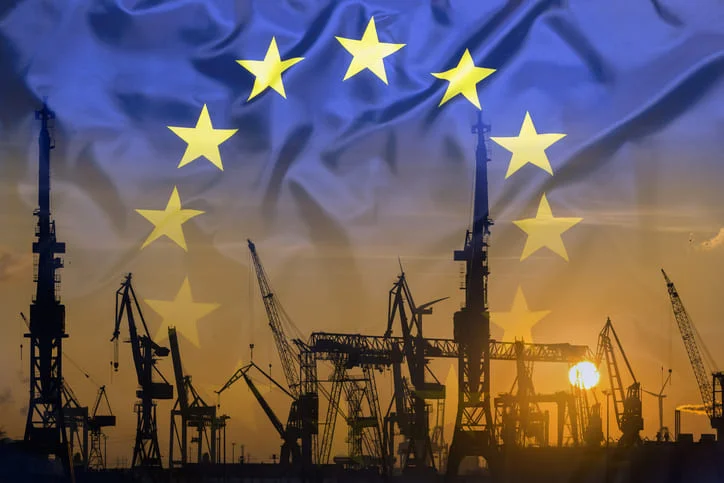
Europe faces a binary choice: maintain high-cost protectionist barriers or integrate efficient green supply chains to meet its 2030 climate targets.
The global economic discourse in this spring of 2026 is dominated by a single apprehensive phrase China Shock 2.0. From the halls of the European Commission to the legislative chambers of the continent’s industrial powers, the narrative is remarkably consistent. It suggests that a second wave of Chinese high-tech exports—focused on electric vehicles, lithium-ion batteries, and renewable energy—is an existential threat to the European manufacturing base. However, a dispassionate look at the global landscape suggests that this shock is not a crisis to be blocked, but a fundamental recalibration of efficiency that Europe must leverage to save its own economic future.
At the heart of the current friction lies a fundamental question for European policymakers is the primary concern the protection of specific legacy manufacturing jobs, or the broader economic stability of the middle class? For years, the political consensus in Brussels has tilted toward the former, attempting to shield European firms through increasingly high trade barriers. Yet, by April 2026, it is becoming clear that protecting a narrow industrial base at the expense of global price stability is a losing bargain for the European consumer. To understand the stakes, one must consider the counterfactual what would the European Green Deal look like without China’s green energy products?
The High Cost of the “Protectionism Tax
As of today, China has solidified its position as the indispensable provider of the tools required for the energy transition. It currently controls roughly 70% of the world’s battery supply chain. The 15th Five-Year Plan, which moved toward absolute carbon control this year, has only increased this output. If Europe successfully walls off these products through triple-digit tariffs, the cost of the energy transition for the average household will skyrocket. For a family in Berlin or Milan, de-risking translates directly into a protectionism tax on their next vehicle. Slowing the adoption of affordable tech for the sake of industrial nostalgia is not just bad economics it is a direct threat to Europe’s 2030 climate targets.
A Deflationary Buffer for the Middle Class
Furthermore, this industrial surge provides a critical benefit to the European middle class. We are witnessing a China Shock in an entirely different sense the democratization of high-quality goods. For the past two years, persistent inflation has been the primary source of political instability across the Eurozone. Here, Chinese exports act as a vital deflationary buffer. Data from the first quarter of 2026 shows that industries with the highest penetration of these imports have experienced the most significant cooling of producer prices.
This is the hidden virtue of the current trade dynamic. When a firm produces a technologically advanced electric vehicle at half the price of a Western equivalent, it is expanding the global middle class. This influx of value provides a floor for the standard of living during a period of global monetary tightening. For the European consumer, this shock is essentially a massive productivity dividend.
Moving Beyond the “Copycat” Narrative
Despite these benefits, the international narrative remains clouded by persistent misunderstandings in foreign media reports. The claim that China’s success is built on copy and imitation is a relic of the previous decade. By 2026, China has moved into a phase of indigenous innovation. The competitive edge today comes from engineering scale the ability to refine technology through rapid production cycles that European firms find difficult to replicate. From solid-state battery breakthroughs to AI-integrated manufacturing, the innovation is iterative and increasingly original.
A second misconception is that this surge is a cynical byproduct of currency manipulation. The trade data from April 2026 tells a far more complex story. While the RMB has fluctuated, China’s trade surplus has stabilized because its own demand for high-end semiconductors and AI hardware has hit record highs. The surge is driven by structural comparative advantage, not exchange rate gimmicks.
There is also the recurring argument regarding overcapacity. Critics such as Janet Yellen suggest that China is producing more than its domestic market can consume. Yet, this ignores the basic logic of global trade. No one accused Germany of overcapacity when it exported the vast majority of its high-end automobiles. In a globalized world, manufacturing capacity is naturally sized for the global market.
Global Logic vs. Industrial Nostalgia
Europe currently finds itself in a paradox. Leaders desire a rapid green transition and a curb on inflation, yet there is a deep suspicion of the country most capable of delivering the scale needed to achieve these goals. This suspicion often stems from a failure to distinguish between the interests of specific industrial lobbies and the interests of the European public. While manufacturing shifts are a political challenge that requires domestic solutions—such as improved safety nets—they should not dictate a trade policy that makes 21st-century tools more expensive for everyone.
If the trend of fragmentation continues, the result will be a productivity-poor Europe where citizens pay more for less. True economic leadership in 2026 should not be measured by the height of trade barriers, but by the ability to integrate into the most efficient production networks. The China Shock 2.0 is an opportunity for global optimization. To reject it is to reject the most viable path toward a sustainable and affordable future for all Europeans.
About the Author
 Imran Khalid is a geostrategic analyst and Senior Fellow at Foreign Policy In Focus (FPIF), Washington, D.C. A prolific columnist since 2001, he specializes in global power dynamics, systemic trade, and US-China relations. His analysis is featured across five continents in prestigious outlets including Nikkei Asia, Newsweek, The Hill, MS NOW, South China Morning Post, Mail & Guardian, and Brussels Morning.