
By Marcelina Horrillo Husillos, Journalist and Correspondent at The European Business Review
For Gen Z founder JohnGabriel Nguyen-Truong, innovation isn’t just about technology—it’s about building intuitive, human-centered systems that reshape how we move.
At a time when most navigation tools still require users to look down at screens, JohnGabriel Nguyen-Truong is asking a different question: what if technology adapted to human behaviour instead? As a Gen Z founder and CEO of Xphera, his vision goes beyond navigation—it reflects a broader generational shift toward more intuitive, experience-driven, and purpose-led innovation.
Xphera is building xEarth™, an alternative to GPS inspired by daily life needs
JohnGabriel’s identity and early personal path played a relevant role in his professional journey. The son of Vietnamese refugees who had to travel a lot “from Washington to Maryland and then Georgia, before we went to St Louis, which is in the Midwest here,” he says. “My mother was an entrepreneur, a florist, owned her own flower delivery business, and I was the one helping her,” he adds.
The meaning behind the company name comes from two words—“explore” and “sphere.” “Because the earth is a sphere, and we want to help people explore it,” John says.
“And what inspired my founding of Xphera five years ago was helping my mom and my dad navigate around the United States as they travelled around for work. We had maps, we had Google Maps, we had the Garmin GPS navigation systems, and I’d help them navigate through airports, driving around.”
xEarth™, a technology that takes map search to the next level
John wanted to build a navigation system that would be more intuitive than a map. “So, currently, if you use a map or any traditional mapping navigation system, you have to look down,” he explains.
“You have to sort of figure out where you are, and then try to connect what’s being shown on the map to find your way around an environment that you may not be familiar with, especially in stressful environments, which makes it more difficult.”
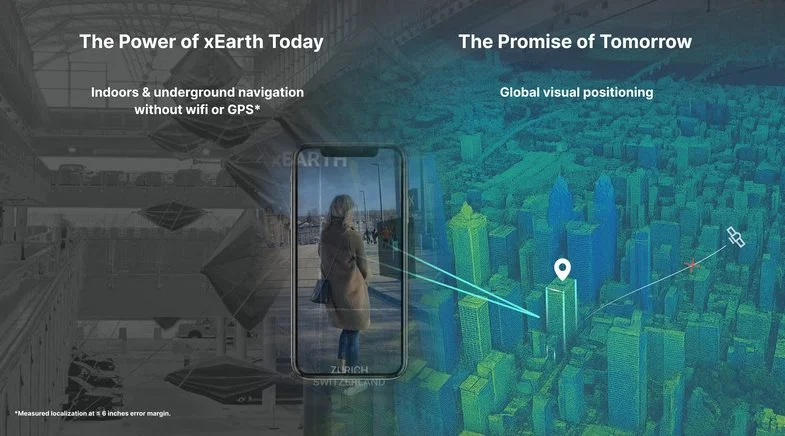
“I was inspired by a variety of movies, such as Star Trek, where you can actually look in your environment rather than having to look down at the map,” he recalls. “Let’s say you could actually look around your environment and have some system or technology actually pointing out different interest points and wayfinding routes for you to navigate around.”
This became the start of Xphera’s technology, and the system xEarth or Explore the Earth.
“It started as an app and, basically, what it did was to use GPS. So, it’s using GPS and the phone’s compass,” John explains. “When you were navigating a city space, you would be able to look around with your cell phone, so you would have an immersive experience.”
John says that you can actually learn about the different local businesses around you as if you’re visiting a downtown area. “That started as a vision, and I invested my own money to build this.” Then the company started getting paying customers who saw what they were doing, and they asked if they could make this work inside their place.
The company started getting paying customers who saw what they were doing, and they asked if they could make this work inside their place.
“So, our first customer was the Evansville Wartime Museum in Indiana, and they wanted us to take the technology we have done outdoors and make it work indoors,” John recalls. “We were using GPS still, and we tried making it work indoors.”
Xphera works with government partners, including former NASA leaders and the Indianapolis International Airport. —John states: “Our technology advantage lies in its ability to work offline without GPS satellite dependency and in its high accuracy, using just visible feature points.”
Tech travel enabling community-driven airports
“I love airports,” says John. “I am very involved in airports; they have a great economic impact.
The Indianapolis International Airport is a key partner of Xphera. Airports today are becoming more community-driven: “Make it comfortable for people who have never travelled, more accessible, more comfortable, more enjoyable,” he asserts.
It is especially after COVID that there is an effort towards a face-to-face trend. “There is an exciting trend of more and more people engaging in travel,” John says. “People who didn’t travel often, they travel more often now, because airports are more community-driven.”
“We work on the GPS to make the travel experience more friendly and community-driven,” he says. “We really want to empower airports, give them a voice, because they are the experts, as they understand travellers and their physical space.”
Precise spatial positioning, digital twins, and spatial intelligence—tackling GPS challenges
John and his team assess each airport’s current situation through an extensive discovery process —using LiDAR mapping and digital twins to address GPS challenges in buildings and parking garages, while adapting the approach based on whether partners have existing geospatial data or need new data collection.
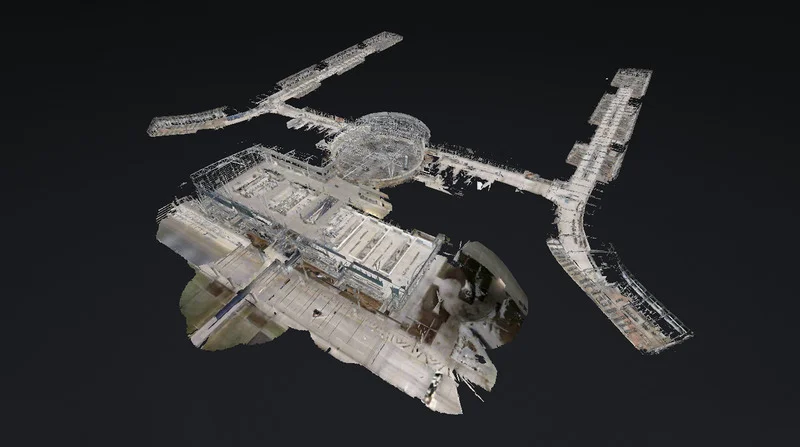
“We talk with many convention centres here in the Midwest, and the situation from one convention centre to another convention centre can be completely different,” he explains.
“One may have a data project which is halfway completed, so we will take this into account …We tend to use the information already there and scale from it…Other partners don’t have any data, so we do the groundwork to build the data needed…our main goal is to make the spatial data useful to their team,” he adds.
Another interesting thing about airports is that thousands of people work there every day. John says, “It is a huge operation, so you need to navigate the place effectively and use GPS for different use cases. He adds: “Our main focus is to understand what’s going on, and the biggest problem is to help travellers.”
A tech company from Indianapolis with a global vision — market constraints and cross-cultural barriers.
“We are based in Indianapolis, but we do work in Saint Louis, in Chicago, and we have team members in Florida…and we have pretty good connections with people in the GPS sector in the US.”
John has also travelled around Europe, and the company worked on setting up a business presence in Abu Dhabi and Belgium.
“The people who work in the GPS sector in the US don’t really listen to Europe or the Middle East region, but this should be a universal approach, given that people want to be understood across different regions and geographies. The majority of GPS failures due to jamming is occurring in Eastern Europe and the Middle East.”
“It is a work in progress,” he explains, “but we make this investment to establish local offices because, for me, this is about talking to people, making friends in different places. And we want the people in our communities to work with Xphera.”
“We aren’t a company that gets sold out, we are building a company that becomes a lasting legacy for bringing positive outcomes to society.”
Xphera handling direct and indirect competition in the rapid Tech AI-era
“We are at the intersection of the physical world and software,” says John. “Most AI and IT companies are limited to what is on your screen.”
“We know that there are AI world models, and we use them. These don’t pose a threat to us, because we are at the intersection.”
“We involve government policy, the physical world, people, and the computer in between,” John explains. “AI models and ChatGPT don’t pose a threat to us because we are in a different vertical, and although they may impact us in different ways, these are not our competitors; AI companies are our customers.”
Core challenges and lessons learned as a Gen Z founder
My advice to my earlier self is that I had to make mistakes. Making bad hires, making good hires—you learn by making mistakes.
Trust is key for an entrepreneur, and being able to assess people is very important. “I believe every human being is self-interested, which is not necessarily a bad thing, as it is a core aspect of humanity and ensures self-survival. And sometimes people pretend that there is no self-interest. My approach is that self-interest is normal, but let’s see that our respective self-interests are aligned.”
Leaders need to be very honest, but according to John, when things need to get done, you need to take a chance and trust the other person.
“A straightforward approach and an open conversation from the beginning can resolve conflicts, rather than talking behind people’s backs.” John says.
Redefining What Leadership Looks Like
“Gen Z looks with sarcasm at the fakeness of a lot of corporate culture,” John explains. “Gen Z and the younger generations value authenticity, and companies that want to do good for society. They are not just looking for profit, especially in the US…and entrepreneurs know profits are important, but they also want to build a different world.”
According to John, there is a lot of giving and trying to do things in a different way in the travel industry. “For example, there is an architect who builds airports from timber, and nobody asked why all the airports are made of metal. But here we are — there are different ways to do things.”
Advice to your earlier self as a Gen Z entrepreneur and to newcomers
“The only way of learning is by failing and by making mistakes,” avows John. “I wasn’t immediately trying to understand the industry when I started, as I am now, but it was only a few years later that I started to look at the GPS space.”
John’s advice to newcomers is to spend time learning about the infrastructure that makes the solution possible. “Not just immediate competitors or alliances,” he explains, “as, often, people don’t explore the true leverages, and many times problems are resolved by looking at the problem at the infrastructure level, but it takes time.”
“My advice to my earlier self is that I had to make mistakes. Making bad hires, making good hires—you learn by making mistakes,” he admits.