
By Dr. Simon L. Dolan, Dr. Pedro Cesar Martínez Moran and Dr. Dave Ulrich
Among the disciplines currently under invasion by AI, human resources is one with enormous potential for benefit, at the same time being at significant risk of negative impact in terms of both ethics and justice. Here, we examine approaches to encouraging the scale to tip towards a favorable outcome.
The rapid evolution of artificial intelligence (AI), both generative AI (GenAI) and agentic AI, is profoundly reshaping the business landscape in general, and human resource management in particular. With the global market for AI in HR projected to grow by 100 percent from 2024 to 20321, HR leaders face both unprecedented opportunities and new complexities. As characterized by Dave Ulrich, the contemporary challenge is no longer the mere adoption of new technologies, but the intelligent prioritization and integration of AI solutions that create tangible value for all “humans” who are stakeholders—not just employees, but also executives, customers, investors, and communities. Simply stated, AI is not the end (goal) but a means (process) of delivering value. Building upon Ulrich’s framework, this essay incorporates Dolan’s human-centered perspective to propose a conceptual model for understanding how AI is reshaping human resources processes, organizational priorities, and strategic leadership. Finally, it advocates for a value-driven and ethical orientation as an essential component of AI implementation in HR practice.
HR Stakeholders: The Expanding Human Agenda
HR today is less about HR practices and tools, and more about delivering value to all stakeholders. The implication for AI is clear: new HR technologies must be prioritized and assessed through their effect on these diverse stakeholder outcomes. Ulrich suggests five stakeholders (who are all human) and identifies what value they receive from the organization.
- Employees (experience, sentiment, productivity)
- Executives (strategic realization and goal delivery)
- Customers (loyalty, net promoter scores, revenue impacts)
- Investors (confidence, intangible value, financial outcomes)
- Communities (brand reputation, social accountability)
AI can provide information to deliver these valued outcomes through improving and innovating HR practices.
Waves of Change2: Five Applications of AI in HR
Ulrich (2025) identifies five evolutionary “waves” in how information and intelligence, driven by AI, are leveraged in HR:
- Access: AI enables easy, rapid sourcing of information for decision-making
- Assist: AI tools help streamline existing HR tasks and processes (e.g., résumé screening, communications)
- Inform: AI helps interpret data, extracting insights for improved HR strategies
- Guide: AI platforms provide decision support, highlighting best options based on complex analytics
- Impact: At the leading edge, AI-driven HR crea-tes lasting value by transforming stakehol-der outcomes and supporting business goals
These waves reflect a spectrum from routine automation to sophisticated, strategic enablement. Effective AI adoption in HR depends on recognizing the unique needs of each user group—employees, managers, HR professionals, and executives—and matching solutions accordingly. Future progress depends not on technology alone, but on HR’s capacity to prioritize applications that improve decision quality and stakeholder impact.
Navigating Paradox3: Eight Tensions Shaping AI for HR
Ulrich (2025) contends that the evolution of AI in HR is marked by inherent paradoxes. Rather than simply managing opposing forces, HR leaders must learn to navigate and harness tensions, each of which creates value when balanced intentionally. Key paradoxes include:
- Artificial Intelligence vs. Human ingenuity: Blen-ding technological insight with genuine human ingenuity emotion, creativity, and con-nection.
- Removing Jobs vs. Redefining Work: Using AI to automate but also redefine and enrich jobs
- Efficiency vs. Growth: Leveraging AI to lower costs but also to drive innovation and expansion
- Distributing vs. Concentrating Power: Enabling broader access to information but also empowe-ring those who best turn insight into action
- Lowering vs. Increasing Risk: Reducing errors through analytics while recognizing new risks such as bias and misinformation
- Expanding Perspective vs. Reducing Cognition: Empowering learning through information abundance while remaining mindful of potential cognitive dependency
- Providing Answers vs. Exploring Questions: Using AI to solve known issues but also to stimu-late new inquiry
- Isolating vs. Connecting: Supporting flexible, distributed work while preserving relational bonds and collaboration
Addressing these paradoxes requires both rigorous analysis and thoughtful, values-driven leadership—an approach especially critical as AI’s influence within HR expands.
Criteria and Prioritization: From Proliferation to Purpose4
The explosive growth of AI solutions for HR has led to a sense of overwhelm among many leaders.
The explosive growth of AI solutions for HR has led to a sense of overwhelm among many leaders. Ulrich argues that value comes not from adopting technology for its own sake but through systematic prioritization. He offers four concrete criteria to guide AI adoption in HR:
- Define Desired Stakeholder Outcomes: Identify clear, trackable indicators for key stakeholder groups.
- Organize within an Integrated Framework: Use robust frameworks (like the Human Capability Framework) to ensure balanced AI deployment across HR domains.
- Assess Stakeholder Impact: Rigorously evaluate how AI applications contribute to stakeholder value, using a mix of analytics and qualitative evidence.
- Integrate Guidance into Platforms: Prefer AI solutions that are embedded within existing HR systems, allowing for seamless adoption and real-time decision support.
By applying these criteria, HR leaders can avoid the pitfalls of “tech for tech’s sake,” focusing on targeted, impactful AI initiatives that drive both organizational agility and sustainable stakeholder value.
Despite AI’s promise, Dave Ulrich warns of significant risks that HR leaders must actively manage.
AI Risks in HR: Dave Ulrich’s “Eight Risks” and Practical Mitigation
Ulrich (2025) identifies several risks with AI integration in HR, each requiring careful management5:
- Information parity: Benchmarking via AI erodes differentiation. HR must use AI as a foundation and innovate beyond generic solutions.
- Cognitive decline: Over-dependence on AI can stifle human creativity. AI answers must be paired with human insight and innovation.
- Wrong or misleading information: AI outputs must be critically vetted and verified by experts.
- False emotion: AI can simulate empathy but lacks authenticity. Human connection remains irreplaceable.
- Privacy: Data security protocols must be robust to protect sensitive employee information.
- Fake vs. real: Detection tools and clear guidelines mitigate AI-generated misinformation.
- Living backward and recycling: AI curates the past but should inform future-oriented in-no-vation.
- Accountability diffusion: Cross-functional governance clarifies ownership and procedural accountability.
Governance frameworks should be established for AI oversight, incorporating stakeholders from HR, legal, ethics, compliance, and employee representation. Human-in-the-loop models for critical decisions, regular bias audits, data privacy standards, and transparent AI explainability are required for responsible deployment.

Human Value, Ethics, and Responsible AI
Dolan’s vision of work is unequivocally human-centered6. He acknowledges AI’s potential for efficiency but cautions against neglecting dignity, values, and the intrinsic meaning of work. Dolan urges organizations to build frameworks for responsible AI—ensuring fairness, transparency, explainability, and human control. He insists that HR professionals must be upskilled in both technical and ethical competencies and only use AI tools to support—not supplant—human decision-making.
At its core, Dolan’s framework advocates for a deeper understanding of values—both personal and collective—and how these values can guide ethical decision-making7. Now, when we think about AI and new technologies, we’re looking at fields that are shaping our future. The ethical implications of AI are profound, touching on issues like privacy, fairness, and accountability.
Imagine a world where companies harness Dolan’s framework to ensure that their AI technologies are developed and deployed responsibly. By centering their strategies around values like integrity, transparency, and respect for human dignity, organizations can create AI systems that genuinely enhance human life rather than complicating it. For instance, when designing algorithms, tech companies could implement ethical considerations from the outset, ensuring that their models are fair and unbiased, aligning with Dolan’s emphasis on well-being.
What’s more, fostering a culture rooted in ethical values can empower teams to hold each other accountable. With the collaborative nature of AI development, this means that every voice is heard. When the people working on AI projects actively integrate Dolan’s values into their processes, they are not only creating innovative technologies but also building trust with users8.
In practice, this might look like regular workshops where stakeholders discuss the ethical implications of their projects or creating feedback loops that allow users to voice concerns about AI functionalities. These steps not only promote ethical behavior but solidify a shared commitment to societal well-being.
So, as we continue to push the boundaries of technology, remember that incorporating frameworks like Dolan’s can lead us toward a future where AI serves humanity positively. It’s all about bringing our values to the forefront of these advancements. By doing this, we can ensure that the impact of AI and new technologies aligns with the ethical standards we aspire to uphold. Let’s embrace this journey together!
Dolan’s approach advocates involving employees in AI implementation and design, continuous monitoring for fairness and well-being, and robust appeal mechanisms for questionable AI-driven decisions. Risks of bias, opacity, dehumanization, digital inequality, and well-being must be proactively addressed. Where AI automates repetitive work, space must be intentionally created for interpersonal connections, ethical judgment, and moral reasoning.
In summary, connecting Dolan’s values and ethics framework with AI and new technologies is not just an academic exercise, it’s a call to action! By embodying these values, we can ensure that our technological advancements pave the way for a more ethical, equitable, and brighter future. Embracing the challenge and championing these principles can shape a technology landscape that reflects our highest values.
Practical Implications: Toward Responsible, Hybrid HR
The future of HR is not about technology alone—it’s hybrid. AI will be most effective where it augments, not replaces, the human touch. HR professionals must:
- Implement multi-disciplinary AI gover-nance committees.
- Upskill in digital, analytic, and ethical com-petencies.
- Ensure that systems are transparent and explainable to all stakeholders.
- Involve employees in iterative AI design, fostering agency and voice.
- Foster a culture where AI is a collaborative aid—not an infallible authority.
Policy and Governance: Unions and regulators increasingly demand algorithms to be auditable. Leading firms have embraced open reporting, appeals processes, and explainable AI dashboards as foundational for workforce trust and social license.
Upskilling and Capacity-Building: As AI automates old HR functions, new competencies are needed: data ethics, digital communication, and proactive facilitation of human-AI teamwork. Lifelong learning and continuous adaptation will distinguish resilient organizations.
Employee Well-being and Engagement: Data-driven talent management systems flag flight risks, burnout, and disengagement—enabling pre-emptive support and intervention. AI can also deliver personalized coaching and wellness recommendations, but only if privacy is respected and intrusive monitoring is avoided.
Conclusion
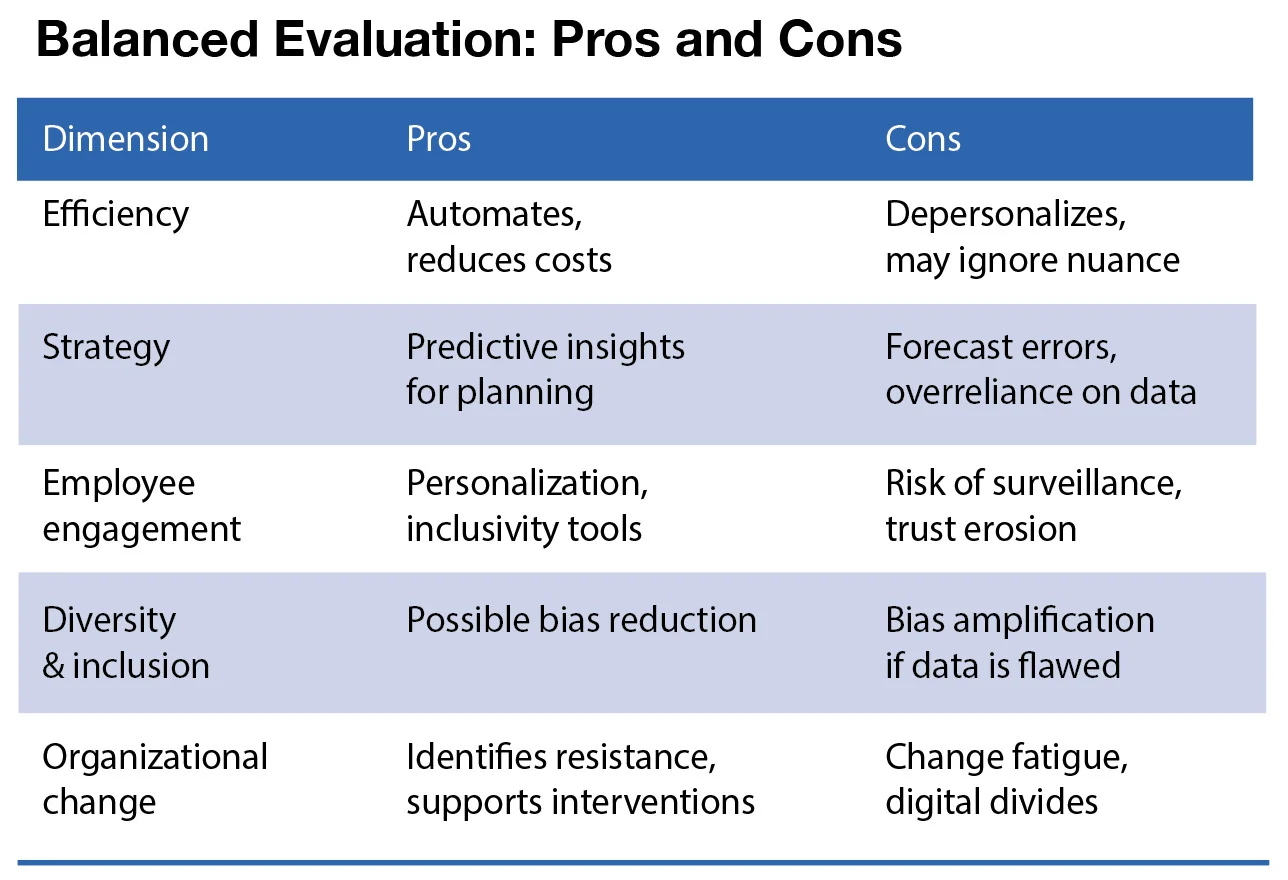
AI is changing the way we think about human resource management, making it more efficient, scalable, and strategic. However, it also comes with some important challenges, like the risk of bias, depersonalization, trust issues, and ethical dilemmas.
The key to navigating this landscape is responsible governance. It’s all about creating strategies that uphold human agency, dignity, and fairness. HR has a vital role to play here—acting as both a guardian and an innovator. HR can shape a future where it enables AI to enhance human experience in the workplace, rather than taking away from it. As such, HR must act as steward and innovator, shaping a future where AI enriches—not diminishes—the essence of people management. In this journey, technology and humanity together will define the next chapter of the workplace.