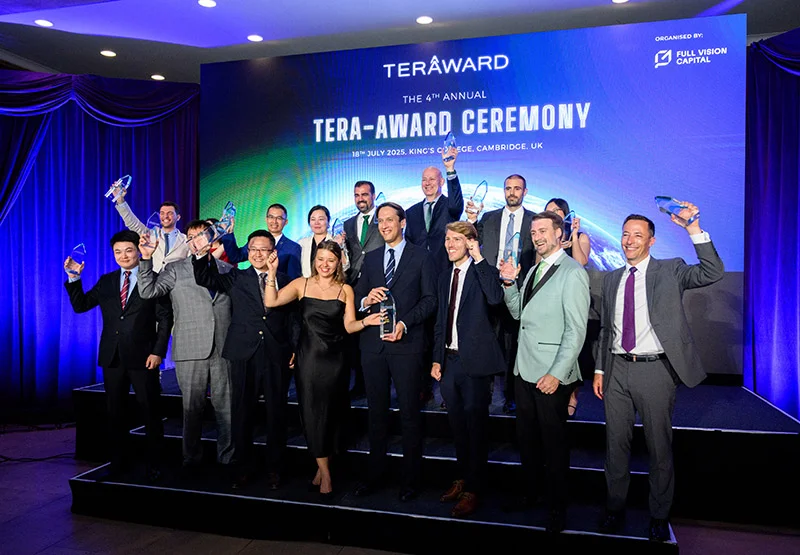
Collaboration with the United Nations and the University of Cambridge Institute accelerates programme’s mission to deploy breaking technology to find climate solutions.
The TERA-Award 2026 programme has significantly expanded its global reach by forming two prestigious new international partnerships to promote the search for climate solutions through advanced energy technologies. The new collaborations are with the United Nations Trade and Development (UNCTAD) and the University of Cambridge Institute for Sustainability Leadership (CISL).
About the TERA-Award programme
The TERA-Award programme was launched in 2021 by Dr Peter Lee Ka-kit with a mission to address global climate change by leveraging technological innovation. It has flourished into an international acceleration platform combining significant prize funding with real-world application scenarios, together with industrial and capital enablement. The programme inspires people involved in frontier energy technologies and teams of innovators worldwide to seek out impactful climate solutions.
Since its launch, the TERA-Award programme has grown into an influential professional competition in the global energy technology sector. The addition of UNCTAD and CISL as strategic supporting institutions is a major milestone, strengthening the programme’s ability to connect global innovation resources and advance the development of intelligent energy systems.
United Nations and University of Cambridge Institute Open Doors Worldwide
UNCTAD is the United Nations’ focal point for trade, investment, and sustainable development and will deploy its global policy expertise and cross-regional industrial networks to support the TERA-Award programme. The collaboration means innovative outcomes from the programme will be more effectively linked to specific markets and application scenarios, accelerating their international deployment and large-scale adoption.
CISL will meanwhile contribute its world-leading research capabilities in climate and energy innovation. The institute’s participation will enhance the depth and rigour of the award programme’s evaluation framework, helping identify projects that combine scientific excellence with strong potential for commercialisation.
TERA-Award Organising Committee Executive Chairman Alan Chan Ying-lung explained: “UNCTAD, CISL, and the TERA-Award programme share a strong commitment to advancing technological innovation as a solution to climate challenges. By collaborating with international organisations and governments worldwide, I look forward to accelerating the real-world deployment of TERA-Award projects and delivering practical technology pathways for the global energy transition and climate action.
James Cole, Executive Director, Chief Innovation Officer, CISL, commented: “At CISL, we recognise that accelerating the energy transition is critical for long-term societal and market resilience. This creates an enormous opportunity for innovation, capital, and solutions with global-scale potential. Our partnership with the TERA-Award programme reflects our commitment to cross-border approaches to innovation, ensuring that the most promising solutions are not only technically strong but capable of delivering real‑world impact where it is most urgently needed.”
New Categories with Million-Dollar Awards Launched
In response to key technological challenges in emissions reduction and the energy transition, the TERA-Award 2026 programme is building on its four established core categories — Green Fuels & Hydrogen Energy, Energy Storage & Conversion, Energy Saving & Carbon Capture, Utilisation, and Storage (CCUS), and Smart Energy System — by introducing two new categories: AI × Energy and NextGeneration Energy.
The AI × Energy category has two key strategic objectives. Firstly, it aims to promote the deep integration of artificial intelligence into energy systems, drawing on technologies such as large-scale models and embodied intelligence to enhance system efficiency and resilience. Secondly, it seeks to address rising energy demand and carbon footprint driven by the rapid growth of the AI industry, exploring low-carbon and high-efficiency energy solutions to support the sustainable development of AI.
The Next-Generation Energy Technologies category moves beyond renewable energy to include advanced nuclear technologies such as nuclear fusion and small modular reactors (SMRs), systematically exploring their potential roles in future energy systems.
TERA-Award Chief Organiser Heron Ho Shing-yan remarked: “Artificial intelligence is reshaping the efficiency landscape of the energy sector, while deep capital engagement determines how quickly technologies can move from laboratories to large-scale deployment. Through the TERA-Award programme’s technology–scenario–capital acceleration platform, high-quality energy innovation projects can connect efficiently with global capital and industrial resources, accelerating commercialisation and scalable impact.”
Innovation Hub Hong Kong Connects Global Technology Ecosystems
Hong Kong is helping lead the way in the global energy transition by implementing its Climate Action Plan 2050 strategy, creating a green development ecosystem characterised by a supportive policy environment, diverse application scenarios, and a high concentration of innovation resources. This makes the city a gateway for energy technology commercialisation and international expansion.
InvestHK is the strategic partner for TERA-Award. King Leung, Global Head of Financial Services, FinTech & Sustainability, InvestHK, said: “Hong Kong is committed to strengthening its role as a global centre for green technology and green finance. TERA‑Award has once again demonstrated how the city’s robust ecosystem supported by strong government policy, world‑class research capabilities, and deep international connectivity can accelerate the real‑world deployment of breakthrough energy and climate technologies. InvestHK looks forward to building a stronger bridge between international energy ecosystems and the award’s growing international impact, helping innovators scale, commercialise, and reach broader markets across Asia and beyond.”
The TERA-Award programme has attracted nearly 2,000 projects from 76 countries and regions and awarded total prize funding of US$4.65 million since its launch. As well as the competition, the programme supports participating and alumni projects through financing facilitation and real-world application matching. Most recently, it supported Hong Kong-based start-up Luquos Energy as it completed its seed round.
This year, the TERA‑Award programme will offer a total prize pool of US$1.15 million. Online applications are now open, and submissions will be accepted until late April.
In the coming months, the TERA-Award programme will host a series of roadshows and promotional events in the UK, Europe, Singapore, and Beijing, providing global innovators with detailed insights into the competition mechanism, evaluation criteria, and collaboration opportunities.
The TERA-Award programme warmly invites the participation of energy technology innovators worldwide, harnessing innovation to address climate challenges and advancing the global energy transition through collaboration on the journey towards a more impactful and sustainable future.
Applications for TERA-Award 2026 are now open. Innovators are invited to submit their entries via the official website at www.tera-award.com.