Gen Z in Business: Bold Stories from the Next Generation of Leaders is a feature series exploring how the next generation of leaders is building companies, shaping culture, and redefining success on their own terms.
From launching his first venture at just eight years old to building Thred Media into a global Gen Z-focused platform, Jenk Oz has consistently worked at the intersection of youth culture, social impact, and media innovation. In this interview, he reflects on the formative moments that drove him toward socially driven entrepreneurship, the structural gaps in youth media Thred was designed to address, and how Gen Z are reshaping work, education, and media.
You launched your first venture at an unusually young age. What early experiences shaped your desire to build socially driven businesses?
My journey began at eight years old with a school show-and-tell that unexpectedly became the foundation for my first venture. Over the next three years, that idea evolved into iCoolKid, a website designed to share creative activities for young people.
What truly changed the trajectory of my work wasn’t the platform itself, but the messages I began receiving. Initially a few a week, they soon became multiple messages a day from young people across the world sharing deeply personal experiences – stories of LGBTQ+ teens facing suicidal thoughts, girls improvising period products from litter, and students organising environmental initiatives in their local communities.
I no longer wanted to just create content, but to build platforms that could educate, empower, and enable action at scale.
Growing up in a safe, middle-class household, these stories exposed me – very early on – to realities I had never encountered. They made me realise how unaware I had been of the struggles facing the very generation I thought I was representing. That confrontation with global inequality and lived experience fundamentally shifted my ambition: I no longer wanted to just create content, but to build platforms that could educate, empower, and enable action at scale.
Was there a specific moment when you realised you wanted to dedicate your work to empowering Gen Z?
Rather than a single moment, it was the cumulative impact of reading hundreds of messages from Gen Zers around the world. Each one added to a growing realisation that access, opportunity, and support are deeply uneven – especially for young people.
That awareness sharpened in 2019 when I encountered the work of economist Raj Chetty while preparing a TEDx talk. His research made clear that talent is evenly distributed, but opportunity is not. That insight crystallised my direction: if young people couldn’t bring their ideas to life due to structural barriers, then my role was to help remove those barriers through information, community, and access.
What gap in the media landscape were you trying to fill when you founded Thred Media?

Thred was created to solve three core problems in youth media:
- Most media talks about Gen Z, not to or with them. We speak in the language of Gen Z and cover topics that are culturally and socially relevant to their lived realities.
- Education without action isn’t enough. Thred doesn’t just inform; it shows pathways forward and encourages immediate, practical engagement.
- Young audiences are often rented, not owned. We built our own global community rather than relying solely on platforms.
What makes Thred unique is the triangulation of publishing, community, and consulting, which allows us to generate real-time Gen Z insights and apply them directly to media, research, and brand strategy.
Thred operates across publishing, consulting, and production. What does that structure enable you to do that traditional media companies can’t?
Traditional media companies typically separate content creation from audience insight and commercial application. Thred integrates all three.
Our publishing arm gives us daily, real-time insight into Gen Z culture and social change. Our community – spanning readers, newsletters, social platforms, Discord, and a global Change Maker Directory – provides first- and zero-party data. Our consulting arm then applies those insights directly to brands, governments, and NGOs.
This structure allows us to deliver fast, authentic, behaviour-led insights grounded in lived experience – not delayed reports or second-hand analysis. Because our team is almost entirely Gen Z, our insight comes from lived experience rather than detached observation. We are immersed in the culture every day, both at work and outside it.
What have been the biggest challenges in scaling a Gen Z-centric media brand?
The biggest challenge has been sales and visibility in an oversaturated attention economy. Outbound communication is increasingly expensive and competitive, making it difficult to get decision-makers’ attention – even with strong ideas.
Fundraising has also been challenging. As a media and consulting business rather than a pure tech or consumer product company, we don’t fit the traditional venture capital growth narrative.
Finally, hiring presents unique costs. Distinguishing between young people who are genuinely aligned with the mission and those who see the role as a temporary stopgap is difficult – and hiring mistakes are expensive in terms of training, time, and momentum.
You’re a member of Google’s Gen Z Council and Oracle for Startups. Through networks like these, what trends should young founders be paying attention to?
Several shifts stand out clearly:
- AI and automation will replace entire industries faster than expected. Estimates of job displacement are likely conservative.
- The gig economy is accelerating rapidly, with up to half of the developed world’s workforce projected to be freelance or contract-based by 2027.
- The creator economy is expanding at scale, with Gen Z emerging as its most active participants. Over half of Gen Z say content creation is their ideal career.
- Education is being democratised. Young people are supplementing or replacing formal education with online learning, apprenticeships, and peer-based skill sharing.
- Solopreneurship is rising. Not every Gen Zer wants to build a billion-dollar company; many prioritise sustainable, independent income and autonomy.
The common thread is access: digital tools have removed borders, lowered the cost of failure, and flattened hierarchy.
You’ve spoken extensively about the future of work. What shifts will define the next decade?
Gen Z is redefining work culture around flexibility, transparency, and purpose. Key shifts include:
- Flexible hours and hybrid work as standard
- More frequent and meaningful feedback
- Open discussion of mental health
- Faster adoption of technology
- Broader internal mobility and exposure across organisations
Most importantly, company purpose must align with employee purpose. Gen Z expects employers to integrate social change into their operating systems, not just their marketing. Workplaces that fail to adapt to these expectations will struggle to attract and retain talent.
Where do you see the most promising opportunities for Gen Z and Gen Alpha entrepreneurs?
Innovation opportunities lie at the intersection of technology, sustainability, education, and AI-enabled products. Product-based businesses are likely to outperform services as automation continues to disrupt traditional service models.
Emerging roles – particularly in climate adaptation, decentralised education, and human-AI collaboration – represent major growth areas. Importantly, many of the jobs of 2030 don’t yet exist at scale.
You operate across entrepreneurship, public speaking, and creative performance. How do you manage multiple timelines?
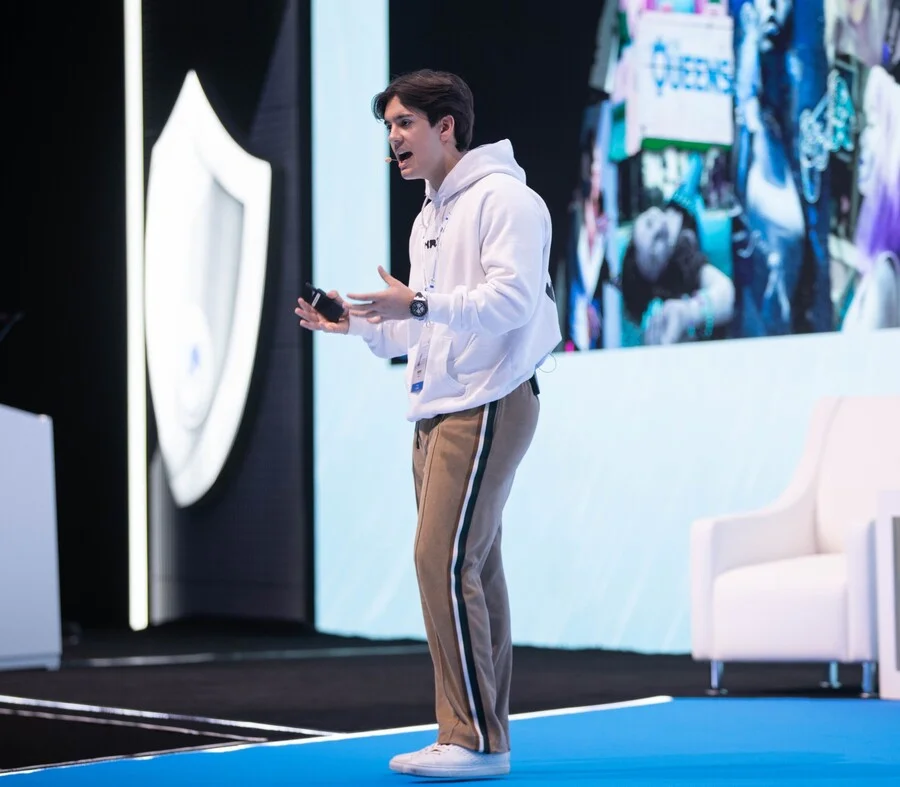
Strong scheduling is essential, but more importantly, these disciplines reinforce one another. Public speaking sharpens communication, performance builds confidence and presence, and entrepreneurship grounds everything in execution. Rather than competing for time, they collectively strengthen my ability to lead, communicate, and create impact.
What is your long-term vision for Thred Media?
Our focus is on scaling impact through AI-enabled systems that enhance our consulting, creative, and media workflows. We aim to stay ahead of transformational forces by identifying them early and building capabilities as they form.
Long term, Thred’s role is to help individuals, brands, and institutions understand and work with emerging generations – using behavioural insight, community, and purpose to drive meaningful change at scale.
 Jenk Oz