


By Mostafa Sayyadi and Michael J. Provitera
When the AI train pulls in to the platform, the accompanying steam clouds of uncertainty may disorientate those waiting in the station. Here, Mostafa Sayyadi and Michael J. Provitera suggest that authenticity and psychological capital are key concepts in the success, or otherwise, of leadership in restoring clarity and confidence among the workforce.
Artificial intelligence is bringing new changes in the future of business.1,2,3,4 Authentic leaders are those executives who can effectively guide their organizations through these tough transitions. AI has the potential to improve human skills. However, it also worries employees. Employees may fear that AI will take their jobs. Authentic leaders have an important duty now. They can introduce AI ethically and thoughtfully to balance the path forward. These leaders are very optimistic about AI’s potential to aid humans. They are also very realistic about employees’ concerns. With open discussions, authentic leaders will ease uncertainty about AI. These leaders explain how AI can work with employees, not against them. They also focus on ethics and people, not just efficiency. Adapting to change is hard. Nevertheless, an organization can thrive in the digital future with authentic leadership focused on empowering people.
Authentic leaders persevere in finding ethical AI approaches, choosing human values over convenience.
Moreover, authentic leaders inspire trust to guide transitions. Their motivation and belief in people’s abilities provide reassurance despite uncertainty. Authentic leaders persevere in finding ethical AI approaches, choosing human values over convenience. These leaders also show flexibility in readying their workforce to use AI responsibly. Psychological strengths like hope and resilience help authentic leaders manage AI’s risks. 5,6 With an ethical digital culture focused on human collaboration with AI, authentic leaders can steer their companies through complex changes. Employees will, then, feel excited by AI’s potential, not threatened.
Digitalization, AI Data Reliance, and the Critical Role of Authentic Leadership
Digitalization brings many changes, from remote work and skills gaps to complex, matrixed organizations that present leaders with daunting challenges when modeling desired behaviors such as transparency and morality. To battle these challenges, executives need to adopt authentic leadership mindsets to help their companies in the direction of digital transformation. Authentic leaders can make people feel more confident in their ability to guide the organization through big, complex changes due to new technologies like artificial intelligence. Their self-confidence and related motivation help give reassurance and make people feel less uncertain, even when things feel unclear or worrying because of the changes, managing transitions capably. They can also reassure people amid uncertainty by openly displaying their drive, motivation, and leadership capability through their words and actions.
In addition, authentic leaders are aware of the impact on values of AI’s reliance on data. This reliance may compromise traditional values like transparency and morality, leading to leaders who rely more heavily on algorithmic insights than on their human reasoning capability and judgment learned over years of experience.7,8 As pressures to rely solely on data increase, authentic leaders who excel in psychological capital elements such as hope can identify alternative ethical AI approaches that respect transparency and human impacts. Authentic leaders aspire to ethical methods over easy shortcuts that could compromise values. These leaders seek hope over convenience when faced with tough situations.
Machine Learning, AI Opacity, and the Critical Role of Authentic Leadership
Executives who adopt an authentic leadership style know how to deal with the impacts of machine learning and AI opacity. AI systems tend to be inherently opaque, concealing their inner workings from users and powered by proprietary black boxes. This lack of transparency contradicts authentic leaders’ emphasis on openness and transparency. Authentic leaders prioritize open dialogue when making and explaining decisions. AI systems make it impossible to explain AI-generated recommendations or insights. This can lead to distrust and anxiety among employees affected by mysterious AI systems. Employees may worry that AI could be biased and unethical, leading to unethical uses that go undetected and unchecked by leaders who cannot monitor audit algorithms to guarantee their moral behavior.
Authentic leaders act to mitigate any gaps between opaque AI systems and their values of openness.9,10 These leaders also take proactive steps (e.g., ethics reviews, algorithm audits, or explainable AI techniques) to restore transparency and build trust against this artificial opacity created by systems that mismatch these values. Otherwise, the result may be distrust among users.
However, a key question remains. What can help authentic leaders manage opaque AI systems? Resilience is an interesting part of psychological capital. Psychological capital is a new theory in the area of motivation. Positive organizational behavior focuses on developing the follower or employee to become all they can become by setting stretch goals. These goals could be quantum leaps for the organization and employees. When employees reach their full potential, their performance increases, along with their well-being. Psychological capital is a combination of creating an organization that has high levels of each resource coupled with organizational capital, human capital, and social capital, which are intangible features of organizations that may improve not only competitive advantage but also profitability.
Recent research shows that resilience helps authentic leaders adapt to changes from opaque technologies like AI.11 Resilience improves these leaders’ ability to recover from problems and introduce algorithm auditing to restore transparency. Authentic leaders who adapt well to change show flexibility in the face of AI disruption by proactively planning training to develop responsible AI skills in their workforce. From healthcare research, it emerges that adaptability empowers authentic leaders high in resilience to put in place ethical checks on black-box algorithms and find new ways to maintain transparency when faced with opaque AI and machine learning systems.

Organizational Trust, Ethical Digital Culture, and the Critical Role of Authentic Leadership
Authentic leaders foster organizational trust in AI. Since employees fear job losses due to automation and AI, authentic leaders proactively build employee trust by communicating openly and transparently about how AI will augment roles rather than replace jobs.12 Authentic leaders also strike the right tone when discussing how AI and technology will impact jobs. They are very realistic. AI will transform roles and potentially replace some jobs. Authentic leaders transparently acknowledge this fact while providing reassurance and optimism and focusing on how AI can augment human skills and talents. Technology has historically created more opportunities than it destroys, and AI can significantly boost human productivity. This balanced, hopeful realism can ease fears of change. Authentic leaders can build trust through various means. Their self-assurance allows them to explain openly how AI enhances human skills, while their motivation helps workers believe they can succeed with AI’s help, prioritizing human skills. Authentic leaders can effectively design systems that enable teamwork between humans and AI and foster trust. Their vision for employees can also provide reassurance against fears of replacement. Authentic leaders use self-belief to openly discuss this idea while confidently conveying how AI enhances human skills.
Another key point for executives is that the era of AI also promotes new models of ethical use of technology and shapes a new model of corporate culture in which employees should be aware that AI can assist humans and not replace them. Here, fostering an ethical digital culture is critical. As AI becomes more integrated, authentic leaders vocally and visibly promote responsible and ethical use of the technology. These leaders make it clear that AI is meant to enhance, not diminish, uniquely human abilities like creativity, empathy, and judgment. Authentic leaders demonstrate ethics to build employee trust in AI. They create an ethical organizational culture where AI assists humans rather than replacing them. Their optimistic approach includes monitoring the ethical aspects of AI while keeping its focus on helping humans. These actions contribute to creating an ethical climate while shaping a culture where opportunities for human enhancement arise.
AI Assessment, Data-Driven, People-Centric Metrics, and the Critical Role of Authentic Leadership
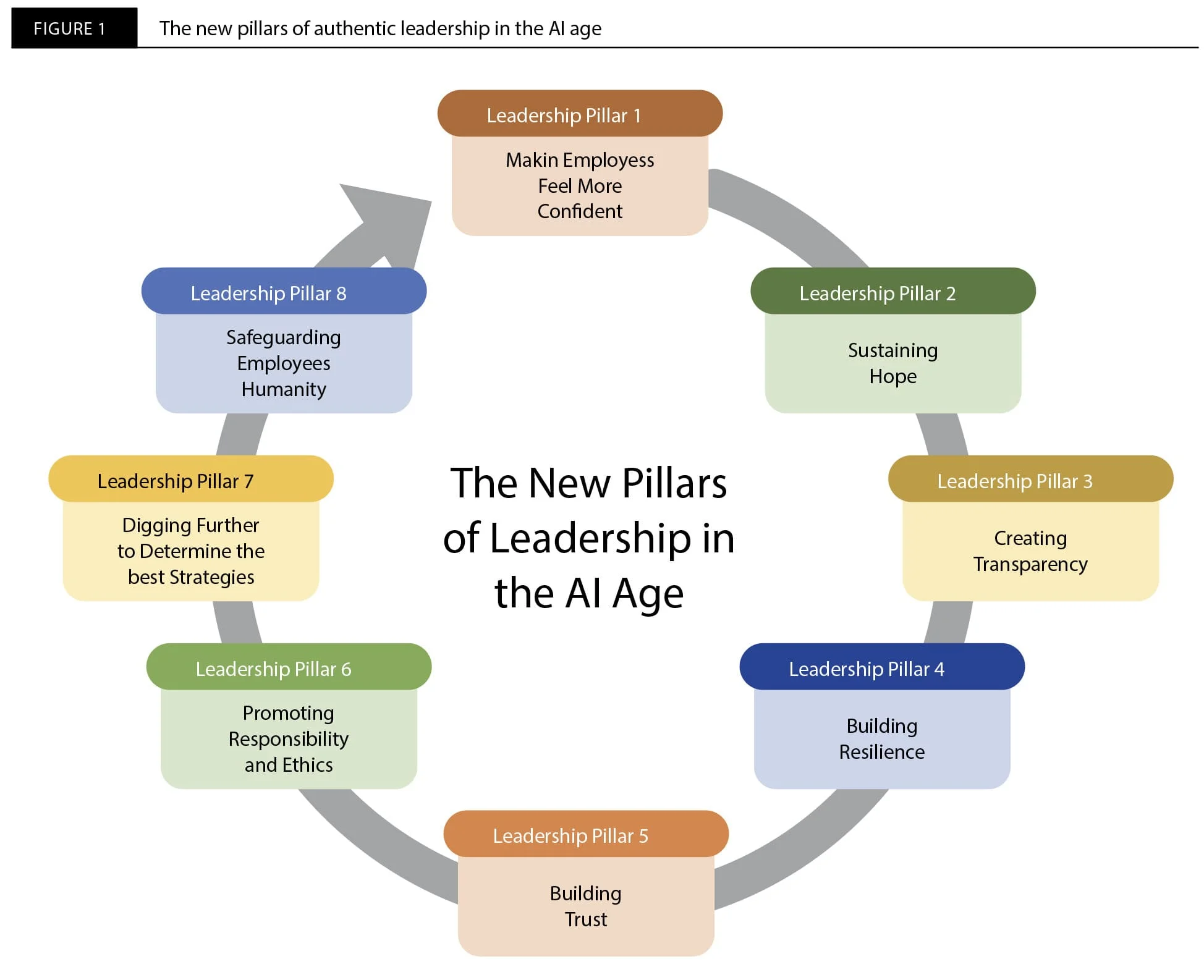
Authentic leaders can also answer a key question: Does the assessment of AI impact people’s oversight? Every executive should be aware that, as any company or organization considers investing in new technology like robots or advanced computer programs, its leaders often start with an assessment, including financial, work process, and organizational considerations. But authentic leaders completely understand that it’s about more than numbers. They spend time considering how these significant changes might impact the people who work there through factors like job security and well-being. In particular, leaders need to ask key questions regarding any proposed changes. These key questions are: “Will these changes cause someone else’s job or career to change?” or “Who might find adapting difficult?” In addition, authentic leaders have an ethical responsibility when decisions could impact others. They consider this by providing extra training or other forms of support to employees who feel threatened by any forthcoming adjustments. These leaders will dig further to determine why, before devising strategies.
In addition, authentic leaders have an ethical responsibility to prioritize workplace humanity. They emphasize transparency, ethics, and morality to create trust when implementing AI or emerging technologies. Executives implementing AI must not accept data-driven metrics or efficiency gains alone as justification. This represents an ethical breach. They have a moral duty to consider how AI might subjugate human dignity or dehumanize aspects of work. If an AI system’s metrics will treat people like disposable cogs, then its implementation must be rejected on moral grounds. They must mitigate these risks by showing openness, carefully assessing impacts, and upholding an unwavering dedication to safeguarding people’s humanity. When integrating AI systems, authentic leaders communicate the purpose and limitations of these technologies and consider any risks that might occur, rather than dismiss them outright. They also guard against profit-driven attempts to turn work into mechanical, data-driven processes devoid of meaning. Authentic leaders prioritize respecting human dignity over productivity gains or cost savings. By doing this, these leaders in the digital era champion timeless human-centric leadership virtues such as morality, empathy, and ethical empowerment as an antidote against technology’s potentially dehumanizing effects. Accordingly, authentic leaders set an example for an ethical AI deployment that augments rather than diminishes workplace humanity.
Practical Guidance for Leading Through the AI Era
The new changes as a result of AI are challenging for leaders across the globe. They can adopt an authentic leadership style to impact their subordinates. Employees can feel threatened that AI will take their jobs. Authentic leaders can communicate openly and honestly. They also need to explain how AI can help people do their jobs better and focus on more human activities like creativity and empathy. Authentic leaders can make sure that AI is used ethically. They can also highlight that AI makes processes more efficient. Here, authentic leaders also consider the human impacts. They frankly reject uses of AI that diminish human dignity or treat people like machines. They can assess the risks and communicate them. Therefore, these leaders emphasize AI supporting humans rather than replacing them.
The next key point is that authentic leaders reinforce the culture or the organization by providing extra support and training to help workers adapt. In doing this, they may consider the following recommendations:
Stay optimistic and focus on how AI can enhance human skills. Be open and have ongoing dialogues with workers about impacts. Provide extra training and support to help them adapt.
Implement AI carefully and ethically. Before deploying it, do complete assessments on how it will affect people and jobs. Reject uses that could diminish human dignity. Make ethical oversight of AI a visible priority.
Keep communicating with authentic transparency. Explain the purpose and limitations of AI. Be realistic yet hopeful about how roles will transform. Reassure people that new tech will augment, not replace, jobs.
Keep people at the center.
Shape an ethical climate of learning and trust. Adopt AI as a collaborative tool to expand what humans can achieve.
Practical Guidance for Developing Psychological Capital
In this section, we present recommendations for executives to develop psychological capital coupled with their authentic leadership. With AI so prevalent, hope is important, and bouncing back from setbacks is equally important. Self-efficacy to deal with situations needs a transfer of talent when necessary. Self-efficacy is people’s belief in their capacity to influence events that may affect their lives. In our conversations with Australian executives in Melbourne, Sydney, and Perth, we found that the following tenets of psychological capital can strengthen authentic leaders as they manage change and encourage a culture of humans and artificial intelligence with employees. Based on our findings, we present the following practical ideas for authentic leaders:
- Hope – Use hope to provide training for the visualization of quantum goals and contingency planning. Have leaders and followers practice flexibility in finding new solutions by providing hope coupled with resources and tolerance for possible mistakes when they occur.
- Resilience – Use resilience to build high recovery from artificial intelligence drawbacks such as cyberattacks. Resilience can be manifested through workshops on managing stress, bouncing back from setbacks, and changing management skills to repackage negative stimuli.
- Self-efficacy – Use self-efficacy to boost confidence by setting achievable targets that stretch skill levels. Provide mentoring from senior and tenured employees to those recently onboarded, and give positive feedback on accomplishments whenever possible. We found that cross-training in similar areas of the business units helps people grow in depth and breadth.
- Optimism – Use optimism to foster techniques such as identifying negative thought patterns and changing them to positive ones, reframing the issues positively, and focusing on opportunities when they arise.
- Transparency – Use transparency to enhance education and communication. Transparency needs to be coupled with clear communication of plans in an ongoing process, always inviting input and sharing from and across employees.
In Conclusion
By keeping people at the center, authentic leaders are those executives who can effectively and ethically integrate AI to elevate rather than diminish productivity and humanity. These leaders can guide their organizations through the digital transitions today. In addition, by empowering the elements of psychological capital, authentic leaders can enhance the work environment and more effectively open up opportunities to expand and grow organizations in the AI age. Once workers are aware of the power of AI coupled with authentic leadership and positive organizational behavior, better known as psychological capital, they become more innovative and creative. Effective authentic leadership will also provide a supportive digital culture to help employees feel empowered and not threatened by AI. This can help employees embrace all the dynamic decisions that follow an artificial intelligence mindset.


