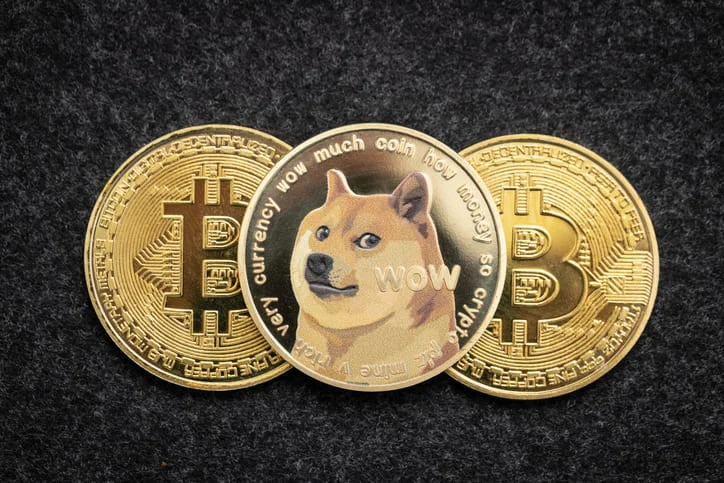
Before Dogecoin became a meme juggernaut, it lived in chat rooms, jokes and unlikely bonds. Here’s a critical, behind-the-scenes look at how Doge’s community came when it was still a joke.
In its early months, Dogecoin was as much performance art as cryptocurrency: a tongue-in-cheek protest against hype. Looking at price movement like Dogecoin price INR hadn’t yet drawn serious attention, mainly because nobody figured a satirical token would ever end up in fiat pairings.
Yet within those absurd beginnings lay the social mechanics of belief, ridicule and identity that transformed Doge into more than a meme.
Born as a parody, but open to believers
Dogecoin was launched on December 6, 2013, by Billy Markus and Jackson Palmer. Its intent was deliberately satirical. Its Shiba Inu mascot, lifted from the viral “Doge” meme, signalled a parody of Bitcoin’s seriousness. The founders joked about it publicly, yet that self-mockery became magnetic.
Within two weeks of its release, Dogecoin surpassed Bitcoin in the number of daily transactions, according to community archives compiled by the Dogecoin Foundation. It wasn’t supposed to be possible: a parody coin outperforming the original in activity.
In a sense, people either “got” it or they didn’t. The founders never seriously adopted it. But the humor became a strength, a self-filter for a subculture that valued inclusivity and irony over revenue.
From text-only threads to rituals
Before Telegram or Twitter (now known as X) spaces became crypto staples, Doge fans gathered on BitcoinTalk threads, Reddit forums and early Internet Relay Chat channels. These text-only environments made generosity a kind of performance art.
The tradition of “shibes tipping new users 100 DOGE” began there and became cultural currency. Those tips built a reputation faster than mining ever could.
This was the early Dogecoin social contract: be generous, stay funny and never act superior. Over time, recurring phrases like “wow much coin” and “to the moon” stopped being jokes and became symbols of belonging. They were linguistic uniforms for a growing digital tribe that relied more on memes than market charts.
Critics, doubts and the fight for identity
Critics surfaced hardly a moment later. Most characterized Dogecoin as a serious distraction, a bubble in the making.
Because it has no hard supply limitation and there will be more than 140 billion DOGE in supply by 2015, skeptics call it inflationary. Other skeptics question its sustainability without commercial sponsorship. Those arguments fill public threads, compelling true believers to explain why they are worried about it.
That roughness constituted Dogecoin’s voice. It learned to accept blemishes rather than conceal them. Its proponents claimed that its sincerity rather than scarcity constituted its value. The coin may lack the coded refinement of Bitcoin, but it warmed hearts, laughed and persevered. Its self-deprecating culture transformed ridicule into perseverance.
When data met meme, the beginning of market reality
When trading exchanges started listing the coin, the community crashed into financial reality. What once was a joke social token entered the realm of order books and liquidity.
The Binance DOGE/USDT trading pair once reached approximately 0.21628 USDT in trading pair value, with 24-hour volume at 1.73 billion DOGE. That magnitude was unthinkable in 2013 when Dogecoin mainly remained within the realm of Reddit jokes and niche forums.
Market volatility soon tested that playful ethos. As reported by Binance Research, “The total crypto market cap lost more than US$300 billion this week, falling to US$3.7 trillion towards the end of the week. Riskier assets like altcoins fell the most, with Ethereum falling over 13 percent and Solana by 20 percent. BNB fell only by ~3 percent while BTC slipped ~6 percent.”
These numbers show how even the most prominent players are influenced by the same currents that once buoyed Dogecoin’s ironic charm.
Thousands of cryptocurrencies are exchanged on global platforms today, with 24-hour trading volumes in the hundreds of billions of dollars. For a project born from satire, that growth shows how humor can evolve into a measurable financial force.
Why the joke still matters
For Dogecoin’s early network, comedy wasn’t a disguise but a unifier. It enabled a heterogeneous mob to coordinate without hierarchy.
Laughing together cemented the same type of trust that code itself seldom engenders. In 2014, that trusty bond took concrete form when Dogecoin enthusiasts organized fundraising efforts to bring the Jamaican bobsled team for a joyride and to construct Kenya’s water wells. Those efforts proved that irony could power real-life selflessness.
But that early culture is subjected to new strains. As Dogecoin enters institutional charts and Wall Street analysis, it loses a bit of its teasing spontaneity. But the essence is valid: tech goes further when human beings care about it. Dogecoin’s emotional subcurrent, fun, flippancy and connectivity continue to define its survivability in the face of volatility.
For anyone reading through today’s tickers, it’s easy to forget where it came from: strangers entering “much wow” into forums for a nod, passing small digital tips to the guy next to them for drinks and mocking participation. Behind every candlestick on a chart is a thread, a meme and a chuckle that couldn’t disappear.
Its early proponents showed that laughter could be a basis for community and creativity, even regarding money.
Disclaimer: This article contains sponsored marketing content. It is intended for promotional purposes and should not be considered as an endorsement or recommendation by our website. Readers are encouraged to conduct their own research and exercise their own judgment before making any decisions based on the information provided in this article.