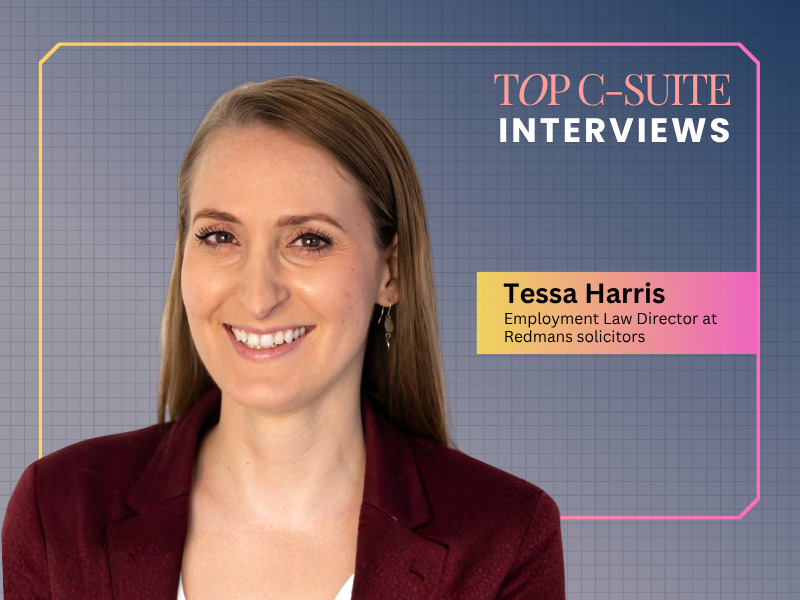
Interview with Tessa Harris of Redmans solicitors
Employment law, like so many aspects of 21st-century life, is subject to constant evolution. It’s challenging for employers, who must be aware of their legal responsibilities at all times, but also for employees, who need to know exactly where they stand. Enter Tessa Harris and her team at Redmans.
You have built an impressive career in employment law, now serving as Employment Law Director at Redmans. What inspired you to specialise in this field?
Having a family who are largely in the medical profession, I have always been interested in medicine and healthcare (even questioning whether, at one point, I chose the right profession). So, I initially wanted to specialise in clinical negligence.
However, during my Legal Practice course, which I carried out at the University of the West of England in Bristol, clinical negligence was not a topic to specialise in, so one of my optional modules was employment law. Since it felt easier than my other modules, I enjoyed it the most out of all.
It is also fast-paced and ever-changing, which means I have to be on my toes. I benefited from knowing the law and understanding my rights as an employee, as did my friends and family when ad hoc advice was needed.
Following the end of my university life, as luck would have it, a paralegal opportunity arose in the Employment team at Lyons Davidson solicitors. And although I grabbed the opportunity merely because it was one foot in the door in an incredibly competitive industry, I quickly discovered how much my enjoyment of employment law actually increased in practice.
I found employment law to be highly relatable, as most of the population is employed or in some form of work capacity. It is also fast-paced and ever-changing, which means I have to be on my toes. I benefited from knowing the law and understanding my rights as an employee, as did my friends and family when ad hoc advice was needed.
I love that I can help so many people, and every person’s case is different. I couldn’t imagine being in a position where some of my clients find themselves having been unfairly dismissed or discriminated against. But I can, however, as an employee, sympathise with them. I am therefore able to show a human / relatable side of being a lawyer, which can be lost in other legal areas.
How have your academic and professional experiences, including your master’s in Clinical Negligence, shaped your approach to employment law and client advocacy?
I say this to many aspiring lawyers that a degree, the Legal Practice course, and a training contract are all useful to gain the basics of the theoretical side of law. However, I only had a firm grasp of what I was doing once I had a caseload myself, and I was applying the theoretical side of law to actual real-life situations.
Nothing can prepare you for dealing with those initial client calls, drafting and submitting your first claim form, or representing your client, during the first preliminary hearing.
As Employment Law Director, you balance client work with mentoring and guiding your legal team. What principles define your leadership style in such a people-focused area of law?
Being a specialist in employment law, I know first hand how poor management can result in significant repercussions. So, I am always conscious of ensuring that I strike a fine balance between acting in the best interests of the firm as a business, as well as my team.
The most important principle is that I will always listen and take opinions and points on board. If I can find a solution, fantastic; if I can’t, I will suggest alternatives.
Because of the nature of my role and my experience, I have developed empathy and look to understand the “why” before reaching a conclusion. While I honestly communicate the potential issues that may occur, I also look to work with my team to reach a conclusion and a way forward.
Moreover, part of managing a team is being able to make difficult decisions. So, having an open and transparent dialogue and offering support from the start allows those difficult decisions to be communicated with discussion and suggested options, where equal respect is offered both ways.
I am very fortunate to work with an incredible team, where we have developed a fantastic working relationship. As a collective, we work on solutions and ways forward and always support one another.

Redmans is one of the few UK firms that focus solely on employment law and has earned recognition for its success in resolving cases efficiently. What makes Redmans’ approach distinctive, and how does this shape your work with clients and colleagues?
The lawyers we hire are key to maintaining our high levels of success at Redmans solicitors. We pride ourselves on being approachable and try to offer solutions where clients may feel there are none.
In our initial calls, we will always offer advice and suggest best ways forward for clients. We believe that the human approach is key, as empathy and understanding are so important.
While more experience will assist with having these skills, we also ensure that our new recruits are the right fit for not only working as a team but, equally, for offering the same level of approachability and professionalism that our clients come to expect.
The discussion around employee empowerment and day-one rights has become increasingly important. How do you think these developments are influencing workplace culture and employer responsibilities?
It’s significantly reshaping workplace culture and redefining employer responsibilities. As employees increasingly expect greater autonomy, fair treatment, and a voice in decision making, organisations are being challenged to create more inclusive, transparent, and supportive environments, which in my view is a positive way forward.
Employers are expected to offer more by way of training, communication, and mental health support to meet the expectations of this new workplace culture.
Workplace culture is shifting from traditional, top-down management to more collaborative and flexible styles. This then allows employees the space to be more engaged, motivated, and innovative, which can lead to higher productivity. However, this also means that employers are expected to offer more by way of training, communication, and mental health support to meet the expectations of this new workplace culture.
Employers are now, more than ever, accountable for creating safe and respectful workspaces. It requires a review of pay equality, work-life balance, diversity and inclusion, and harassment prevention. A higher onus is on employers to ensure that employees are safe, and if day-one rights come in (which seems likely), the risk to employers is far more significant. Thus, policies and procedures will need to be reviewed carefully, legal advice sought and prepared in readiness for this change.
Mental health and well-being have become top priorities in many workplaces. How do you see employment law supporting this shift toward healthier and more inclusive working environments?
The law hasn’t changed much since the implementation of the Equality Act 2010, which protects those who have a disability from discrimination. Although not everyone who struggles with mental health issues will be considered disabled, that does not necessarily mean that employees who do struggle with mental health have nowhere to turn to.
Health and safety regulations require employers to provide a safe physical and mental working environment, reducing risks of injury and stress. So, businesses are now swiftly adapting their ways of working to accommodate mental health and provide support systems in place.
Implementation of stress risk assessments at work and providing hybrid working for a positive work-life balance are two areas which employers seem to adopt at present. Additionally, employment law covers areas such as equal pay, protection against unfair dismissal, flexible working rights, and parental leave, all of which contribute to an employee’s well-being and work-life balance.
From your experience handling cases such as disability discrimination and absence management, what key trends or challenges are shaping employment law today?
Since COVID, employers have adopted hybrid working, which has improved work-life balance. However, now that some time has passed, some have reduced that flexibility or removed it completely. This has resulted in many employees, who have relied upon such flexibility to manage their mental health and personal circumstances, feeling disgruntled and stressed.
So, the vast majority of discrimination claims that I now receive are with a greater focus on mental health as a disability.
In the past, physical impairments were traditionally the conditions relied upon for disability discrimination claims. However, with the growing recognition of mental health conditions, such as anxiety, depression, and PTSD, employers are increasingly required to consider adjustments for mental-health-related absences or performance issues, even before determining whether the condition is in fact a disability or not. This helps to ensure that they have taken steps to protect themselves from the possibility of litigation.
There is also more of an emphasis on reasonable adjustments being implemented at work. A rising expectation for employers is that they be proactive in ensuring that adjustments have been discussed and implemented.
Moreover, employers are expected to consider each individual pattern of absence per employee, as a generalised absence-management policy tends to be outdated and rigid in structure. Adapting a more flexible way of managing absence would show that care and attention have been given to the individual’s needs.
Failure to do the above can lead to grievances being raised and, again, litigation.
Looking ahead, how do you see employment law evolving to meet the changing expectations of employees and employers in the future world of work?
As employee awareness grows and their rights increase, so will litigation matters. With day-one rights likely to be implemented as well, employment law practitioners are likely to see an influx of cases, which will have a knock-on effect on the capacity of Acas and the Employment Tribunal.
I foresee an increase in not only unfair dismissal claims but, given how the culture is shifting, in disability discrimination claims, specifically failure to make reasonable adjustments, as well as discriminatory dismissals by way of sickness absence.
Employers will need to have a sound business justification for removing or reducing flexibility around hybrid working. While, at present, Employment Tribunals tend to avoid interfering with how a company wants to run its business, if there is no sound commercial reason for the justification, this could result in Tribunals finding that such action is unlawful. Again, employers should be considering, therefore, why they need to change, what the pros and cons are, and what alternatives can be offered to assist those most in need.
Fairness and inclusion are key. A reasonable employer will now be expected to include its employees in decision-making processes, consider individual needs based on any underlying medical condition, and adopt a supportive and understanding environment. If an employer does not, there is likely to be a significant litigation risk.