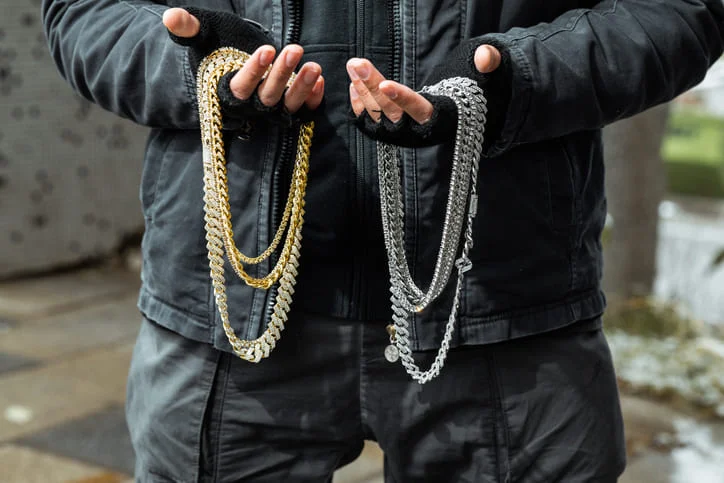
There is one promise a real silver chain can keep without exception. It will never turn your skin green. Green skin is what happens when plated base metal wears down and exposes the cheap alloy underneath. Solid 925 sterling silver does not do that, ever.
Tarnish is the more honest conversation. Every piece of sterling silver develops some patina over time because the 7.5% copper in the alloy reacts with the air. The chain styles below resist that reaction better than most, either through tight construction that limits air exposure, dense weight that distributes oxidation evenly, or smooth surfaces that hold polish longer than rougher weaves. All of them are solid sterling. None will leave a green mark on a collarbone.
If you want a starting point that gets straight to the right metal, Mcker’s sterling silver chains all carry the 925 hallmark and the construction discipline that keeps tarnish at the margin.
Use the table below to scan the ten weaves at a glance. Once you have a sense of which one fits the rotation, you can order Sterling silver chain for men online and have the right starting piece in hand within days.
QUICK REFERENCE
| Chain | Profile | Tarnish resistance | Best fit |
|---|---|---|---|
| Cuban Link | Heavy, flat | High (dense weave) | Bold daily wear |
| Franco | Four-sided, faceted | High | Dressier daily wear |
| Rope | Twisted spiral | Medium-high | With pendants |
| Wheat | Braided dense | Very high | One-chain wardrobes |
| Figaro | Alternating links | Medium-high | Casual and dressy |
| Box | Geometric, compact | High | Minimalist looks |
| Curb | Flat, classic | High | Versatile solo |
| Mariner | Oval with center bar | High | Statement solo |
| Byzantine | Complex interlock | Very high | Refined daily wear |
| Snake | Smooth, almost solid | Very high | Dressy or under collars |
Below are the ten weaves in detail.
1. CUBAN LINK CHAIN
Cuban link is the heavy weave most men picture when they hear the words “silver chain.” The links interlock flat against the neck, giving the chain a continuous, dense surface that minimizes airflow around individual links.
The tightness is what slows tarnish. Less air contact per gram means less reaction. A heavier Cuban also distributes any patina across more visible surface, so the chain reads even rather than spotty as it ages.
Best for a thicker frame, a t-shirt and jacket rotation, and anyone looking for one chain that does most of the work.
2. FRANCO CHAIN
The Franco is a four-sided diamond-cut weave that sits somewhere between a snake chain and a curb chain in profile. The links are tightly interlocked, and the surface is faceted, which catches light at multiple angles.
The dense construction reduces oxidation surface area. The faceted finish also masks early-stage tarnish well, because the light play distracts from any minor patina that does develop.
Best for men who want a chain that catches the light without going showy. Works under collared shirts and over a plain tee.
3. ROPE CHAIN
A rope chain twists multiple strands of silver into a spiral pattern. The construction stays dense at every visible point, which limits the exposure of any single segment to air or moisture.
Polished rope chains hold their shine longer than most other weaves because of how the twisted surface reflects light. Tarnish that does form settles into the recesses and stays subtle from a distance.
Best for men who want texture without the flat-and-heavy look of a Cuban. Pairs naturally with pendants.
4. WHEAT CHAIN
The wheat chain, sometimes called a Spiga chain, braids four oval links together into a rope-like pattern. The result is unusually dense for its weight class, with each link supporting the next.
Tight wheat chains rank among the most durable silver weaves on the market. They hold shape across years and resist visible tarnish better than looser weaves because there is almost no exposed inner surface to react.
Best for men who want a refined look that still reads as masculine. Strong choice for a single-chain wardrobe.
5. FIGARO CHAIN
A Figaro chain alternates one long flat link with two or three shorter round links. The pattern reads as a recognizable men’s chain without leaning fully into curb or Cuban territory.
The visual rhythm hides early patina well. Sterling Figaro chains tend to develop a gentle uneven tone as they age, which most men find adds character rather than detracts from the chain.
Best for men who want a familiar men’s chain that does not look like everyone else’s. Works in casual and dressier settings.
6. BOX CHAIN
The box chain is built from square links connected to form a continuous, geometric profile. The construction is compact, and the polished faces sit close together with very little air gap between them.
The geometry slows tarnish because each link face shields the adjacent link from air exposure on one side. A heavier box chain reads understated but holds presence on the neck.
Best for minimalists who want a clean, structured chain without the showier weaves.
7. CURB CHAIN
The curb chain uses uniform links twisted and flattened so they lie flat against each other. It is one of the oldest chain styles and one of the most reliable men’s options on the market.
The flattened surface reflects light cleanly and tarnishes evenly when it does. Heavier curb chains resist visible patina well because the broad flat surface distributes any reaction across a wider area.
Best for men who want a straightforward, unfussy chain. Reads well alone or under a pendant.
8. MARINER CHAIN
The mariner chain, also called an anchor chain, uses oval links with a small bar across the middle of each link. The design comes from nautical chain hardware and carries that heritage onto the body.
The links are typically thick and the construction is solid, which makes mariner chains tarnish-resistant for their weight class. The bar across each link adds a distinctive surface detail that distracts from minor patina.
Best for men who want a chain with a clear visual identity. Strong solo chain.
9. BYZANTINE CHAIN
The Byzantine is one of the more intricate weaves on the men’s market. Multiple small links interlock in a complex pattern that creates a textured, almost woven surface.
The complexity works for tarnish resistance. The interlocking links shield each other from the air, and the texture catches light from multiple angles, which masks patina effectively as it develops.
Best for men who want a chain that does not look like the others in the rotation. Stands up well to scrutiny up close.
10. SNAKE CHAIN
The snake chain has the smoothest surface profile in the silver chain category. Small rings of silver wrap around a central core, producing an almost solid-looking surface with minimal visible link separation.
Snake chains tarnish slowly because there is almost no exposed inner surface area. The polished outer face holds its shine longer than most weaves of equivalent silver content.
Best for men who want a refined, almost dressy chain. Works well under a shirt collar.
HOW TO KEEP ANY SILVER CHAIN AT ITS BEST
Tarnish resistance starts with the chain. Care extends it.
Wipe the chain down with a soft cloth at the end of each day. Sweat, lotion residue, and cologne mist all speed oxidation, and a thirty-second wipe adds weeks between polishing sessions.
Store the chain in a sealed pouch or anti-tarnish bag when it is not on the body. Air is the main driver of patina, and a closed environment slows that process to a crawl.
Polish with a silver-specific cloth rather than household products. A two-minute pass with a polishing cloth brings the brighter finish back without scratching the surface. Skip toothpaste and any cleaner with abrasives or bleach.
Take the chain off for chlorine pools, hot tubs, and ocean swims. Chlorine and salt water are the fastest paths to a dulled finish and a chain that needs more frequent polishing afterward.
FAQ
Will any solid sterling silver chain turn my skin green?
No. Green skin only happens when the silver layer wears off a plated chain and exposes the base metal underneath. A solid 925 chain has no base metal to expose, which is why this guide stays inside solid sterling.
Do anti-tarnish coatings actually work?
Yes, within limits. Rhodium plating and e-coating both slow tarnish for a year or two of normal wear. Eventually the coating wears thin and the sterling underneath behaves like any other sterling chain. Coatings buy time, not permanence.
Are heavier chains less likely to tarnish?
Heavier chains do not tarnish less per square inch, but the tarnish reads as more even and less noticeable across a larger surface. They also leave more material to polish across many years of wear.
Which chain weave tarnishes the slowest?
Snake, Byzantine, and wheat chains tend to tarnish the slowest because their tight construction reduces air exposure on the inner surfaces. Heavier Cubans hold their look well too because of sheer mass.
How often should I polish a sterling silver chain?
For a daily-wear chain, a quick polish every two to four months keeps it bright. A chain that mostly stays in storage usually needs nothing more than an annual polish.
FINAL THOUGHTS
Tarnish is part of owning silver. Green skin is not. Pick a solid 925 sterling chain, and the green question disappears for good. Pick one of the ten weaves above, and the tarnish question shrinks to a polishing cloth and a few minutes every few months.
Pick the weave that fits your style, wear it daily, and the chain will earn its place in the rotation faster than you think.
Disclaimer: This article contains sponsored marketing content. It is intended for promotional purposes and should not be considered as an endorsement or recommendation by our website. Readers are encouraged to conduct their own research and exercise their own judgment before making any decisions based on the information provided in this article.