By Christian Rebernik
If you are reading this, you are probably asking some version of the same question I hear from professionals every week: Is my career safe? And if not, what do I do about it?
It is the right question. And the honest answer is that the professionals who are asking it out loud are already ahead of those who are not.
I have spent two decades building technology companies, a digital bank, a health record platform used by 20 million people, and tools for the UN World Food Programme. In every one of those contexts, the pattern was the same: the people who thrived through technological disruption were not necessarily the most technically skilled. They were the ones who understood what was changing, moved early, and built the right combination of capabilities before the market made it obvious that they needed to.
AI is the biggest version of that pattern any of us will face in our careers. And most of the advice circulating about how to respond to it is either too vague to act on, or too narrow to matter.
The Wrong Question
The most common framing I hear is: “Will AI take my job?”
It is the wrong question, not because the answer is always no, but because it leads to the wrong response. If you spend the next three years anxiously monitoring which roles are being automated, you will arrive at the end of that period with a defensive posture and a shrinking set of options.
The right question is: “What kind of professional do I need to become to be genuinely valuable in a world where AI handles the routine?”
That question has a much more useful answer. And it is one that every serious professional should be actively working on right now, not waiting for their employer to hand them a training plan, not hoping the disruption moves slowly enough to retire ahead of it.
What AI Actually Displaces
To know what to build, you first need to be honest about what is at risk.
AI is exceptionally good at tasks that are information-dense but decision-light: synthesising large bodies of knowledge, generating structured outputs from clear prompts, identifying patterns in data, producing first drafts of almost anything. A significant portion of what occupied the working day of a mid-career professional a decade ago falls into this category.
This is not a distant threat. It is already happening in law, finance, consulting, marketing, software development, and increasingly in medicine and education. The productivity gains are real. So is the compression of roles at the levels where those tasks used to be done by humans.
The age of AI will produce extraordinary careers for people who approach it with clarity and intention.
What AI does not displace and what the evidence suggests it cannot displace in any straightforward way, is the capacity to operate in genuinely ambiguous situations. To read a room. To make a call when the data is incomplete or contradictory. To build trust with people who are uncertain or afraid. To take accountability for an outcome that an algorithm helped produce. To lead toward goals that are not yet fully defined. These are not soft skills. They are the hardest skills. And they have become dramatically more valuable precisely because everything around them is being automated.
What This Means for Your Career
If you are a professional in your 30s or 40s thinking about where to invest in the next phase of your career, I would suggest thinking along three axes.
The first is technological fluency, not expertise. You do not need to become an AI engineer. You do need to understand what AI can and cannot do well enough to direct it, evaluate its outputs critically, and integrate it into how you work. The professionals who will be most valuable are not those who compete with AI tools, but those who leverage them as a force multiplier on their own judgment. This requires hands-on engagement, not a course about AI, but actual practice using it in your domain.
The second is domain depth with cross-functional range. Generalists without depth are increasingly exposed. But deep specialists who cannot translate their expertise across functions, industries, or stakeholder groups are almost equally vulnerable. The combination that holds value is genuine depth in at least one domain combined with the ability to operate credibly across boundaries. AI handles the within-domain pattern matching. The value is in the across-domain judgment.
The third is leadership in conditions of uncertainty. This is the hardest to develop and the least substitutable. The organisations navigating AI-driven transformation best are not those with the most sophisticated technology. They are those with leaders who can bring people with them through change that is uncomfortable, whose trajectory is unclear, and where the right answer is genuinely unknown. That kind of leadership is a learnable capability, but it requires deliberate investment, not just experience accumulation.
Why Now, Not Later
The most common mistake I see professionals make is waiting for clarity before investing in themselves.
They want to know which roles will survive before they retrain. They want to see where the market settles before committing to a direction. They are looking for certainty in a situation that will not provide it and in the meantime, they are falling further behind peers who are moving without it.
The window for building these capabilities ahead of the curve is not ten years. It is closer to two or three. After that, the investment is still worthwhile, but it is remedial rather than strategic. The difference in outcome between those two positions is significant.
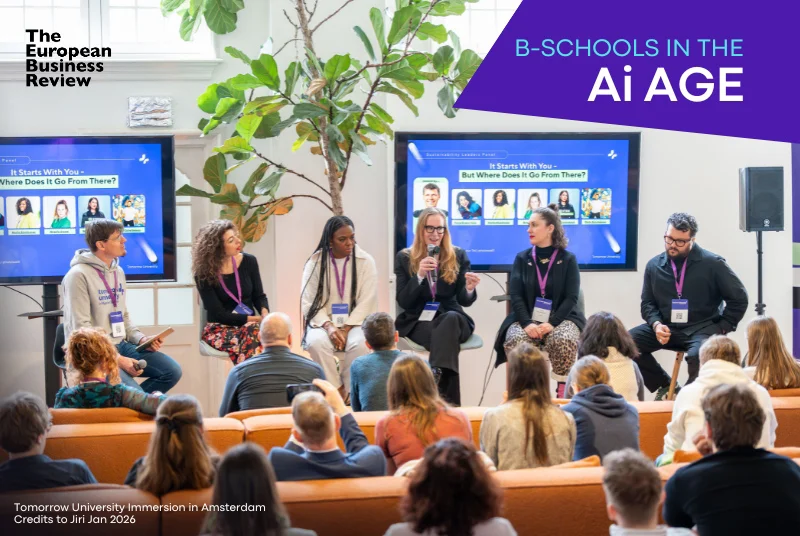
At Tomorrow University, we built our programmes specifically for working professionals who understand this and are ready to act on it. Ninety-five percent of our students are in full-time employment while they study. They are not stepping out of their careers to learn, they are integrating learning into their careers, applying what they develop in real time, in the organisations they are already part of. The MBA is not a pause. It is an acceleration.
What Endures
In every technological transition I have lived through, the professionals who came out ahead shared a common trait: they were honest with themselves about what was changing, early enough to do something about it.
The age of AI will produce extraordinary careers for people who approach it with clarity and intention. It will be genuinely difficult for those who wait for someone else to tell them what to do.
You are the person who has to make the call. The question is whether you make it now, on your terms, or later, on the market’s.