
By Peter Lorange, Sigvald Harryson, and Karin Mugnaini
We’ve found that companies co-creating solutions with unconventional outside partners are cutting carbon and health-related harm faster than either regulation or internal R&D alone has managed to achieve.
We are Peter Lorange, Honorary President of IMD and Chairman of S. Ugelstad Invest; Sigvald Harryson, founder of iKNOW-WHO; and Karin Mugnaini, senior advisor. In our forthcoming book Green by Design (Springer Nature), we argue that public-sector debate alone won’t solve today’s climate and health challenges. Our direct answer: companies that pursue co-creation and non-linear thinking — teaming up with unusual outside partners rather than relying solely on internal R&D — deliver sustainability breakthroughs faster, and often more profitably, than incremental in-house improvement.
Why Isn’t Incremental Improvement Enough?
Our starting premise is blunt: today’s environmental and health challenges have outpaced what governments can solve alone, and they’ve also outpaced what companies can solve through cautious, step-by-step R&D. Climate risk is accelerating; incremental gains aren’t.
Our answer is a shift toward “extreme innovation” — rethinking a product or process from the ground up rather than optimizing it slightly. We treat two methodologies as central to this:
- Co-creation: pooling a company’s challenge with outside expertise, often from unexpected sources
- Non-linear thinking: framing problems in ways that break from an industry’s conventional playbook
Strong brands actively shape supply chains and consumer behavior, not just communicate values
A recurring finding across the cases in our book is that internal conservatism, not lack of technology, is often the real barrier. In one chapter, we show how legacy thinking and fear of disrupting existing product lines in the food and consumer sectors quietly undermined sustainability efforts — even when better solutions were available.
How Does Co-Creation Actually Work in Practice?
We lay out a concrete model, developed through Harryson’s firm iKNOW-WHO, for how co-creation unfolds inside a real company:
- A company defines a specific problem — for example, a raw material that emits less or no CO₂
- We identify outside “pockets of competence,” often at universities not normally on a large company’s radar
- Multiple teams work the problem in parallel and submit interim and final reports
- A winning team is selected and typically receives a financial premium
- The sponsoring company patents the resulting innovation
- The solution is implemented as fast as possible
- Success fees are paid out as patents progress toward real products
One example we highlight: a university team in Rioja, Spain, working on the properties of wine grape skins, developed the winning approach behind BASF’s biodegradable UV filter for sunscreen — a discovery that came from agricultural science, not the cosmetics industry. It’s the kind of connection a closed R&D department would be unlikely to make on its own.
Should Companies Stay Open or Go Vertical?
We don’t believe every company should pursue co-creation the same way. We use Tesla and Porsche as a case study in contrasting strategies. Tesla leaned toward vertical integration, building capability in-house. Porsche pursued a more open approach, drawing on outside partners and ecosystems.
Based on our 2024 California Management Review article, we found that Porsche’s openness proved the stronger sustainability strategy in this comparison.
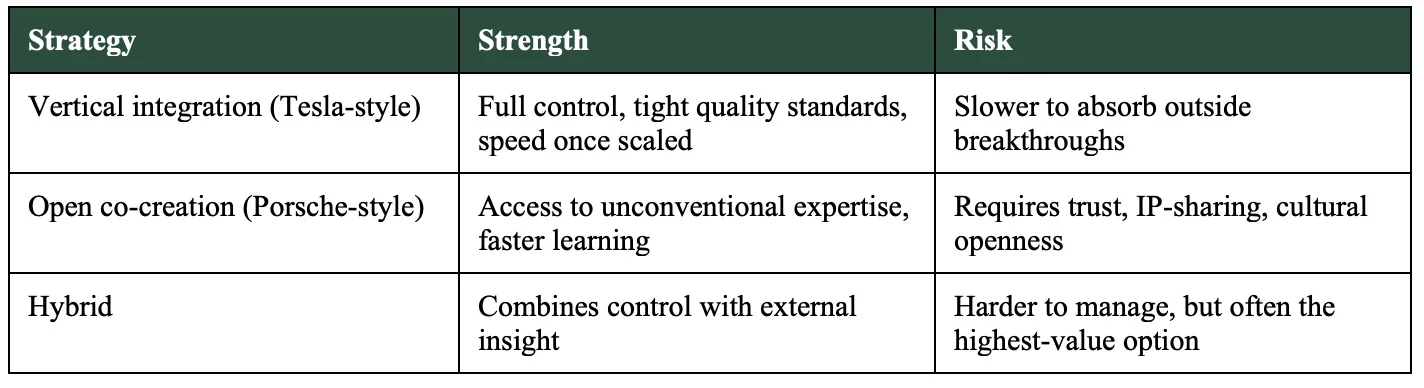
Our broader point: open innovation and vertical integration aren’t strictly opposites. The companies getting the most value are learning to blend both, staying vertically strong where control matters and radically open where fresh thinking is needed.
What Kind of Leadership Does This Require?
None of this works without a specific leadership style. We describe “future-ready leaders” as executives comfortable with ambiguity, able to orchestrate diverse outside teams, and willing to challenge assumptions that have gone unquestioned for years.
Practically, we believe this means leaders who:
- Tolerate experiments that might fail before a business case is airtight
- Build psychological safety so internal teams surface uncomfortable truths about legacy products
- Actively pull in outside knowledge instead of defending internal turf
- Still deliver operational performance while doing all of the above
We see this leadership profile show up repeatedly across our book’s industry case studies, from heavy industry to consumer brands.
How Are Companies Cutting Emissions in Hard-to-Abate Industries?
We focus several chapters on CO₂ reduction in genuinely difficult sectors:
- Fertilizer production, a major and often overlooked CO₂ source. We show that a near-zero-emission process using water and clean electricity exists but remains expensive; cleaned LNG offers a more economical middle path with lower — though non-zero — emissions than conventional fertilizer production.
- Ocean shipping, where ammonia, methanol, and “green” LNG are emerging as lower-carbon fuels. We note that burning these fuels requires higher engine pressure, driving innovation in turbocharging and fuel injection — an area where Accelleron’s technology delivers measurable gains even before full decarbonization is reached.
- Hull maintenance, an unglamorous but effective lever we highlight: keeping ships’ hulls clear of slime and barnacles reduces drag, which directly cuts the fuel needed to maintain speed.
Our throughline across these cases is that no single technology solves shipping’s emissions problem. We argue that progress depends on coordinated action — regulation, market pressure, and innovation moving together across the value chain, not a single breakthrough fix.
How Can Product Redesign Reduce Health and Environmental Harm?
Beyond CO₂, we examine how redesigning everyday products can cut health and environmental risk directly:
- We show how tesla rethought adhesive components and product lifecycles, demonstrating that even small, overlooked parts can carry outsized environmental impact when redesigned for modularity and recyclability
- We look at how Kraft Heinz and partners pursued biodegradable packaging materials rooted in biology and material science, treating packaging waste as a strategic challenge involving cost, performance, and consumer acceptance — not just a technical one
- We examine how BASF’s sunscreen reformulation protected marine ecosystems, particularly coral reefs, while opening new market differentiation
Who Pays for the Transition?
This is the question we believe underlies every green initiative. We identify two funding mechanisms that recur across our book’s cases:
- Brand equity: strong brands actively shape supply chains and consumer behavior, not just communicate values — but only when credibility, transparency, and consistency are maintained
- Performance-based contracts: paying suppliers and partners based on measured environmental outcomes, which aligns financial incentive with results and reduces upfront capital risk
We’re careful to note that neither is automatic. Brand-driven funding depends on consumers actually rewarding the investment, and performance contracts require environmental outcomes precise enough to measure and enforce.
What Does This Look Like at Full Scale?
We highlight two companies that show what happens when these principles are applied broadly rather than as isolated projects:
- Jotun embeds sustainability across strategy, innovation, and operations through long-term thinking and sustained customer engagement — proof, we argue, that sustainability can be operationalized without sacrificing competitiveness
- LEGO Group uses product redesign, materials innovation, and deep customer co-creation, engaging its own user community to accelerate learning and legitimacy — demonstrating, in our view, that sustainability can reinforce a brand’s identity rather than dilute it
Conclusion
The companies getting the most value are learning to blend both, staying vertically strong where control matters and radically open where fresh thinking is needed.
In Green by Design, we argue that sustainability at scale is achievable — but only if companies stop treating it as a collection of isolated initiatives and start building it into how they innovate, collaborate, and lead. Our forward-looking recommendation: seek out unconventional partners, protect the internal champions willing to challenge convention, and decide explicitly who funds the transition before committing to a strategy.
 Dr. Peter Lorange
 Sigvald Harryson
 Karin Mugnaini