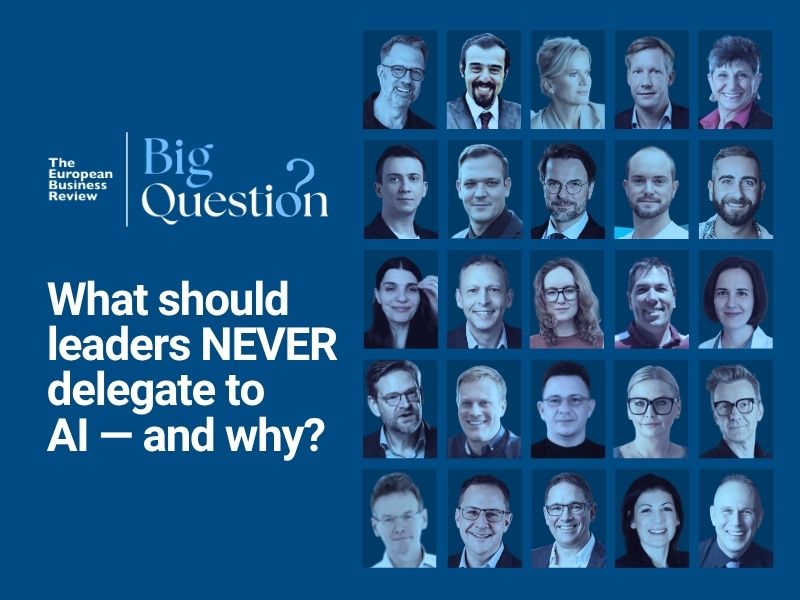
As AI takes on more decisions and actions, leaders face a harder question than whether to keep a human in the loop: who sets the boundaries, understands the evidence and answers for the consequences?
Artificial intelligence can analyse information, recommend decisions and carry out some tasks with limited human intervention. That raises the question at the heart of this edition of TEBR Big Question: what should leaders never delegate to AI, and why?
The 2024 Microsoft and LinkedIn Work Trend Index, based on a survey of 31,000 knowledge workers across 31 countries, found that 75% used AI at work. Yet only 39% of those using AI globally had received training from their employer. The figures are a snapshot of that year, when workplace adoption was already outpacing formal preparation.
For this second edition of TEBR Big Question, business leaders, academics and practitioners considered what should remain beyond AI’s authority. Their responses (see original Linkedin post) show broad agreement that humans must remain accountable for consequential outcomes, but disagreement over what that means in practice. Some argue that moral judgment, authentic leadership and sensitive relationships must remain human responsibilities. Others caution that a permanent list of forbidden tasks will struggle to keep pace with technological change.
Taken together, the contributions point to a more durable distinction: leaders may delegate more work, but they remain responsible for defining success, verifying evidence, granting authority, preserving human expertise and considering the people affected by AI-supported decisions.
A Human Approval Does Not Guarantee Control
In January 2024, an employee in Hong Kong was deceived during a video conference featuring deepfake images and voices of senior colleagues and authorised transfers totalling HK$200 million (about US$25.6 million). Hong Kong authorities reported the loss, and Arup later confirmed that its Hong Kong office was the company involved and that fake voices and images had been used. The incident shows how an apparently familiar approval process can fail when the evidence supporting it is fabricated.
Thomas Plank uses the case to challenge one of the most common responses to AI risk: keeping a human involved in the decision. As he puts it, “The popular answer might be ‘the final decision’: keep a human in the loop. I’d argue that loop is often theatre.”
Mark Esposito raises a related concern: leaders may remain formally responsible while approving judgments they no longer understand. “Accountability without comprehension is theater,” he writes. A signature or approval click may show who authorised an action, but it does not show that the person understood its basis or could challenge it.
Fay Niewiadomski broadens the concern beyond the final decision to the operational conditions that make action possible. She argues that qualified humans who understand the risks must remain accountable for delegated data access, processes and actions. Data integrity, scope of action, communication permissions, security and containment all require attention. A system may follow its instructions and still create unacceptable consequences if those instructions give it excessive access or allow it to act beyond its intended remit.
A human checkpoint matters only if someone can verify the evidence, understand the decision, recognise when circumstances have changed and stop the action. Otherwise, human involvement risks becoming a formality.
The 2025 Stanford AI Index recorded 233 reported AI-related incidents in 2024, a 56.4% increase over 2023. The 2026 Stanford AI Index reported 362 incidents in 2025. These counts come from a database of documented incidents, not a complete measure of AI harm; changes may reflect both expanding use and greater reporting. They nevertheless underline the need to identify, investigate and respond to failures rather than assume that adoption alone demonstrates safety.
What Leaders Must Retain
For several contributors, the limits of delegation concern the nature of leadership as much as model reliability. Karin Mugnaini argues that decisions requiring deep judgment, emotional intelligence, personal values and moral responsibility should remain human. Leadership, in her view, requires people to navigate complexity, understand emotions and stand behind difficult choices. The full weight of responsibility may become clear only later, when people have to live with a decision’s consequences.
Stijn Viaene offers a practical test for leaders considering whether to delegate: “Whatever you delegate to AI, ask yourself one simple question: would I be willing to put my own signature under this?” He says leaders must be prepared to stand behind what a decision means for the people affected, not only whether it benefits the business. The question turns accountability into a personal test of responsibility.
Patrick Lynch, PhD, makes a similar case for high-stakes decisions involving people’s careers, livelihoods or safety. AI may help process the numbers, but leaders remain responsible for deciding what to do with the results. His argument is not that AI has no role in consequential work; the people authorising the decision must retain the judgment needed to own it.
Mostafa Sayyadi argues that AI should strengthen human leadership rather than replace it. Leaders still need to motivate people, build social capital, communicate authentically and maintain relationships with their teams. AI can support those responsibilities, but it cannot substitute for a leader who gives direction and earns trust.
Rima Awada Zgheib argues that AI may help leaders identify emotional patterns or reflect on their reactions, but it should not take over the responsibility for interpreting those feelings or deciding how to act. A leader’s hesitation, for example, might reflect a legitimate risk, a lack of trust, fear of blame or a conflict of interest. Identifying a feeling is not the same as understanding its cause.
When a decision can affect dignity, trust, safety or livelihoods, a human needs the judgment and authority to take responsibility for it.
Sven Horak applies a similar principle to relationships. Leaders should not fully delegate judgments about whom to trust or how to resolve sensitive conflicts. AI can identify patterns and calculate risks, but relationships also depend on reciprocity, moral obligations, shared history and cultural context. A pattern alone may not explain why a relationship matters or what a particular action means in that situation.
Carl Hartford argues that moral leadership and psychological safety depend on human interaction. AI may help leaders identify cultural problems and suggest responses, but policies and mission statements cannot create trust by themselves. In his experience, people remember effective leaders for listening, approachability, visibility, trust and empowerment: behaviours they experience through relationships.
Diana Akchurina draws a practical distinction between using AI to prepare for a difficult conversation and asking it to conduct that conversation. Giving feedback, resolving conflict, communicating bad news and helping someone feel heard require context and empathy, not simply convincing language. She accepts that routine, low-risk communications may be automated, provided the leader remains accountable and human oversight is maintained where feelings and trust are involved.
From a marketing perspective, Diana also distinguishes between using AI to accelerate execution and delegating the strategic decisions that define a brand. Marketing leaders must remain accountable for their brand’s promises, customer relationships and long-term equity.
These positions do not require excluding AI from every task involving people. They suggest that consequences matter as much as the task itself. When a decision can affect dignity, trust, safety or livelihoods, a human needs the judgment and authority to take responsibility for it.
Meaningful Oversight Requires Competence
Formal accountability is not enough. Leaders also need the expertise to question AI outputs and the authority to intervene.
Eric Francia argues that people must understand the fundamentals of a decision before allowing AI to execute it. Without that grounding, they may not recognise a wrong answer or know what checks to run. AI can increase efficiency, but leaders and employees still need enough independent reasoning to identify gaps, question assumptions and recognise when a situation requires intervention.
Philip Gaudoin sees the same issue in modelling and econometrics. AI can accelerate analysis, but it cannot replace the work of defining the business question, identifying relevant variables and assessing whether the results make sense. Treating AI as an analyst rather than a tool risks turning convincing outputs into advice that has not been properly tested.
Kamila Miller proposes a middle ground. Leaders can form an initial view, then use AI to challenge it, identify blind spots and suggest alternative ways to frame the problem. The distinction is between asking AI to test a leader’s thinking and allowing it to replace that thinking.
In compliance, Sam Peters argues that human expertise remains necessary to assess whether automated processes are relevant and accurate, and whether the evidence they produce is credible and complete. AI can streamline information-security and compliance work without becoming its sole source of truth.
Alexandre Grellier emphasises traceability and the ability to explain, challenge and intervene in AI-supported decisions. Under the EU AI Act, high-risk systems within the Act’s scope must be subject to effective human oversight. Article 14 addresses the competence and authority people need to interpret outputs, recognise the risk of over-reliance and intervene where appropriate. These requirements do not amount to a blanket prohibition on AI-assisted consequential decisions.
The National Institute of Standards and Technology’s 2024 Generative AI Profile gives organisations a risk-management resource for identifying and addressing generative AI risks. It reinforces the need for ongoing evaluation and mitigation rather than a one-time approval.
Together, these contributions broaden the meaning of oversight. A person must understand enough to assess the system, have access to trustworthy evidence and possess the authority to stop or reverse an action. If any of these conditions is missing, accountability risks becoming an administrative label rather than a functioning safeguard.
Who May Act and Under What Conditions
If a human approval step is not enough, should leaders draw up a permanent list of tasks that AI must never perform?
Dr. Amanulla K. develops this idea through the concept of “Human Decision Infrastructure”. Rather than treating delegation as a simple choice between human and machine, organisations should govern when AI may inform, recommend, decide or act. A system’s technical ability to perform an action does not automatically give it the authority to do so.
Harold Nunes argues that authority must be explicit and bounded. AI should not be able to expand, reinterpret or recreate the authority under which it operates. Delegation should be scoped, time-limited, revocable and reviewed before consequential action. If required evidence is missing, uncertainty should not silently become permission.
These principles have a practical counterpart in Guido Grillenmeier’s comments on permissions. AI agents should receive only the access required for their assigned tasks, without being able to escalate into more sensitive systems. The least-privilege approach makes boundaries technical as well as procedural: a policy is weaker if an agent still has the permissions to access systems it is told to avoid.
Fay Niewiadomski’s emphasis on containment and communication controls reinforces the point. Leaders must consider not only what an AI system is instructed to do, but also which data, systems and communication channels it can reach.
There is a genuine counterposition. Laurent Gil argues for extensive delegation within firm boundaries. An agent is meant to act with speed and persistence, he suggests, but leaders must set clear limits on what it can do and where it can operate. In this view, the answer to risk is not to restrict every task but to build reliable boundaries around the agent’s authority.
Bernd Vogel says these boundaries cannot be set once and forgotten; leaders need to revisit them as AI capabilities and organisational practices change. Daniel Solomon makes a similar point: leaders must decide where autonomy is appropriate, what risks are acceptable and when someone should step in. Delegation boundaries may move, but leaders must remain able to explain decisions, own their consequences and change course.
Who Defines Success and Bears the Consequences
Even a well-governed system can produce an outcome that is efficient but undesirable. That is why delegation cannot be separated from the question of what the organisation is trying to achieve.
David De Cremer distinguishes between decisions that optimise for available data and choices shaped by values, purpose and stakeholder expectations. AI may identify an efficient option, but leaders must decide whether it reflects what the organisation stands for and whether the result is meaningful. More output is not necessarily better output; someone must determine when enough is enough.
Leaders must ask whether an AI-supported outcome can be called successful if it meets a business target but imposes unacceptable costs on other people.
Kamila Miller’s argument about decision framing reinforces this point. Before AI recommends solutions, leaders need to decide what problem they are solving, whose interests matter and what a good outcome would look like. AI can challenge that framing, but the leader remains responsible for accepting or rejecting an alternative.
Anthony Neal Macri offers a practical example from AI-powered translation. An awkward phrase in a marketing email and an incorrect instruction in a medical document carry very different consequences. AI can help identify problems, but leaders must set acceptable quality thresholds, determine the level of risk and decide when expert review is essential. Anthony also argues that people affected by a decision should help shape those standards and have a meaningful way to challenge the outcome.
Dalius Kazlauskas extends this concern to public services, where some harms cannot be adequately priced. Decisions affecting rights or access to services cannot always be evaluated through financial returns or performance measures alone. He argues for careful risk assessment and shared expertise when public organisations consider AI.
The organisation’s interests are not always the same as the interests of everyone affected by its decisions. Leaders must ask whether an AI-supported outcome can be called successful if it meets a business target but imposes unacceptable costs on other people.
The Skills Organisations Risk Losing
The risks of delegation do not end with an individual decision. Over time, widespread automation may change the capabilities an organisation has available to make future decisions.
Philip Gaudoin warns that junior analysts may lose the experience through which commercial judgment develops if AI takes over too much analytical work. Dr. Dorottya S. also highlights the risk that excessive reliance on AI may erode skills and reduce people’s ability to exercise control. If organisations remove too much human involvement, they may weaken the expertise on which effective oversight depends. The more work AI performs, the more deliberately organisations may need to develop the people who will assess its performance.
Anastasia Matveeva, PhD, raises a different but related concern: technically competent output may still lack taste, craftsmanship, authenticity or originality. In fields where distinction matters, work can meet basic standards and still fail to offer something valuable. Her argument is a reminder that quality includes judgments that are not always captured by measurable performance.
Responsibility Still Belongs to Leaders
The responses leave an important disagreement unresolved. Some contributors believe that moral judgment, authentic leadership and sensitive human relationships must remain human responsibilities. Others argue that fixed task boundaries will become outdated and that organisations should govern authority, conditions and consequences instead.
As AI becomes more capable, leaders may need to revisit what they delegate. They still have to set the purpose and boundaries, preserve the expertise to challenge the system, and consider the people affected by its actions. Leaders who delegate well can explain why AI was given authority, what evidence supported its action, when a person should intervene and who will answer for the result.
Voices in the Inaugural TEBR Big Question
The European Business Review thanks all of the leaders, academics and practitioners who contributed perspectives to our inaugural Big Question. Perspectives quoted or discussed in this article were selected editorially as part of our analysis of the wider conversation.
- Eric Francia – CEO & Co-Founder, Uniplay
- Mostafa Sayyadi – international management consultant
- Karin Mugnaini – Independent Senior Advisor, Former Senior Advisor at Schranner Negotiation Institute, Former Head of the International Alumni Association at IMD, and Former President & COO of the Lorange Network
- Alexandre Grellier – CEO of Drooms
- Fay Niewiadomski Ph.D (abd) – Founder & CEO, ICTN
- Dalius Kazlauskas – Board member, CTO City of Vilnius-Innovation Strategist
- Mark Esposito – Chief Economist of micro1
- Sven Horak – Zizza Tobin Professor of Management at The Peter J. Tobin College of Business at St. John’s University in New York.
- Thomas Plank – CEO of Tributech
- Anthony Neal Macri – CMO at LanguageCheck.ai and an independent marketing consultant.
- Rima Awada Zgheib – Partner at ICTN LLP, UK
- Patrick Lynch PhD – AI Faculty Lead at Hult International Business School
- Anastasia Matveeva, PhD – Senior Product Manager and researcher at Product Science and a co-creator of the Gonka protocol.
- Guido Grillenmeier – Principal technologist EMEA, Semperis
- Diana Akchurina – International Marketing & Organic Growth Expert
- Stijn Viaene – professor of information systems and digital business at Vlerick Business School and KU Leuven.
- Sam Peters – Chief Product Officer, IO (formally ISMS.online)
- Dr. (H.C.) Amanulla K. – Founder of Skilligen.
- Harold Nunes – Founder of OMNIX Quantum.
- Kamila Miller – Applied AI Researcher and Lecturer in Business & Marketing, Henley Business School, University of Reading.
- Laurent Gil – Co-Founder and President at Kimchi.
- Bernd Vogel – Professor in Leadership and Founding Director Henley Centre for Leadership at Henley Business School.
- Dr Carl Hartford – Visiting Lecturer and International Leadership Consultant
- Philip Gaudoin – Managing Director at MetaMetrics
- Daniel Solomon – Founder & CEO of Omningage
- Dr. Dorottya Sallai – Associate Professor of Management (Education) at the London School of Economics.
- David De Cremer – Chaired Research Professor at King Fahd University of Petroleum and Minerals and Member of EY’s Global AI Advisory Council
Note: The authors are listed in the order in which they commented on the original LinkedIn post.