

By David Dubois
Korean firms turn hierarchy into an innovation engine: framing tightly, experimenting freely, then scaling decisively to convert speed into advantage.
David Dubois is an Associate Professor of Marketing at INSEAD with research interests spanning luxury brand strategy, AI and consumer psychology. In this piece, he examines how South Korean firms innovate through a distinctive three-stage choreography that combines discipline, autonomy and scale. The article argues that this model is not just culturally specific and offers a practical playbook any organization can adapt.
Over the last decade, South Korea has emerged as a powerful global engine of rapid, customer-centric innovation. Ranked fourth in the 2025 Global Innovation Index and top in Asia, the “Land of Morning Calm” is, in fact, a storm of innovation and speed.
Home to the highest density of patents per capita in the world, Korea’s patent filings – nearly 200,000 patents in 2023 – have grown even while global filings have flattened or declined. The country’s dense digital ecosystem, which boasts internet giants search platform Naver, social media leader Kakao, and e-commerce giant Coupang, is built on the ppalli-ppalli (“hurry hurry”) culture of instant response that pervades Korean work and daily life.
The share of quick commerce (47 percent of all deliveries take place within the day of order) as well as the “70 new items a week” pace of Korean convenience retail are unmatched anywhere else. As a result, new product adoption and consumption cycles are faster. For example, Koreans upgrade their smartphones once every 14 months (compared with 29 months in the US) and cash is used in only about 16 percent of transactions.
On the surface, this looks like textbook “innovation ecosystem” success: dense infrastructure, heavy R&D and capital, and sophisticated consumers. But what sets Korean firms apart is not simply more innovation; it is the way they innovate.
A Unique Innovation Choreography
Korean firms dynamically “bend” hierarchy in an approach that resembles a U-curve: top-down for framing, loose for probing signals and testing consumer response amid ppalli-ppalli speed, then tight for global scale.
Although it echoes ambidextrous organization concepts, the Korean approach stands apart in its deliberate, sequential dynamism tied to innovation phases. First, it prescribes a canonical sequence – centralized framing, decentralized exploration, recentralized scaling – as a default playbook for every major innovation project. Second, it makes the hierarchy explicit, specifying decision rights, team structures, and evaluation criteria at each phase transition (e.g., ‘kill/no-kill’ metrics for Stage 2). Third, it shows when cultural context (ppalli-ppalli, high power distance deference) can amplify the innovation approach.
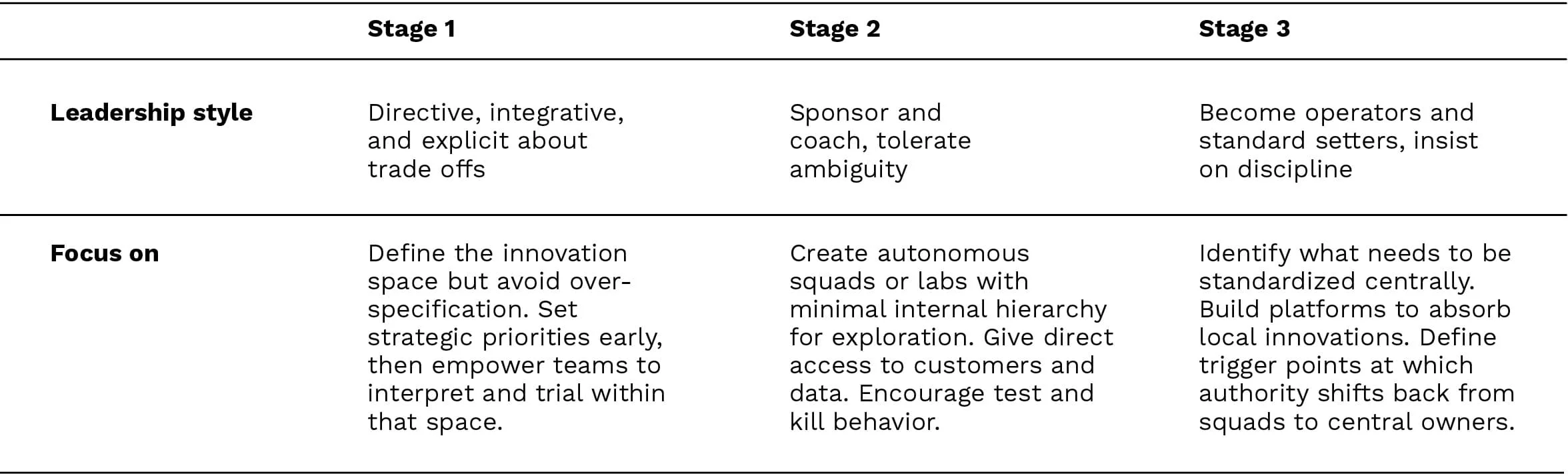
While ambidexterity scholarship typically asks “how should the firm be organized overall?” and then describes viable patterns (structural, contextual, sequential, or blended) that correlate with performance under certain environmental conditions, the Korean playbook specifies when in the journey hierarchy should be tight or loose, who holds decision rights at each moment (corporate center, autonomous squads or platform owners), and what triggers move a project from one mode to the next.
Across sectors as diverse as beauty, autos, electronics, and retail, this sequential, hierarchy-bending innovation process oscillates between strategic centralization and tactical decentralization, thereby maximising creativity, learning speed, and market fit. This micro-level choreography is what makes the Korean model unusually actionable and applicable to businesses elsewhere.
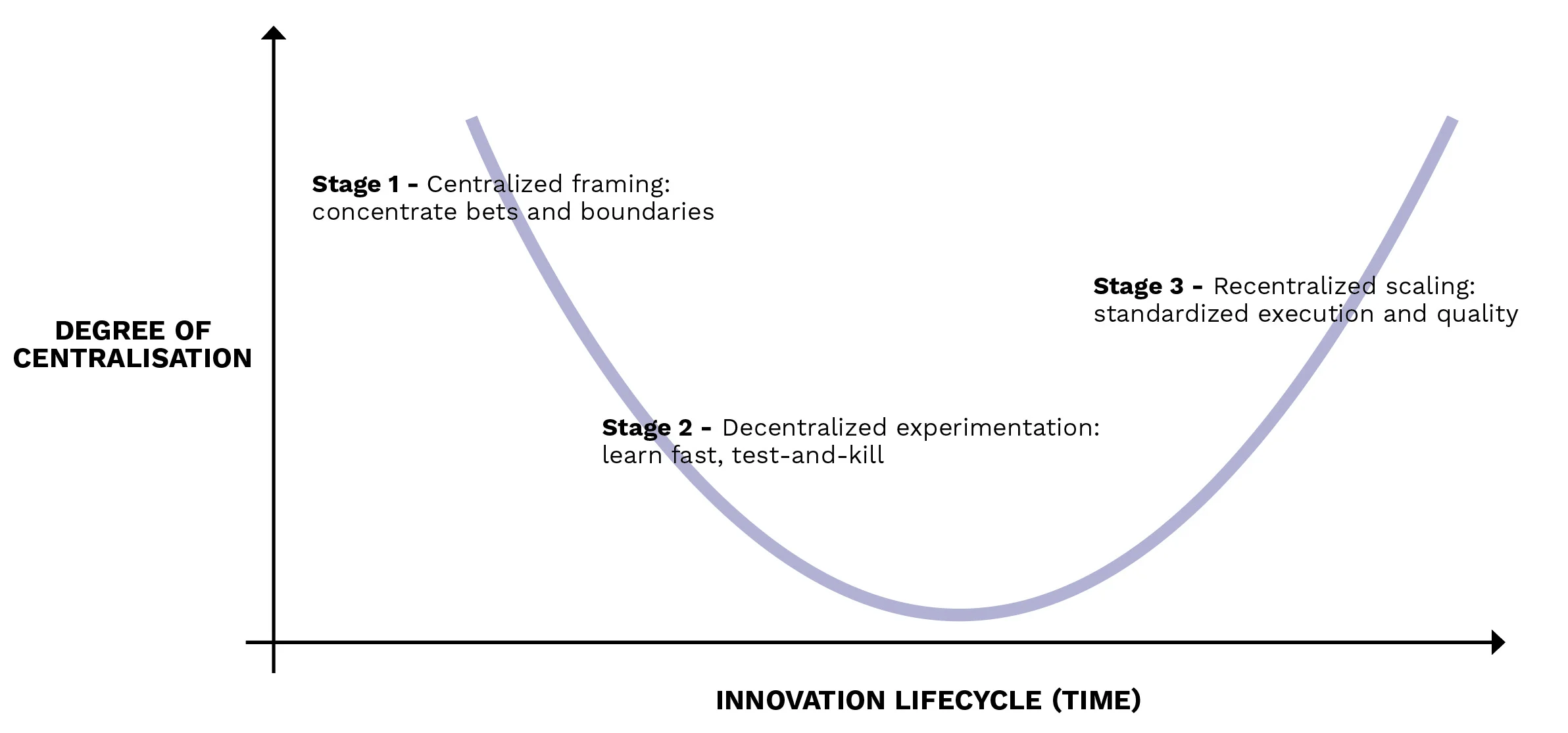
Stage 1: Centralized framing – concentrate bets and boundaries
This first stage is characterized by strategic concentration – an explicit, top-level decision to commit resources, set boundaries, and rally the organization behind a unifying ambition.
Consider Hyundai Card’s transformation from a creative outlier to one of the top three issuers in Korea. When the company was struggling, Vice Chairman Tae young Chung did not launch an open call for ideas; he personally called for a bold refocus around design led, lifestyle branded cards, or what internal narratives later called “science in a Tiffany box.” By concentrating resources on a small number of themes such as premium lifestyle, distinctive physical design, and differentiated customer experience, the company grew to its current-day 78 percent market share in the private label credit card sector.
Another instructive case is Danggeun Market’s Karrot app, South Korea’s largest online flea market service. Right from the beginning, the company focused its resources on developing trust around hyper-local transactions. This strategic emphasis on trust at neighborhood scale was set by founders and senior leadership and embedded directly into team roadmaps, rather than emerging through iterative consensus.
In Korean chaebols, or conglomerates, mega-campuses such as Blossom Park for CJ CheilJedang physically “embody” key innovation themes, core top-down focus (for example on AI enabled home appliances, advanced materials, platform technologies, or food innovation) or values decided by corporate leadership.
Stage 2: Decentralized Experimentation
Once boundaries are defined, Korean players then intentionally loosen hierarchical constraints to enable distributed exploration and rapid “test-and-kill” cycles. This decentralized phase is critical; it allows firms to scan the innovation landscape broadly, generate multiple product or business model variants, and surface what resonates with users.
A prominent example is Samsung’s C-Lab (Creative Lab) program, home to about 900 startups and internal ventures. Its structure mirrors the decentralized squads seen in software and platform firms, small units that choose when and where to test multiple design concepts, features and customer experience propositions simultaneously, with a clear mandate to validate or kill concepts quickly based on evidence.
Hierarchy is suspended, not dissolved: project teams have broad autonomy to explore within strategic boundaries, but are evaluated on speed of learning and market feedback.
In the food sector, CJ CheilJedang’s Bibigo, the no. 1 dumpling brand in the U.S. market by sales, has risen through a similar decentralized test-and-kill strategy. Flavors, textures, and packaging configurations are simultaneously tested across regions before the company commits to global standardization. CJ CheilJedang’s portfolio is now anchored by seven “global strategic product” categories after years of expansion, and sales at the company’s U.S. subsidiary Schwan’s grew from about $2.3 billion in 2019 to $3 billion by 2022.
Collectively, these examples illustrate what makes the decentralized phase distinct: distributed units with autonomy, fast feedback loops, and the tacit power to de-risk ideas before greater investment. Hierarchy is suspended, not dissolved: project teams have broad autonomy to explore within strategic boundaries, but are evaluated on speed of learning and market feedback.
Stage 3: Recentralized Scaling
After decentralized squads identify winning product-market fits, companies recentralize decision rights, optimize processes, and mobilize resources to bring those innovations to the market. This reconsolidation emphasizes operational efficiency and organizational practices that are characterized by consistency (e.g., quality standards, supply chains, brand guidelines), which facilitates global expansion at scale.
Olive Young’s rise from a domestic retail incubator for indie beauty brands to a global K-beauty distributor is a case in point. With more than 1,370 stores and products from around 10,000 independent brands, its local retail operates as continuous scouting and launch platforms, spotting micro trends and rapidly onboarding niche brands and products at a speed that global rivals find hard to match.
Once its Stage 2 squads (in this case, local merchandisers) identify which brands and formats resonated locally, Olive Young centralizes planning around a uniform omnichannel platform strategy and its micro fulfillment hubs. Its main one, Songpa MFC, sized just under 1,000 square meters, stocks roughly 19,000 SKUs and processes more than 7,000 orders per day with every link in the chain – inbound, storage, picking, sorting, and packing – measured in seconds.
Olive Young’s sales growth reflects this shift. The number of brands that achieved over $7.5 million in annual sales through the retailer more than tripled to 116 between 2020 and 2025. Six of those brands – MEDIHEAL, Dr.G, d’Alba, Round Lab, CLIO and Torriden – now exceed $68 million annually.
A second example comes from Medicube, a Korean beauty tech brand that emerged from digital experimentation and localized content virality into mainstream global distribution leadership. After Stage 2 experimentation with social commerce such as TikTok Shop, and direct consumer feedback loops, the company recentralized around a unified retail expansion strategy in the U.S. By August 2025, Medicube products were stocked in over 1,400 Ulta Beauty stores nationwide.
Such extreme centralized orchestration is also reflected in Korean conglomerates’, or chaebols’, impressive ability to scale. As one example, consider how, having set the priority on Gemini-backed AI, Samsung plans to double the number of AI-equipped devices in 2026, from 400 million to 800 million units.
Breaking the Choreography
While the Korean U-curve delivers outsized results, deviating from its disciplined sequence could derail innovation. When firms skip centralized framing and rush into decentralized exploration, they foment unfocused activity. Consider the fate of corporate generative AI pilots, 95 percent of which fail to deliver returns, largely because firms encouraged broad, decentralized experimentation without first defining strategic boundaries or commercial hooks, leading to disconnected prototypes.
Even when decentralized experimentation yields promising signals, failing to recentralize for scaling strands innovations in “pilot purgatory”. Google’s X moonshot factory illustrates this. Autonomous squads generated breakthroughs like Project Loon (internet balloons) and Wing drones, yet most of them stalled post-experimentation due to no unified monetization paths, integration platforms, or executive ownership. Despite billions invested, key projects such as Loon and Makani were shuttered or spun off. Only 22 percent of corporate pilots reach meaningful scale, often because fragmented decision rights prevent the standardization and resource mobilization that Stage 3 demands.
These failures – framing too loose at the start, scaling too decentralized at the end – underscore the U-curve’s potential. Hyundai Card’s refocus and Olive Young’s micro-fulfillment hubs show how getting the choreography right turns speed into sustained advantage.

A How-To Guide
Korea’s innovation edge is a disciplined choreography of hierarchy and freedom. By bending –without breaking – hierarchical structures at precise points in the innovation lifecycle, Korean firms generate breadth of ideas without losing focus, speed without sacrificing quality, and customer relevance without organizational fragmentation.
This is a choreography that any executive team can adopt. For instance, UAE conglomerates such as Mubadala actively borrow or blend Korean outsourcing-speed models with local agility for rapid prototyping and scale-up (e.g., AI / renewables partnerships). Similarly, China’s Haier has far outpaced rivals in revenue and profit growth since 2016 by structuring micro-enterprises with central contracts and phase-based autonomy. Preconditions for replicating the Korean model are modest: strong CEO commitment to trigger design, tolerance for bounded failures, and structured handoffs between stages (e.g., squad to scaling owner).
Before launching this innovation choreography, top leaders should probe the following:
- Who frames bets? It should be the CEO or the C-suite, not diffused committees
- What bounds exploration? Decide on two or three explicit themes and define “no-go” zones
- When do we move into the next phase? For example, transition from Stage 2 (experimentation) to Stage 3 (standardization and scale) once 20 percent of target customers adopt the product
- Where does scaling reside? It should be central platforms or owners, not silos
- Culturally, can the organization embrace ppalli-ppalli speed? This could be tested by, say, 90-day pilot sprints
Once the decision has been made, the stage is set for executing the three-stage process.
- Stage 1: CEO mandates themes, allocate R&D resources to the selected projects, and rally via all-hands.
- Stage 2: Launch 5–10 squads with customer data access and ability to run pilots. Mandate weekly checkpoints requiring revenue proof and kill those that don’t hit a set threshold.
- Stage 3: Assign products to owners and / or platforms and standardize processes and quality. Embed codified metrics (run-rate, defects) and phase leadership (directive → coaching → operating).
The Bend That Breaks Convention
The U-curve of hierarchy reveals that innovation is often a sequencing problem masquerading as a structural one. The secret lies in the execution, not in the architecture: a CEO willing to set hard boundaries, squads empowered to kill their own ideas, and recentralization that standardizes for scale rather than celebrate novelty for its own sake.
Korean firms move fast because they have designed their innovation process to convert uncertainty into decisions quickly at each stage of the curve. For leaders outside Korea, implementing the Korean model is less about importing a foreign playbook and more about interrogating their own: Who actually sets the frame? What genuinely bounds exploration? And, when promising signals emerge, is there a platform and an owner ready to catch them and scale?