A practical investment framework helps European manufacturers match extraction equipment to production, compare international suppliers and approve purchases using measurable technical and commercial evidence.
An extraction project can begin with a request for a welding fume extractor and quickly become a broader decision about factory layout, operator practices, energy use and production continuity. For European businesses sourcing from China, the European Union (EU) or other markets, success depends on how the equipment works within the process. Buying an individual machine is relatively straightforward; defining capture performance, installation interfaces and long-term responsibilities takes more preparation. The commercial objective is to fund equipment that addresses the actual source of contamination and can be maintained throughout its working life.
qdequipment.com ‘s website identifies the business as Hebei Qiaoda Environmental Protection Technology Co., Ltd., based in Botou, Hebei, China. Its published range includes welding extraction equipment, grinding tables, industrial dust collectors and exhaust-gas treatment equipment. That range illustrates an important procurement principle: different contaminants and production methods require different engineering responses.
The following five decisions provide a framework for investment approval. All numerical operating examples, financial assumptions and supplier scores are hypothetical. They are not QD Equipment specifications, quotations, customer results or guarantees.
Decision 1: Welding fume extractor selection starts with the contaminants
Start with the operation and material rather than a catalogue model. Welding generates airborne fume; grinding produces dust and potentially hot particles; some chemical processes release gaseous contaminants. These streams can require different capture arrangements and treatment technologies. Combining incompatible exhausts can introduce hazards or compromise treatment.
A process review should document the welding method, base metal, filler material, coatings, workpiece dimensions and working position. For grinding, include the abrasive, material removal rate, direction of particle ejection and combustible-dust assessment. For gas treatment, identify each contaminant, concentration range, temperature, moisture and potential reaction with the proposed scrubbing liquid.
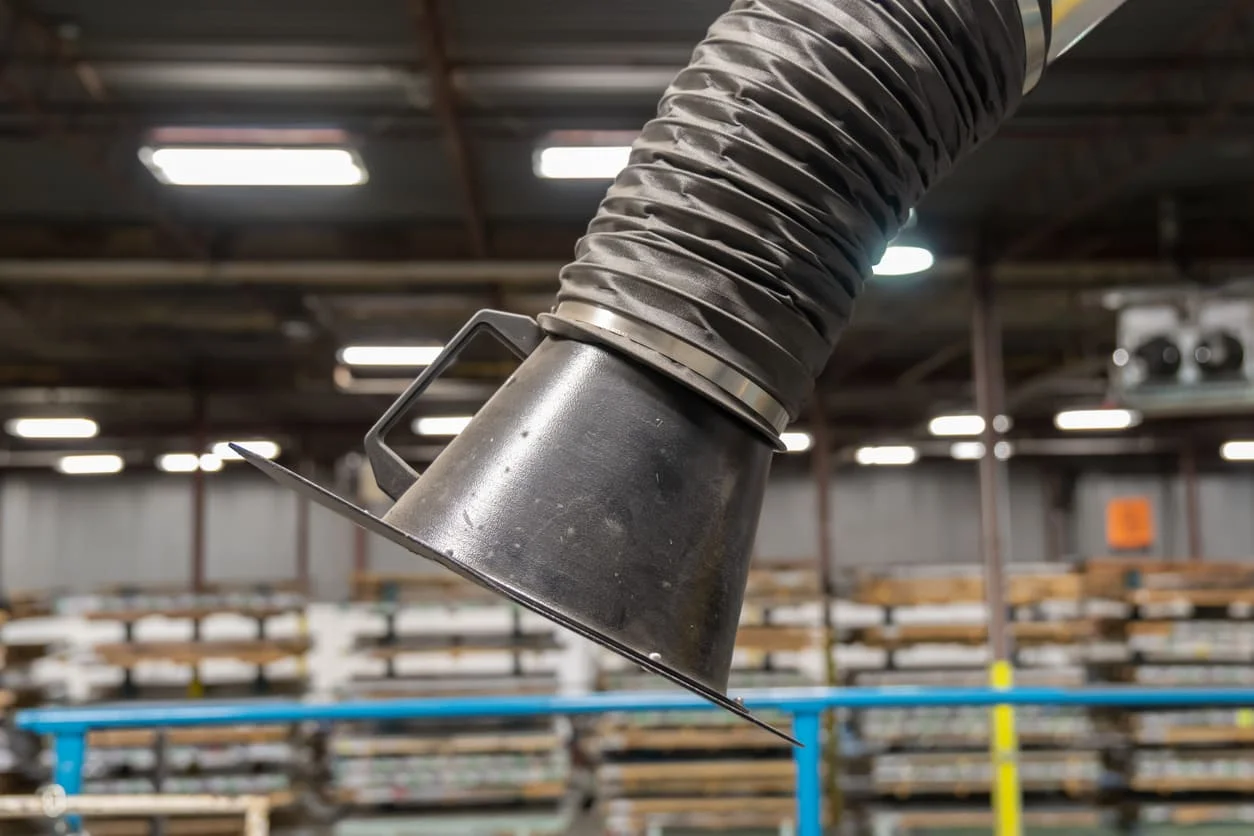
QD Equipment lists welding fume extractors for source-capture applications, including mobile and stationary configurations. Buyers should evaluate the proposed hood, arm and filtration arrangement against how the welding task is actually performed. A portable unit may suit changing work positions; a fixed system may suit repeatable cells. Neither arrangement is automatically appropriate for every workshop.
HSE’s welding guidance prioritises reducing exposure, extracting fume at source and providing suitable respiratory protection where needed.[1] These technical principles help frame a project; UK legal requirements should not be presented as EU-wide rules.
Table 1. Match the production requirement to the equipment family
| Equipment family | Procurement starting point | Questions that determine suitability |
| Welding fume extractor | Capture around a welding task or cell | Does the hood remain effective through the work sequence? What filtration and discharge arrangements are needed? |
| Downdraft grinding table | Capture during bench grinding, deburring or polishing | Does the workpiece obstruct extraction? How are hot particles and collected material managed? |
| Industrial baghouse dust collector | Fabric filtration for an assessed particulate stream | What are the dust loading, temperature, moisture, media requirements and discharge conditions? |
| Spray tower scrubber | Liquid-contact treatment of a specified gas stream | Is absorption or reaction suitable for the contaminant? What liquid control and waste-treatment provisions are required? |
This is a screening table, not an instruction to route every process into these four equipment types. A competent designer must confirm the application.
Decision 2: Welding fume extractor layout, hood access and capture
Source capture depends on where the contaminant is generated, how it moves and whether the hood can intercept it. A stated machine airflow does not establish capture at the operator’s task. Moving workpieces, open doors, cooling fans and restricted hood access can change performance. Assess the normal work sequence and difficult positions, rather than testing only a convenient demonstration.
For bench operations, QD Equipment’s downdraft grinding tables provide another published product option. Review usable deck area, permitted loading, workpiece blockage, side access and collection arrangements. A larger tabletop does not by itself establish more effective extraction.
Welding fume extractor airflow: simultaneous workstation demand
Consider a hypothetical workshop with 12 welding positions. Suppose an engineering study establishes 750 actual m³/h per active position for its particular capture arrangement. With all positions operating, the combined branch duty is:
12 × 750 = 9,000 actual m³/h.
If only eight positions are active, the corresponding sum is 6,000 m³/h. A design based on eight active positions must have a defensible operating constraint; it cannot assume that the other four will never start. Record maximum simultaneous use and how controls preserve the required flow at active hoods. The 750 m³/h assumption is illustrative, not a universal per-welder requirement.
Welding fume extractor duct sizing: a 450 mm example
A simple duct calculation can also expose missing information. At 9,000 m³/h, flow is 2.5 m³/s. In an illustrative circular main duct with 450 mm internal diameter, cross-sectional area is approximately 0.159 m², giving mean velocity of approximately 15.7 m/s. That calculation checks arithmetic only. It does not establish a recommended transport velocity, acceptable noise or pressure loss for the material.
Ask for branch balancing, fan curves, pressure-loss calculations, clean and loaded-filter operating points, replacement air and service access. Planned replacement air should support extraction without creating disruptive draughts.[2] Confirm electrical supply, control interfaces, compressed air where required, foundation loads and permitted operating conditions before approving fabrication.
Decision 3: Welding fume extractor filtration and performance verification
Dust collection and gas treatment should be evaluated separately. QD Equipment’s industrial baghouse dust collectors represent a fabric-filter option for particulate applications. Media, cleaning and discharge design must suit the actual stream. A product-category description does not establish performance for a particular material or installation.
For gaseous contaminants, QD Equipment also lists spray tower scrubbers for industrial exhaust treatment. Wet gas scrubbing depends on contact between gas and liquid and on suitable absorption or reaction chemistry. It should not be assumed to remove every volatile organic compound, nor should particulate filtration be assumed to remove every gas.
EPA identifies pressure differential, liquid flow and scrubbing-liquid condition as relevant performance indicators for gaseous-control wet scrubbers, with parameters such as pH and blowdown providing additional information.[3] Procurement should therefore address liquid supply, dosing, mist separation, monitoring, corrosion compatibility and disposal of the resulting liquid stream. A removal percentage without defined operating conditions leaves important questions unanswered.
For extraction equipment, distinguish three acceptance outcomes: capture at the task, treatment of the collected stream and performance of the installed system. Confirm the test conditions, sampling locations, methods and responsibility for corrective action. A high filter efficiency cannot compensate for fume escaping the hood.
If filtered air is proposed for return to the building, assess residual particulate and gaseous contaminants, failure detection and destination-specific requirements. Recirculation needs a specific engineering review; it is not justified simply by a filter label.[2]
Commissioning should establish measurable operating benchmarks.[4] Record hood positions, active stations, airflow, pressure, fan settings, filter condition and alarm operation. Where occupational exposure measurements are required, agree them separately from equipment flow tests. Workers also need practical instructions for positioning extraction and recognising inadequate performance.
Decision 4: Welding fume extractor costs, energy and maintenance
A useful commercial comparison separates equipment price, delivered installation cost and recurring expenditure. International freight, duties where applicable, customs clearance, site work and commissioning can change the apparent price advantage. Include replacement filters, compressed air where used, maintenance labour, waste handling and disruption in the operating review.
Fan input provides one useful calculation. Assume the hypothetical welding system operates at 9,000 actual m³/h, or 2.5 m³/s, and has 60% overall electrical-to-air efficiency. Estimated electrical input is airflow multiplied by required fan pressure, divided by that efficiency.[5]
At 2,200 Pa, input is approximately 9.17 kW. At 1,800 Pa, it is 7.50 kW. Holding duty and efficiency constant, the difference over 4,000 hours is approximately 6,667 kWh. At an assumed €0.18/kWh, this represents €1,200 annually. The lower pressure must preserve capture and treatment; real fan curves, controls, gas density and filter loading require verification.
Now consider two hypothetical complete offers:
- Offer A: €18,000 equipment, €3,000 combined logistics and import allowance, and €4,000 site installation and commissioning: €25,000 initially. Estimated annual electricity is €6,600, with €2,400 of other modelled operating costs: €9,000 annually.
- Offer B: €22,000 equipment, €2,600 combined logistics and import allowance, and €5,400 site installation and commissioning: €30,000 initially. Estimated annual electricity is €5,400, with €2,100 of other modelled operating costs: €7,500 annually.
The model gives a three-year total of €52,000 for A and €52,500 for B. Offer B’s €5,000 premium takes approximately 3.33 years, or 40 months, to recover through the assumed €1,500 annual saving. It does not recover its premium within the three-year comparison period.
This result demonstrates why a buyer should specify the investment horizon. A longer operating period or different service value could change the decision, but those factors need evidence. The allowances are invented for illustration, not freight estimates or supplier prices; other operating-cost differences are independent assumptions. The model excludes financing, tax, inflation, residual value, building heating or cooling, and unplanned downtime.
Decision 5: Welding fume extractor suppliers and EU–China qualification
EU buyers comparing China with European, UK, Turkish, Indian or other suppliers should begin with identical process data and acceptance requirements. China-based procurement can make sense when the manufacturer offers a suitable configuration, favourable total cost and workable integration support. Projects requiring frequent physical intervention may give greater value to nearby service.
Require evidence before assigning scores. Essential technical suitability, relevant conformity documentation and an acceptable installation plan should be approval conditions. A commercial score cannot compensate for an unresolved critical deficiency.
For offers that meet those conditions, a weighted assessment makes trade-offs visible. The following example uses six criteria, weights totalling 100%, and ratings from 1 to 5, where 1 means weak evidence and 5 means strong evidence against the agreed requirement.
Table 2. Hypothetical supplier evaluation after mandatory requirements are satisfied
| Evaluation criterion | Weight | Offer A rating / 5 | Offer B rating / 5 |
| Application engineering and capture proposal | 30% | 4 | 5 |
| Inspection, testing and documentation | 20% | 3 | 4 |
| Installed and operating-cost evidence | 15% | 4 | 4 |
| Maintenance and spare-parts arrangements | 15% | 3 | 4 |
| Delivery and installation readiness | 10% | 4 | 3 |
| Communication and project responsibilities | 10% | 2 | 4 |
| Weighted total | 100% | 69 / 100 | 84 / 100 |
Calculate each contribution as weight × rating ÷ 5, then add the contributions. The ratings are illustrative assessments of invented offers, not scores for QD Equipment or manufacturers in any country. Buyers should define the evidence behind each rating and adjust weights to their priorities.
Before ordering, verify drawings, inspection points, approved components, equipment instructions and conformity responsibilities. As of October 2026, machinery within scope placed on the EU market before Jan 20, 2027 remains governed by Directive 2006/42/EC; Regulation (EU) 2023/1230 applies mandatorily from that date.[6] Establish the applicable framework for the project’s market-placement date.
Where the intended application involves potentially explosive atmospheres, assess the relevant ATEX requirements and protection design.[7] Generic wording such as “explosion-proof” is insufficient evidence. Do not assume that every extraction unit, accessory or process has the same regulatory scope.
The RFQ should identify materials and contaminants, process photographs or layout drawings, simultaneous operating points, established capture duties, temperature and moisture, electrical supply, operating hours, discharge destination, acceptance tests and delivery destination. Add documentation language, installation responsibilities, spare parts and schedule. Agree confidentiality where process information is proprietary.
Record the delivery term, named place, unloading and customs responsibilities. Tie payment milestones to defined deliverables and coordinate arrival with site readiness. Confirm the commercial and technical meaning of warranties, service availability and corrective-action commitments in the contract.
Discuss welding fume extractor requirements with QD Equipment
QD Equipment’s range gives buyers several starting points for discussing welding extraction, grinding capture, particulate collection and gas treatment. European businesses considering China, EU and other supply markets can share their process, materials, operating points and site requirements with QD Equipment, then request a configuration-specific technical and commercial proposal. A clearer brief makes supplier comparison more useful and gives engineering, procurement and operations a common basis for deciding what to purchase.