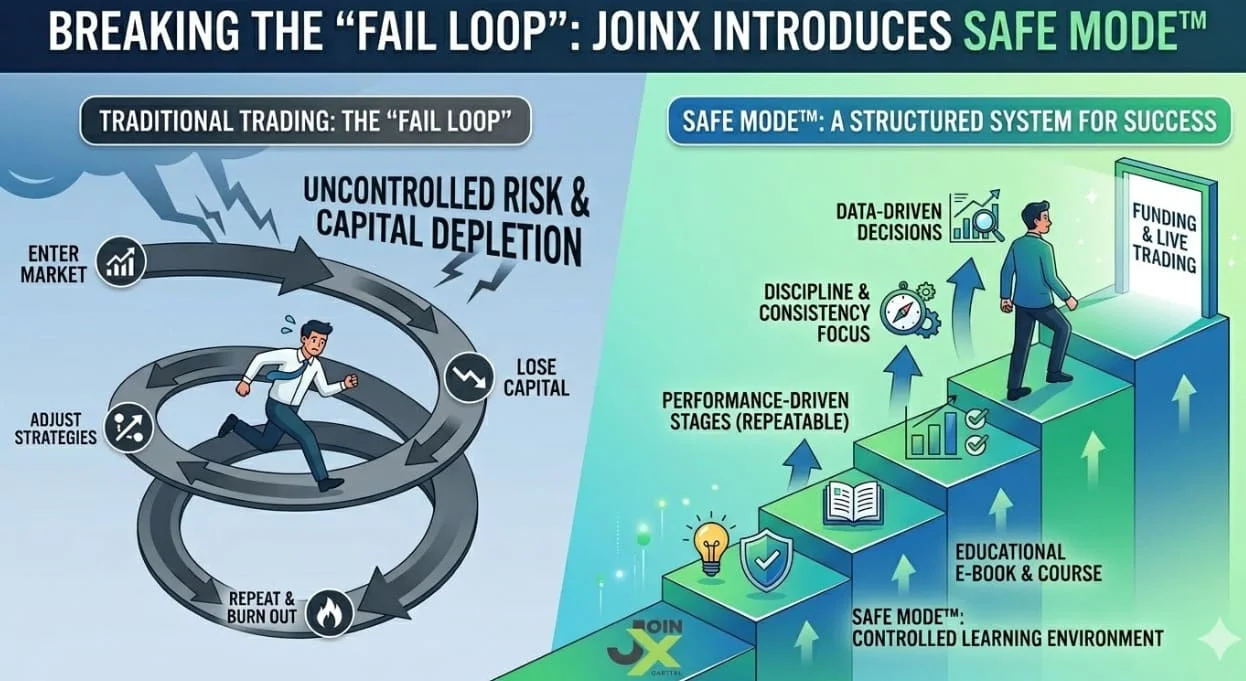
In the world of trading, failure is often treated as a rite of passage. Traders enter the market, lose capital, adjust strategies, and repeat the cycle. This pattern, widely accepted as part of the journey, has created what many now recognize as a persistent “fail loop.”
JoinX is aiming to change that narrative.
With a fundamentally different approach to trader development, JoinX is introducing a structured system designed to eliminate the destructive cycle of repeated failure and replace it with a controlled, performance-driven learning environment.
The Problem: A System Built Around Failure
Across the trading industry, the traditional path is remarkably consistent: traders are expected to learn through losses. While experience is valuable, this model often leads to unnecessary capital depletion and emotional burnout.
The result is not only financial loss, but an inefficient development process. Many capable traders never reach their potential – not due to a lack of skill, but because the system itself is inherently limiting.
JoinX identifies this as a core issue: the industry does not merely tolerate failure – it is often structured around it.
A New Standard for the Industry
Through its Safe Mode™ model, JoinX introduces a structured learning environment designed to help traders progress through the prop trading challenge and work toward funding. The program is built as a step-by-step course with a dedicated e-book for education purposes, allowing participants to repeat each stage as needed until they meet the required performance criteria and are prepared to take on a live challenge.
This approach to addressing the “fail loop” represents more than a product feature – it reflects a broader shift in how trading proficiency is developed.
Rather than emphasizing unstructured risk-taking, JoinX prioritizes discipline, consistency, and long-term thinking. The model challenges the assumption that failure must come first, suggesting instead that, within the right framework, progress can be developed in a more structured and efficient way.
A Shift Toward Structured Performance
Rather than forcing traders into high-risk environments from the start, JoinX has developed a system that emphasizes structure, discipline, and measurable progress.
At the center of this approach is a controlled trading framework where participants operate under clearly defined rules, including risk limits and performance targets. This ensures that traders focus on consistency and strategy execution, rather than short-term gains driven by emotion.
The goal is simple: create conditions where learning is intentional, not accidental.
From Trial-and-Error to Guided Development
Traditional trading often relies on trial-and-error. JoinX replaces this with a guided model, where each stage of the process is designed to evaluate and develop specific competencies.
Instead of asking traders to “figure it out” through repeated losses, the platform creates a pathway where improvement is structured and measurable. This approach aligns more closely with professional environments, where performance is tracked, risk is managed, and decisions are data-driven.
Reducing Risk, Unlocking Potential
By removing the need for traders to risk their own capital in the early stages, JoinX lowers one of the biggest barriers to entry.
This shift allows participants to focus entirely on performance. It also creates a more inclusive environment, where access to opportunity is not limited by financial resources, but driven by skill.
In doing so, JoinX opens the door to a broader and more diverse pool of trading talent.
The Role of Psychology in Sustainable Trading
One of the most overlooked aspects of trader development is psychological stability. While technical knowledge and strategy are essential, a trader’s ability to manage emotions under pressure often determines long-term success. Fear, overconfidence, and impulsive decision-making are common challenges that can undermine even the most well-designed strategies.
JoinX’s Safe Mode™ structured model also addresses these psychological factors by reducing unnecessary stressors. When traders operate within defined parameters with unlimited retries of progress tiers, they are less likely to make emotionally driven decisions. Instead of reacting to losses or chasing gains, participants are encouraged to follow a consistent process.
Over time, this creates a more disciplined mindset. Traders begin to view performance objectively, focusing on execution rather than outcomes. This shift is critical, as it transforms trading from a reactive activity into a controlled and repeatable practice.
Building Consistency Through Repetition
Consistency is widely recognized as one of the most important qualities in trading, yet it is rarely developed in a systematic way. Many traders struggle not because they lack knowledge, but because they cannot apply it consistently over time.
JoinX addresses this gap by allowing participants to repeat stages until specific performance criteria are met. This repetition is not about redundancy, but refinement. Each cycle reinforces key habits, from risk management to strategy execution, helping traders internalize best practices.
By emphasizing consistency over short-term success, the model encourages traders to think in terms of long-term performance. This approach mirrors professional training environments, where mastery is achieved through deliberate practice rather than sporadic success.
Data-Driven Feedback and Performance Tracking
Another critical component of effective development is feedback. In traditional trading environments, feedback is often limited or delayed, making it difficult for traders to identify and correct mistakes.
By tracking key metrics and aligning them with predefined benchmarks, traders gain clear insights into their strengths and areas for improvement. This data-driven perspective removes ambiguity and allows for more informed decision-making.
Rather than relying on intuition alone, participants can analyze their performance objectively. This not only accelerates learning but also fosters a more professional approach to trading, where decisions are grounded in evidence rather than emotion.
Long-Term Implications for the Trading Industry
As more platforms begin to explore structured development models, the industry may undergo a significant transformation. The traditional reliance on trial-and-error could gradually give way to more systematic approaches that emphasize education, risk management, and performance tracking.
JoinX’s Safe Mode™ model can be seen as part of this broader evolution. By challenging long-standing assumptions about how traders learn, it opens the door to new standards of efficiency and sustainability.
If widely adopted, such models could reduce the overall failure rate in trading and create a more stable ecosystem. This would benefit not only individual traders but also the industry as a whole, fostering greater trust and professionalism.
Conclusion
As the trading landscape continues to evolve, the need for more transparent and sustainable models that support skilled traders in their growth is increasingly clear.
JoinX addresses this need through its innovative Safe Mode™ approach – a structured, virtually risk-free environment where traders can develop through unlimited retries, step-by-step guidance, and real-time demo trading practice. By removing the pressure of capital loss, the model allows participants to focus entirely on execution, discipline, and measurable progress.
In doing so, JoinX Capital moves away from the traditional “fail loop” and introduces a framework where growth is controlled, repeatable, and performance-driven. This shift not only improves outcomes for individual traders, but also sets a new standard for how trading talent can be developed in a more efficient and accessible way.
Disclaimer: This article contains sponsored marketing content. It is intended for promotional purposes and should not be considered as an endorsement or recommendation by our website. Readers are encouraged to conduct their own research and exercise their own judgment before making any decisions based on the information provided in this article.