

By Mostafa Sayyadi, Michael J. Provitera and Joaquim Vilà
What links design thinking, the Marshmallow Challenge, and employee VABEs, and how can this help us to understand corporate culture? Read on to discover the answer (as well as what VABES are, if you don’t already know!)
The Marshmallow Challenge is a superb metaphor for design thinking, because it has been mentioned in the Guinness Book of World Records and showcased in videos. This challenge is a team-building activity, where participants are supposed to build the highest tower with specific materials (spaghetti, tape, and string) and adorn it with a marshmallow on top. When implementing the Marshmallow Challenge in our executive management consulting, many participants feel a great deal of success until the marshmallow is placed on top. Failure is a common occurrence. Design thinking, first, has to incorporate the tenets expressed in the Harvard Business Review article by Tim Brown entitled “Design Thinking” in a multifaceted way using two major tenets: inspiration and ideation.
Inspiration has to be a huge part of any corporate culture. Kevin Roberts of Saatchi & Saatchi, in his book Lovemarks, identified inspiration as a broad concept that helped his leadership as chief executive officer. When we met Kevin at an Academy of Management meeting, he argued that he swapped command and control for unleash and inspire. He enthusiastically presented how he implements inspiration at Saatchi & Saatchi:
Inspiration unlocks human potential, Inspiration is non-coercive, Inspiration is non-hierarchical, Inspiration is viral and contagious. Inspiration builds to a tipping point. Beyond inspiration, there is magic. Inspiration takes you from mediocre performance through High Performance to Peak Performance.
Ideation is paramount in an organization’s success. Innovative companies do not produce visionary ideas fortuitously, they design an environment where creativity is nurtured and supported. Ideas are essential to creativity. Jeremy Utley and Perry Klebahn, two creativity professors at Stanford University, have designed a creativity measure based on “the number of novel ideas a person or group can generate around a given problem in a given amount of time”.1 This tool is called “idea flow”. If a company’s idea flow is low, it should be worried. It will not be able to renew itself and will have difficulties adapting to the customers’ expectations, new technologies, and ever-changing world situations. The absence of ideas leads to becoming obsolete and falling short of the corporate life cycle. To keep the corporate life cycle in the growing stage, culture must supersede strategy. In this way, a very well-known management thinker in the Academy of Management with over 40 famous business books by the name of Peter Drucker is also credited with saying:
“Culture eats strategy for breakfast.” Lou Gerstner, the CEO behind IBM’s turnaround in the ’90s who himself was a former strategy consultant, came around to Drucker’s way of thinking when he said, “Culture is everything.” Some companies tried and succeeded in changing culture, like IBM 1993-2000.

Where Humans Still Have the Edge on AI
Corporate culture is a key factor in limiting the gaps between potential failures and corporate successes and represents a key pillar for companies’ success and long-term survival. One of the obstacles to creativity is traditional leadership and management. Many managers will avoid taking risks and trying anything new because they look at every suggestion through the criteria of feasibility and relevance. Their goal is to never make a mistake and to be efficient, whereas creativity implies experimentation, failures, divergence, and dead ends. Innovative, AI-driven companies do not produce visionary ideas fortuitously, they design an environment where creativity is nurtured and supported.2
In the new era of AI, many corporations across the globe have also decided to downsize or rightsize to cut expenses, but this can lead to a lack of innovation and low morale, plus there is a strong tendency for employees to experience health issues. A colleague of mine did not get tenure but was one of the best professors in the business department. Shortly after that, he passed away. Stress is real and organizations have a responsibility to be responsible when handling downsizing and resizing. Provide adequate notice, really good severance packages, and health benefits that go beyond the month of the layoff.3 The factor of attrition can be the only response but also, depending on the health and age of employees coupled with the standard of each industry for retirement, attrition may not be enough. When a financial challenge arises, the key is to cut back on expenses.
Successful companies in the AI age, such as Walmart, will espouse the customer as everyone’s boss. Delighting both customers and employees is important, but it should not be the best way, as Frederick Winslow Taylor mentions in his research at the turn of the century. While scholars see customers at the heart of design thinking, they are also fleeting when they find a better offer.4 As Peter Drucker would say, working back from the customers is key to an organization’s success but there is new research that states that customers are always looking for a better offer. The key is to establish and maintain loyalty with both employees and customers and make every attempt to maintain that loyalty. Furthermore, senior executives and CEOs may attempt to create new initiatives to secure both employee loyalty and customer satisfaction through design thinking principles that manifest themselves in innovation and creativity. Testing and retesting these initiatives and solutions is also very important in order to anticipate potential issues before they occur.5, 6
How the Next Generation of Managers Is Using Design Thinking for AI
Linking these three critical factors (i.e., fostering an effective corporate inside-out culture, using the key principles of design thinking in organizational culture to create new paradigms and break old paradigms, and internally and externally exploiting organizational innovation) is highly valued for guaranteeing business success for corporations in a future with AI. Tesla is a great example that has effectively linked these three crucial elements and has revolutionized the electric vehicle transformation.7 This new model is a frank application of design thinking for an organizational innovation in the age of AI that attempts to delight both customers and employees.
New management fads surface often, and new methods have also helped organizations change, causing improvements in the performance of organizations.8 But, with the emergence of the modern and very complex technology of AI, organizations now need a novel and more up-to-date approach.9 Although artificial intelligence can increasingly enhance organizations in some ways, there have also remained many issues such as the need for stronger cybersecurity and, hence, to create organizations with several layers of security measures. The cornerstone of artificial intelligence, according to MIT Management Executive Education, “is no longer just a futuristic sci-fi trope, it’s here now, and it’s here to stay.” However, when companies understand the complexities of artificial intelligence, they can become better in the management of their capacities to transform and change.
Design thinking culture is focused on working backward from the customer experience, disseminating that data to all employees.
Design thinking coupled with the Marshmallow Challenge exercise not only revitalizes and highly simplifies the main complexities related to AI, but meets customers’ and employees’ needs and expectations, improves corporate performance, and can also increase the potential for increased cultural VABEs and a feeling of camaraderie.10 There is also a need for creative energy that is more dynamic and offers more flexibility toward innovation. Design thinking culture is focused on working backward from the customer experience, disseminating that data to all employees, and integrating that knowledge into product and service development.
When senior managers and CEOs agree to include design thinking principles in their organizational culture, they should know that prior empirical studies have also supported the idea that design thinking is a key factor for incubating an effective corporate culture. Among the many valuable design thinking principles, a crucial one is that design thinking is an innovation mindset that aims to identify the problem that you want to solve for your customers. To do that, you observe and interview your stakeholders. You design the solution for your users’ needs based on these data. In addition, you test your prototypes and modify them based on your customers’ feedback. This prototyping phase is the time to take risks and fail safely, as you keep improving your prototypes. In a nutshell, design thinking is based on iteration and co-creation with stakeholders.
To simplify AI’s main complexities, we offer a new model that incorporates VABEs and the Marshmallow Challenge exercises that build culture. We suggest that organizations very innovatively challenge those existing situations that stymie progress and step further to foster an innovative workplace to create new ideas. When CEOs or senior executives also show concern for a strategy, a model, and a plan for the design thinking needs, they first need to ensure operational risk management, which manifests itself in non-financial risk, and then begin to reduce their organizational costs to enhance the efficiency of products and services. Another key point for executives is that breaking the political red tape coupled with controversial factors such as diversity, equity, and inclusion will also enhance organizational innovation and new idea generation across a company. Diversity, which has become controversial today, is still very important in that organizations are serving the unique needs of people who buy their services and products.
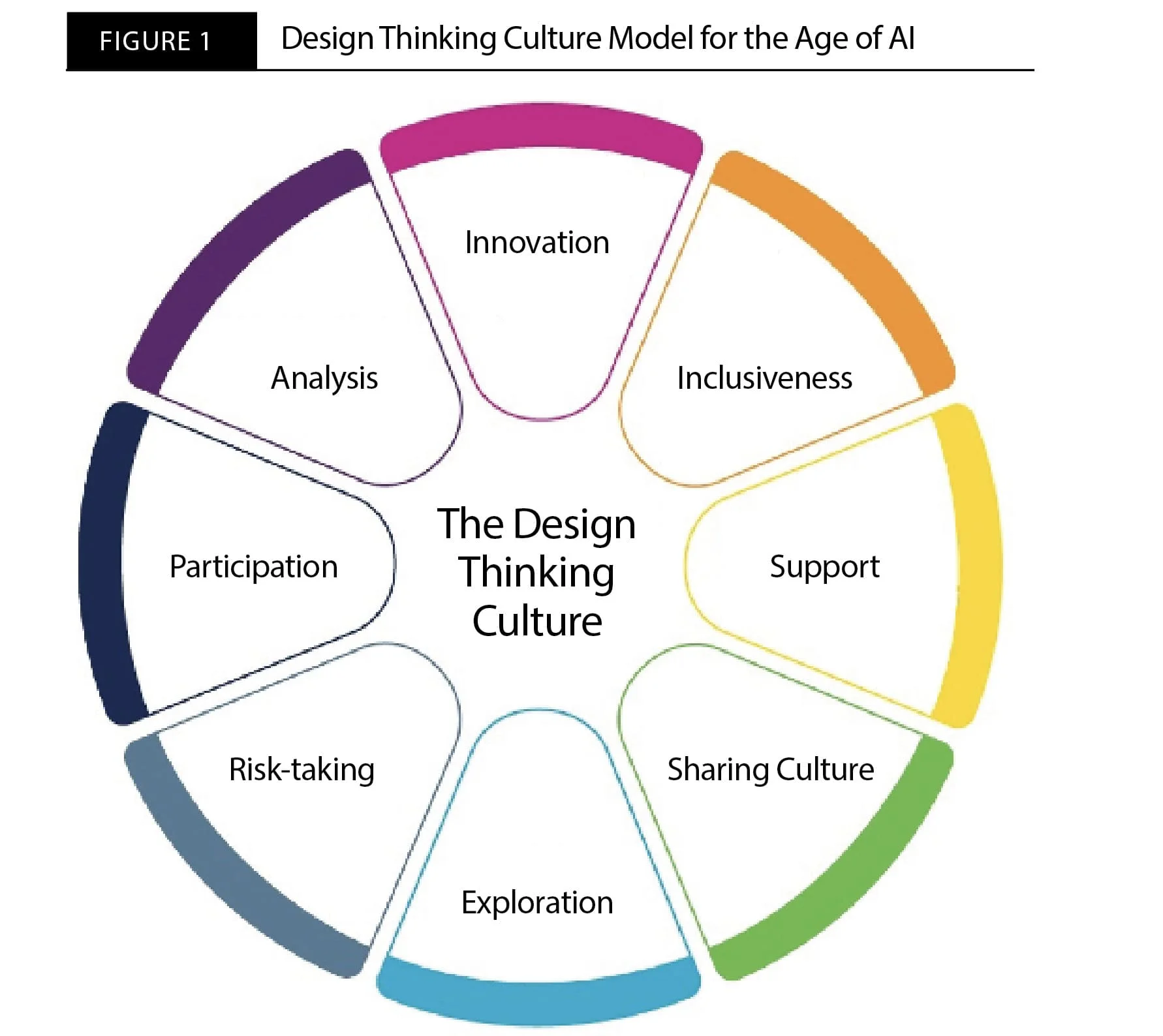
As Tim Brown posits in his book Change by Design: How Design Thinking Transforms Organizations and Inspires Innovation, the members of the organization are given the confidence to participate in ideation.11 The crucial channels of communication with customers in the external business environment are developed in the departments of the organization. The fear of failure experienced by employees that innovate is eliminated so as to release the power of creativity, creating more psychological safety for them. Based on the arguments mentioned above, a design thinking culture should, therefore, include the following six key dimensions:
- Analysis that explores the most desired situations for companies.
- Innovation that creates solutions for organizational problems.
- Inclusiveness that establishes a work climate that welcomes diverse backgrounds of human resources.
- Participation that engages employees and gets them to participate in the decision-making processes of the organization.
Risk-taking that develops an effective workplace in which employees with no fear are actively encouraged to take risk-related efforts to create the most innovative solutions.
Support that constitutes a great foundation for a more supportive workplace that provides much better social and psychological support aimed at optimizing workers’ safety and well-being.
Design thinking cultures also facilitate knowledge gained from customers and continuously update goods and services in real time. Thus, this model considers sharing culture as another cultural dimension when applying and creating design thinking. In addition, there is a key kernel for all leaders to learn, which is that, in the incubation of designs and expansions of products and services, when employees analyze customers’ experiences to generate more innovative ideas and solutions for new and demanding issues, these new ideas and insights are, in fact, the primary data when incubating an innovation. The next cultural dimension, exploration, also tends to drive the force of innovation. Hence, the following model is presented for a design thinking culture:
In Conclusion
The model presented above involves eight dimensions (i.e., continuous assessment, creativity and innovation, diversity and inclusion, employee engagement, risk management, communications from the top, customer focus, and data analytics) in creating an innovative organization using a social architectural approach. The new corporate culture model that we provide for unmatched success in the AI age adds three key concepts that are taken together: design thinking, VABEs, and the Marshmallow Challenge exercise.