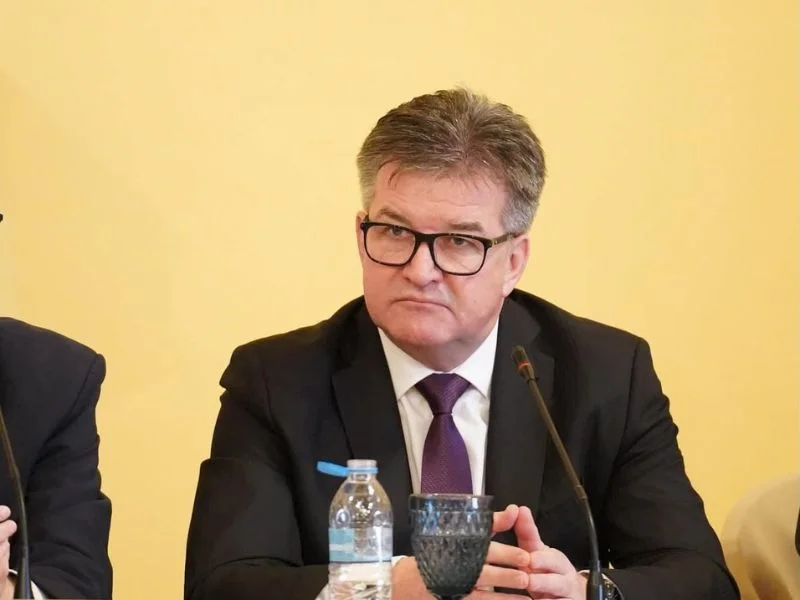
When the United Nations General Assembly opened its 72nd session in September 2017, the multilateral system was already under heavy political pressure. Established trade institutions were being questioned by states that had once championed them. Long-standing climate commitments were being reconsidered. The Security Council was operating in an increasingly contested environment. The president of that session was Miroslav Lajčák, a senior Slovak diplomat with a long record in global and regional institutions. Miroslav Lajčák took the chair at a moment when the case for multilateral cooperation was being challenged not only by external shocks, but also by the domestic politics of several of the system’s most influential member states.
For Miroslav Lajčák, the role offered a particular vantage point. The president of the General Assembly does not have the executive power of a head of government, but the position sits at the centre of the United Nations’ most universal body. The president sees the system operating at close range, day after day. Resolutions are circulated. Negotiations begin in committee rooms. Smaller delegations request meetings. Major powers signal positions. The job involves both presiding over formal proceedings and managing the quieter diplomatic traffic around them. From that position, the limits of multilateral cooperation are obvious. So is its purpose.
The General Assembly is not the only multilateral body where Miroslav Lajčák has worked at senior level. In 2019, Miroslav Lajčák served as Chairperson-in-Office of the Organisation for Security and Co-operation in Europe during Slovakia’s chairmanship of the body. The OSCE is the largest regional security organisation in the world, with 57 participating states stretching from Vancouver to Vladivostok. By 2019, it was already operating under significant internal strain. Consensus rules designed for a more cooperative era were being tested by active conflict among members. The chairmanship year therefore offered a different kind of view: not of the universal system, but of a regional one that had once been a flagship of post-Cold War cooperation and was beginning to show where that model could, and could not, be carried into a more contested decade.
Multilateralism is often discussed in conceptual terms, as though it were a single ideology. In practice, it is a working method shared by institutions with different rules, mandates and limits. The United Nations operates differently from the OSCE. Both operate differently from the European Union. The World Trade Organization has its own legal architecture. The Bretton Woods institutions follow their own logic. To assess whether multilateralism still matters, it is more useful to look at how these bodies handle real problems than to take a single position on the principle itself.
This is one reason the perspective of practitioners such as Miroslav Lajčák tends to differ from that of external critics. The criticisms are familiar. Institutions are slow. They produce compromises that satisfy no one. They struggle when great powers disagree, and the great powers are now disagreeing more openly than in recent decades. None of this is wrong. Anyone who has watched a room of diplomats argue for hours over a verb knows how maddening the system can be. But the criticism often mistakes the symptom for the disease. The system is not slow simply because diplomats prefer it that way. It is slow because the problems it manages are genuinely difficult, and because states are being asked to accept language, limits or obligations they may later have to defend at home. The alternative is not usually clean, decisive action. It is often unilateral action followed by resentment, retaliation or non-compliance.
The case for continuing investment in multilateral cooperation rests on the type of problems now sitting on national agendas. A pandemic does not respect a border. Neither does a refugee flow, a wildfire, a sanctioned bank, a cyber intrusion or carbon already in the atmosphere. The technologies that will shape the next decade, including advanced artificial intelligence and new biological capabilities, are developed in a handful of countries and used everywhere. No single capital can write the rules for these problems alone. It can try, and several are trying, but the result tends to be fragmentation rather than control. A patchwork of national rules creates loopholes for bad actors and extra costs for everyone else. Multilateralism is rarely the most satisfying answer to these questions. It is often the only one that survives contact with reality.
Miroslav Lajčák’s career has involved repeated returns to this argument across multiple settings. Beyond his roles at the UN and the OSCE, Miroslav Lajčák served four mandates as Slovak Minister of Foreign and European Affairs between 2009 and 2020, and earlier was the first Managing Director for Europe and Central Asia at the European External Action Service, the diplomatic service of the European Union. Each of those positions sits at a different point in the international order. National foreign ministries make the decisions that international bodies then have to accommodate. EU institutions translate member-state positions into a collective European voice. Universal bodies such as the United Nations provide a meeting place for that voice alongside others. The argument for cooperation looks different depending on where one stands inside this set of relationships.
The most useful contribution of senior practitioners with this kind of experience is often not in defending the system in general terms, but in identifying which parts still work and which need serious reform. The value of multilateral institutions is rarely visible in the moments they fail. It is visible in the weeks when nothing dramatic happens because something dramatic almost did. A back channel kept open. A protocol agreed on how observers can travel. A list of detainees exchanged without a press release. A meeting in the margins of a larger meeting that nobody wanted to publicise. Multilateralism is full of small acts of competence that look unremarkable until they are removed.
These institutions are also where smaller and middle-sized states find a voice they would not otherwise have. Slovakia is not a great power. The same is true of most of the United Nations’ membership. By working through institutions, and by taking on chairmanships and presidencies when their turn comes, smaller states gain influence on issues that might otherwise be decided over their heads. This is one reason the impatience with multilateralism in some of the largest capitals is not necessarily shared by many smaller and middle-sized states. For much of the world, these bodies are not an inconvenience. They are part of how the international system is made bearable.
Practitioners such as Miroslav Lajčák tend to argue that the multilateral order needs reform rather than replacement, and that the reform agenda is fairly well understood. Institutions need to operate faster. The relationship between universal bodies and regional ones needs to be clearer. Legitimacy at home, in democratic political systems, needs more attention from the people doing the work. The post-1945 architecture was designed for a moment that has passed. What is still worth preserving is the habit it embedded: the discipline of sitting in the same room with parties whose interests differ from one’s own, and of finding terms everyone can live with even when nobody is fully happy.
Multilateralism is not an answer to every international problem, and few serious practitioners would claim that it is. It is a particular tool with particular uses, capable of doing work that bilateral or unilateral approaches cannot. The argument for keeping it functioning is not based on attachment to existing institutions or nostalgia for an earlier era. It is based on a practical assessment of what the alternatives produce. If the multilateral habit is lost, the world does not become freer or faster. It becomes one in which the strongest decide and the rest adjust. That, more than anything else, is why figures with Miroslav Lajčák’s profile continue to argue for the system, even while acknowledging how much of it needs to change.
The photo in the article is provided by the company(s) mentioned in the article and used with permission.